


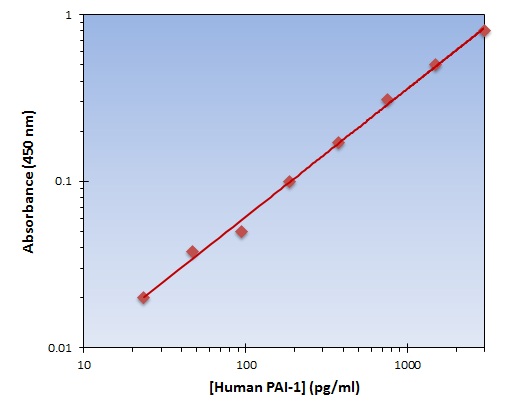
Human PAI-1 PicoKine ELISA Kit standard curve
Human PAI-1 PicoKine ELISA Kit standard curve
Human PAI-1 ELISA Kit PicoKine(r)
EK0859

ReactivityHuman
Product group Assays
Overview
- SupplierBoster Bio
- Product NameHuman PAI-1 ELISA Kit PicoKine(r)
- Delivery Days Customer9
- ApplicationsELISA
- Applications SupplierELI
- Assay Detection Range156 pg/ml - 10,000 pg/ml
- Assay Sensitivity<10 pg/ml
- Assay Time20-25
- CertificationResearch Use Only
- Scientific DescriptionHuman PAI-1 ELISA Kit PicoKine® (96 Tests). Quantitate Human SERPINE1 in cell culture supernatants, cell lysates, serum and plasma (heparin, EDTA, citrate ). Sensitivity: 10pg/ml. The brand Picokine indicates this is a premium quality ELISA kit. Each Picokine kit delivers precise quantification, high sensitivity, and excellent reproducibility. Only our most reliable and effective kits qualify as Picokine, guaranteeing top-tier results for your assays.
- ReactivityHuman
- Reactivity SupplierHuman PAI-1
- Storage Instruction-20°C,2°C to 8°C
- UNSPSC41116158
References
- Zhang X, Qin Y, Ruan W, et al. Targeting inflammation-associated AMPK//Mfn-2/MAPKs signaling pathways by baicalein exerts anti-atherosclerotic action. Phytother Res. 2021,35(8):4442-4455. doi: 10.1002/ptr.7149Read this paper
- Abolhasani S, Shahbazloo SV, Saadati HM, et al. Evaluation of Serum Levels of Inflammation, Fibrinolysis and Oxidative Stress Markers in Coronary Artery Disease Prediction: A Cross-Sectional Study. Arq Bras Cardiol. 2019,113(4):667-674. doi: 10.5935/abc.20190159Read this paper
- Sun Y, Yang D, Xi L, et al. Primed atypical ductal hyperplasia-associated fibroblasts promote cell growth and polarity changes of transformed epithelium-like breast cancer MCF-7 cells via miR-200b/c-IKKβ signaling. Cell Death Dis. 2018,9(2):122. doi: 10.1038/s41419-017-0133-1Read this paper
- He S, Le NA, Frediani JK, et al. Cardiometabolic risks vary by weight status in pediatric kidney and liver transplant recipients: A cross-sectional, single-center study in the USA. Pediatr Transplant. 2017,21(6). doi: 10.1111/petr.12984Read this paper
- Yıldırım ME, Karakuş S, Kurtulgan HK, et al. The Association of Plasminogen Activator Inhibitor Type 1 (PAI-1) Level and PAI-1 4G/5G Gene Polymorphism with the Formation and the Grade of Endometrial Cancer. Biochem Genet. 2017,55(4):314-321. doi: 10.1007/s10528-017-9796-7Read this paper
- Wu W, Liu R, Chen L, et al. Disequilibrium of Blood Coagulation and Fibrinolytic System in Patients With Coronary Artery Ectasia. Medicine (Baltimore). 2016,95(8):e2779. doi: 10.1097/MD.0000000000002779Read this paper
- Nargesi AA, Shalchi M, Nargesi RA, et al. The lost correlation between heat shock protein 70 (HSPA1A) and plasminogen activator inhibitor-1 in patients with type 2 diabetes and albuminuria. Cell Stress Chaperones. 2016,21(2):361-5. doi: 10.1007/s12192-015-0634-8Read this paper
- Sogutlu Sari E, Yazici A, Eser B, et al. The prevalence of 4G/5G polymorphism of plasminogen activator inhibitor-1 (PAI-1) gene in central serous chorioretinopathy and its association with plasma PAI-1 levels. Cutan Ocul Toxicol. 2014,33(4):270-4. doi: 10.3109/15569527.2013.854372Read this paper
- Hui CY, Guo Y, Zhang X, et al. Oligodeoxyribonucleotides derived from salmon sperm DNA: an alternative to defibrotide. Biologicals. 2013,41(3):190-6. doi: 10.1016/j.biologicals.2012.12.003Read this paper
Datasheet
MSDS
Related products
Product group Assays

Human PAI-1 ELISA KitA101871
Assay Sample TypePlasma, serum, and lysates.
ReactivityHuman
- SizePrice
Product group Assays

Human Pai-1 ELISA KitEKA51871
Assay Sample TypePlasma, serum, lysate
ReactivityHuman
- SizePrice



Product group Assays

ReactivityHuman
- SizePrice
