

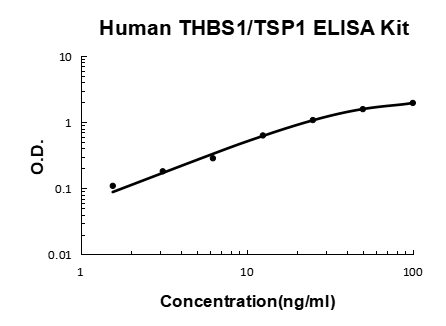
Human THBS1/TSP1 PicoKine ELISA Kit standard curve
Human THBS1/TSP1 PicoKine ELISA Kit standard curve
Human THBS1/TSP1/Thrombospondin-1 ELISA Kit PicoKine(r)
EK0899

ReactivityHuman
Product group Assays
Overview
- SupplierBoster Bio
- Product NameHuman THBS1/TSP1/Thrombospondin-1 ELISA Kit PicoKine(r)
- Delivery Days Customer9
- ApplicationsELISA
- Applications SupplierELI
- Assay Detection Range1.56 ng/ml - 100 ng/ml
- Assay Sensitivity<50 pg/ml
- Assay Time25-30
- CertificationResearch Use Only
- Scientific DescriptionHuman THBS1/TSP1/Thrombospondin-1 ELISA Kit PicoKine® (96 Tests). Quantitate Human THBS1 in cell culture supernatants, cell lysates, serum and plasma (heparin, EDTA). Sensitivity: 50pg/ml. The brand Picokine indicates this is a premium quality ELISA kit. Each Picokine kit delivers precise quantification, high sensitivity, and excellent reproducibility. Only our most reliable and effective kits qualify as Picokine, guaranteeing top-tier results for your assays.
- ReactivityHuman
- Reactivity SupplierHuman THBS1
- Storage Instruction-20°C,2°C to 8°C
- UNSPSC41116158
References
- Wang X, Zhang A, Yu Q, et al. Single-Cell RNA Sequencing and Spatial Transcriptomics Reveal Pathogenesis of Meningeal Lymphatic Dysfunction after Experimental Subarachnoid Hemorrhage. Adv Sci (Weinh). 2023,10(21):e2301428. doi: 10.1002/advs.202301428Read this paper
- Lin Z, Gu Y, Zhou R, et al. Serum Exosomal Proteins F9 and TSP-1 as Potential Diagnostic Biomarkers for Newly Diagnosed Epilepsy. Front Neurosci. 2020,14:737. doi: 10.3389/fnins.2020.00737Read this paper
- Ulu İ, Çekmez Y, Yıldırım Köpük Ş, et al. Maternal serum thrombospondin-1 is significantly altered in cases with established preeclampsia. J Matern Fetal Neonatal Med. 2019,32(15):2543-2546. doi: 10.1080/14767058.2018.1441279Read this paper
Datasheet
MSDS
Related products
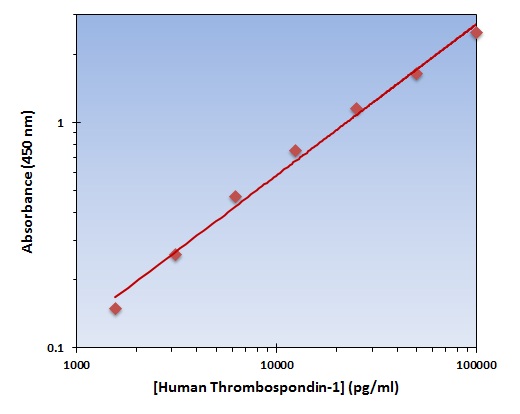
Product group Assays

Assay Sample TypePlasma, serum, and lysates.
ReactivityHuman
- SizePrice
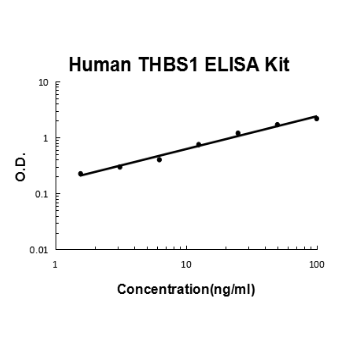
Product group Assays
ReactivityMonkey, Primate
- SizePrice
Product group Assays

Human Thrombospondin-1 ELISA KitEKA52070
Assay Sample TypePlasma, serum, lysate
ReactivityHuman
- SizePrice
Product group Assays

Human Thrombospondin-1 ELISA KitHUFI02929
Assay Sample TypeSerum, Plasma
ReactivityHuman
- SizePrice
Product group Assays

ReactivityHuman
- SizePrice