


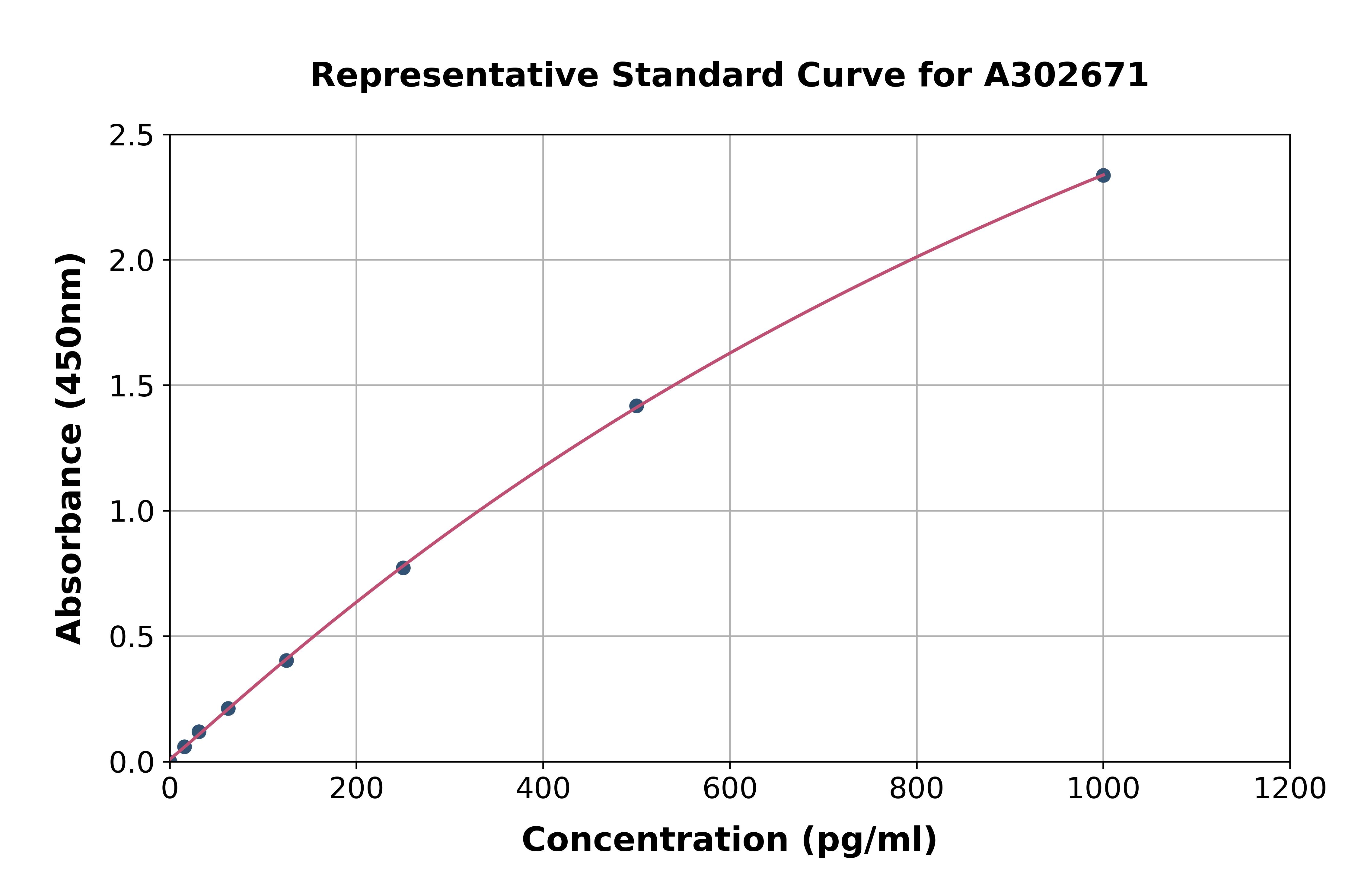
Human Tryptase/TPSAB1,B2 PicoKine ELISA Kit standard curve
Human Tryptase/TPSAB1,B2 PicoKine ELISA Kit standard curve
Human Tryptase/TPSAB1,B2 ELISA Kit PicoKine(r)
EK0898

Assay Sample Typecell culture supernatants, cell lysates, serum and plasma (heparin, EDTA).
Product group Assays
ReactivityHuman
Overview
- SupplierBoster Bio
- Product NameHuman Tryptase/TPSAB1,B2 ELISA Kit PicoKine(r)
- Delivery Days Customer23
- ApplicationsELISA
- Applications SupplierELISA
- Assay Detection Range156 pg/ml - 10,000 pg/ml
- Assay Sample Typecell culture supernatants, cell lysates, serum and plasma (heparin, EDTA).
- Assay Sensitivity<15 pg/ml
- CertificationResearch Use Only
- Scientific DescriptionHuman Tryptase/TPSAB1,B2 ELISA Kit PicoKine® (96 Tests). Quantitate Human Tryptase/TPSAB1,B2 in cell culture supernatants, cell lysates, serum and plasma (heparin, EDTA). Sensitivity: 15pg/ml. The brand Picokine indicates this is a premium quality ELISA kit. Each Picokine kit delivers precise quantification, high sensitivity, and excellent reproducibility. Only our most reliable and effective kits qualify as Picokine, guaranteeing top-tier results for your assays.
- ReactivityHuman
- Reactivity SupplierHuman
- Reactivity Supplier NoteHuman
- Storage Instruction-20°C,2°C to 8°C
- UNSPSC41116158
References
- Tsilioni I, Theoharides T. Luteolin Is More Potent than Cromolyn in Their Ability to Inhibit Mediator Release from Cultured Human Mast Cells. Int Arch Allergy Immunol. 2024,185(8):803-809. doi: 10.1159/000537752Read this paper
- Liu J, Liu S, Zeng L, et al. Amyloid Beta Peptides Lead to Mast Cell Activation in a Novel 3D Hydrogel Model. Int J Mol Sci. 2023,24(15). doi: 10.3390/ijms241512002Read this paper
- Tsilioni I, Theoharides TC. Recombinant SARS-CoV-2 Spike Protein Stimulates Secretion of Chymase, Tryptase, and IL-1β from Human Mast Cells, Augmented by IL-33. Int J Mol Sci. 2023,24(11). doi: 10.3390/ijms24119487Read this paper
- Ko HK, Cheng SL, Lin CH, et al. Blood tryptase and thymic stromal lymphopoietin levels predict the risk of exacerbation in severe asthma. Sci Rep. 2021,11(1):8425. doi: 10.1038/s41598-021-86179-1Read this paper
Datasheet
MSDS
Related products

Product group Assays

Assay Sample TypeResearchers plate their cell line of choice
ReactivityHuman, Mouse, Rat
- SizePrice
Product group Assays

ReactivityAll Species
- SizePrice