

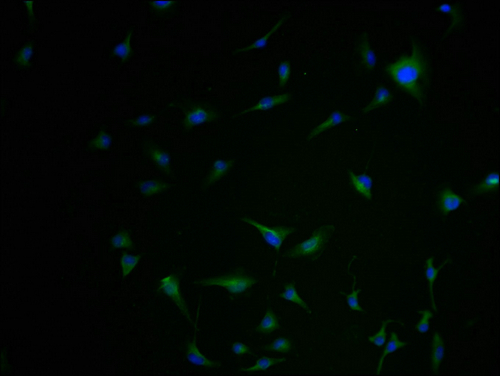
Immunofluorescence staining of U251 cells with CSB-PA619877LA01HU-IF at 1:100, counter-stained with DAPI. The cells were fixed in 4% formaldehyde and blocked in 10% normal Goat Serum. The cells were then incubated with the antibody overnight at 4°C. The secondary antibody was Alexa Fluor 488-congugated AffiniPure Goat Anti-Rabbit IgG(H+L).
Immunofluorescence staining of U251 cells with CSB-PA619877LA01HU-IF at 1:100, counter-stained with DAPI. The cells were fixed in 4% formaldehyde and blocked in 10% normal Goat Serum. The cells were then incubated with the antibody overnight at 4°C. The secondary antibody was Alexa Fluor 488-congugated AffiniPure Goat Anti-Rabbit IgG(H+L).
KCNJ12 Antibody
CSB-PA619877LA01HU

ApplicationsImmunoFluorescence, ELISA
Product group Antibodies
ReactivityHuman
TargetKCNJ12
Overview
- SupplierCusabio
- Product NameKCNJ12 Antibody
- Delivery Days Customer20
- ApplicationsImmunoFluorescence, ELISA
- CertificationResearch Use Only
- ClonalityPolyclonal
- ConjugateUnconjugated
- Gene ID3768
- Target nameKCNJ12
- Target descriptionpotassium inwardly rectifying channel subfamily J member 12
- Target synonymsIRK-2, IRK2, KCNJN1, Kir2.2, hIRK, hIRK1, hkir2.2x, kcnj12x, ATP-sensitive inward rectifier potassium channel 12, potassium channel, inwardly rectifying subfamily J, member 12, potassium voltage-gated channel subfamily J member 12
- HostRabbit
- IsotypeIgG
- Protein IDQ14500
- Protein NameATP-sensitive inward rectifier potassium channel 12
- Scientific DescriptionInward rectifying potassium channel that is activated by phosphatidylinositol 4,5-bisphosphate and that probably participates in controlling the resting membrane potential in electrically excitable cells. Probably participates in establishing action potential waveform and excitability of neuronal and muscle tissues. Inward rectifier potassium channels are characterized by a greater tendency to allow potassium to flow into the cell rather than out of it. Their voltage dependence is regulated by the concentration of extracellular potassium; as external potassium is raised, the voltage range of the channel opening shifts to more positive voltages. The inward rectification is mainly due to the blockage of outward current by internal magnesium.
- ReactivityHuman
- Storage Instruction-20°C or -80°C
- UNSPSC41116161
Related products

Product group Antibodies

KCNJ12 / Kir2.2 AntibodyLS-C749380
ApplicationsWestern Blot
ReactivityHuman, Mouse, Rat
TargetKCNJ12
- SizePrice

Product group Antibodies

Anti-KCNJ12 AntibodyHPA027021
ApplicationsImmunoHistoChemistry
ReactivityHuman
TargetKCNJ12
- SizePrice
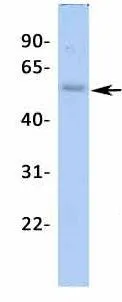
Product group Antibodies

Kir2.2 antibody, InternalGTX47662
ApplicationsWestern Blot, ImmunoHistoChemistry, ImmunoHistoChemistry Paraffin
ReactivityHuman
TargetKCNJ12
- SizePrice

Product group Antibodies

Anti-KCNJ12 Antibody144-60653
ApplicationsWestern Blot
ReactivityHuman, Mouse, Rat
TargetKCNJ12
- SizePrice