

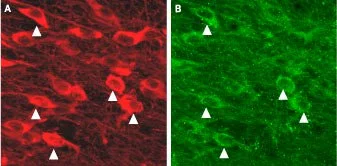
IHC-Fr analysis of mouse dopaminergic neurons tissue using GTX54779 KCNN3 antibody. Triangles point at cells with co-localization. Panel A : KCa2.3 is detected ?in ?substantia nigra pars compacta. Panel B : Tyrosine hydroxylase staining shows dopaminergic neurons.
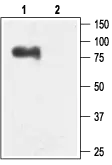
IHC-Fr analysis of mouse dopaminergic neurons tissue using GTX54779 KCNN3 antibody. Triangles point at cells with co-localization. Panel A : KCa2.3 is detected ?in ?substantia nigra pars compacta. Panel B : Tyrosine hydroxylase staining shows dopaminergic neurons.
KCNN3 antibody
GTX54779

ApplicationsImmunoFluorescence, Western Blot, ImmunoCytoChemistry, ImmunoHistoChemistry, ImmunoHistoChemistry Frozen
Product group Antibodies
ReactivityHuman, Mouse, Rat
TargetKCNN3
Overview
- SupplierGeneTex
- Product NameKCNN3 antibody
- Delivery Days Customer7
- ApplicationsImmunoFluorescence, Western Blot, ImmunoCytoChemistry, ImmunoHistoChemistry, ImmunoHistoChemistry Frozen
- CertificationResearch Use Only
- ClonalityPolyclonal
- Concentration0.6 mg/ml
- ConjugateUnconjugated
- Gene ID3782
- Target nameKCNN3
- Target descriptionpotassium calcium-activated channel subfamily N member 3
- Target synonymsKCa2.3, SK3, SKCA3, ZLS3, hSK3, small conductance calcium-activated potassium channel protein 3, SKCa 3, potassium channel, calcium activated intermediate/small conductance subfamily N alpha, member 3, potassium intermediate/small conductance calcium-activated channel, subfamily N, member 3, small conductance calcium-activated potassium channel 3
- HostRabbit
- IsotypeIgG
- Protein IDQ9UGI6
- Protein NameSmall conductance calcium-activated potassium channel protein 3
- Scientific DescriptionAction potentials in vertebrate neurons are followed by an afterhyperpolarization (AHP) that may persist for several seconds and may have profound consequences for the firing pattern of the neuron. Each component of the AHP is kinetically distinct and is mediated by different calcium-activated potassium channels. This gene belongs to the KCNN family of potassium channels. It encodes an integral membrane protein that forms a voltage-independent calcium-activated channel, which is thought to regulate neuronal excitability by contributing to the slow component of synaptic AHP. This gene contains two CAG repeat regions in the coding sequence. It was thought that expansion of one or both of these repeats could lead to an increased susceptibility to schizophrenia or bipolar disorder, but studies indicate that this is probably not the case. Alternatively spliced transcript variants encoding different isoforms have been found for this gene. [provided by RefSeq, Feb 2011]
- ReactivityHuman, Mouse, Rat
- Storage Instruction-20°C or -80°C,2°C to 8°C
- UNSPSC41116161
References
- The roles of PDGFRalpha signaling in the postnatal development and functional maintenance of the SMC-ICC-PDGFRalpha+ cell (SIP) syncytium in the colon. Lin Q et al., 2019 May, Neurogastroenterol MotilRead this paper
Datasheet
Related products
Product group Antibodies

Anti-KCNN3 AntibodyA31109
ApplicationsWestern Blot, ImmunoHistoChemistry
ReactivityHuman, Mouse, Rat
- SizePrice
Product group Antibodies

KCNN3 / SK3 AntibodyLS-C830218
ApplicationsELISA, ImmunoHistoChemistry
ReactivityHuman, Mouse, Rat
TargetKCNN3
- SizePrice

Product group Antibodies

Anti-KCNN3 AntibodyHPA057127
ApplicationsImmunoCytoChemistry
ReactivityHuman
TargetKCNN3
- SizePrice
Product group Antibodies

Anti-KCNN3 AntibodyA03865-1
ApplicationsWestern Blot
ReactivityHuman, Mouse, Rat
TargetKCNN3
- SizePrice
Product group Antibodies

KCNN3 AntibodyCSB-PA838540
ApplicationsELISA, ImmunoHistoChemistry
ReactivityHuman, Rat
TargetKCNN3
- SizePrice
Product group Antibodies
References
KCNN3 antibody, C-termGTX47693
ApplicationsWestern Blot, ImmunoHistoChemistry, ImmunoHistoChemistry Paraffin
ReactivityHuman, Monkey, Mouse
TargetKCNN3
- SizePrice
Product group Antibodies
KCNN3 antibodyGTX16683
ApplicationsWestern Blot
ReactivityHuman, Mouse, Rat
TargetKCNN3
- SizePrice