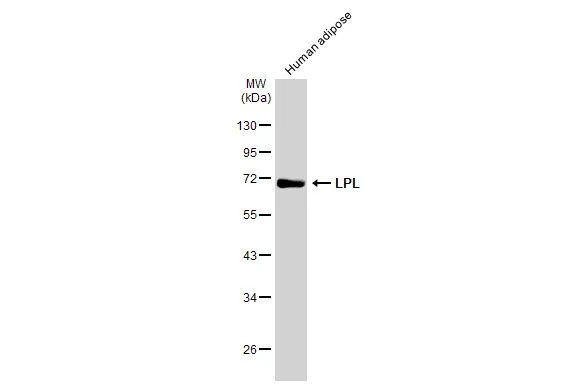
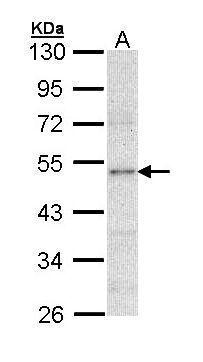
Human tissue extract (30 μg) was separated by 10% SDS-PAGE, and the membrane was blotted with LPL antibody (GTX101125) diluted at 1:1000. The HRP-conjugated anti-rabbit IgG antibody (GTX213110-01) was used to detect the primary antibody.
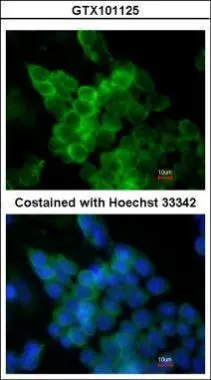
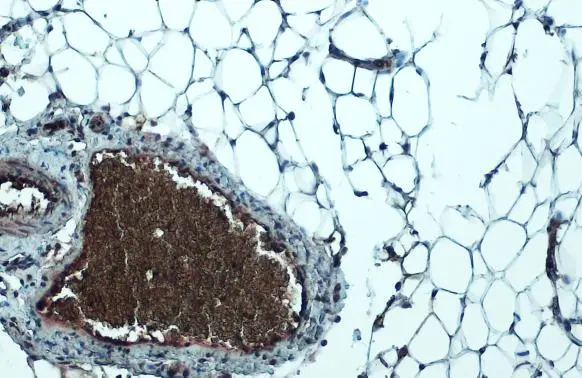
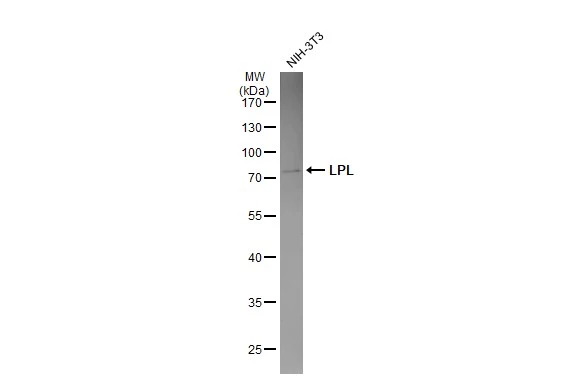
Human tissue extract (30 μg) was separated by 10% SDS-PAGE, and the membrane was blotted with LPL antibody (GTX101125) diluted at 1:1000. The HRP-conjugated anti-rabbit IgG antibody (GTX213110-01) was used to detect the primary antibody.
LPL antibody
GTX101125

ApplicationsImmunoFluorescence, Western Blot, ImmunoCytoChemistry, ImmunoHistoChemistry, ImmunoHistoChemistry Frozen, ImmunoHistoChemistry Paraffin
Product group Antibodies
ReactivityChicken, Human, Mouse, Sheep
TargetLPL
Overview
- SupplierGeneTex
- Product NameLPL antibody
- Delivery Days Customer9
- Application Supplier NoteWB: 1:500-1:3000. ICC/IF: 1:100-1:1000. *Optimal dilutions/concentrations should be determined by the researcher.Not tested in other applications.
- ApplicationsImmunoFluorescence, Western Blot, ImmunoCytoChemistry, ImmunoHistoChemistry, ImmunoHistoChemistry Frozen, ImmunoHistoChemistry Paraffin
- CertificationResearch Use Only
- ClonalityPolyclonal
- Concentration0.11 mg/ml
- ConjugateUnconjugated
- Gene ID4023
- Target nameLPL
- Target descriptionlipoprotein lipase
- Target synonymsHDLCQ11, LIPD, lipoprotein lipase, phospholipase A1
- HostRabbit
- IsotypeIgG
- Protein IDP06858
- Protein NameLipoprotein lipase
- Scientific DescriptionLPL encodes lipoprotein lipase, which is expressed in heart, muscle, and adipose tissue. LPL functions as a homodimer, and has the dual functions of triglyceride hydrolase and ligand/bridging factor for receptor-mediated lipoprotein uptake. Severe mutations that cause LPL deficiency result in type I hyperlipoproteinemia, while less extreme mutations in LPL are linked to many disorders of lipoprotein metabolism. [provided by RefSeq]
- ReactivityChicken, Human, Mouse, Sheep
- Storage Instruction-20°C or -80°C,2°C to 8°C
- UNSPSC41116161
Datasheet
Related products

Product group Antibodies

Anti-Lipoprotein lipase [5D2]AB03241-1.1-BT
ApplicationsImmunoFluorescence, Western Blot, ELISA, ImmunoCytoChemistry, Neutralisation/Blocking, Other Application
ReactivityBovine, Chicken, Feline, Guinea Pig, Human, Rat
TargetLPL
- SizePrice

Product group Antibodies

Anti-LPL Antibody144-64237
ApplicationsImmunoFluorescence, Western Blot
ReactivityHuman, Mouse, Rat
TargetLPL
- SizePrice
Product group Antibodies

LPL / Lipoprotein Lipase AntibodyLS-C680779
ApplicationsImmunoFluorescence, ELISA, ImmunoHistoChemistry, ImmunoHistoChemistry Paraffin
ReactivityHuman
TargetLPL
- SizePrice

Product group Antibodies
References

ApplicationsWestern Blot, ImmunoHistoChemistry
ReactivityHuman
TargetLPL
- SizePrice
Product group Antibodies
References

ApplicationsFlow Cytometry, ImmunoFluorescence, Western Blot, ELISA, ImmunoCytoChemistry, ImmunoHistoChemistry, ImmunoHistoChemistry Frozen, ImmunoHistoChemistry Paraffin
ReactivityBovine, Guinea Pig, Human, Mouse, Porcine, Rabbit, Rat, Sheep
TargetLPL
- SizePrice
Product group Antibodies

LPL AntibodyCSB-PA013065LA01HU
ApplicationsImmunoFluorescence, ELISA, ImmunoHistoChemistry
ReactivityHuman
TargetLPL
- SizePrice
Product group Antibodies

LPL Polyclonal AntibodyCAC13102
ApplicationsImmunoFluorescence, ELISA, ImmunoHistoChemistry
TargetLPL
- SizePrice