

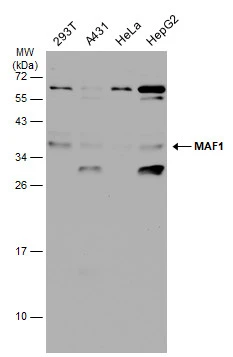
Various whole cell extracts (30 μg) were separated by 12% SDS-PAGE, and the membrane was blotted with MAF1 antibody (GTX106776) diluted at 1:1000. The HRP-conjugated anti-rabbit IgG antibody (GTX213110-01) was used to detect the primary antibody, and the signal was developed with Trident ECL plus-Enhanced.
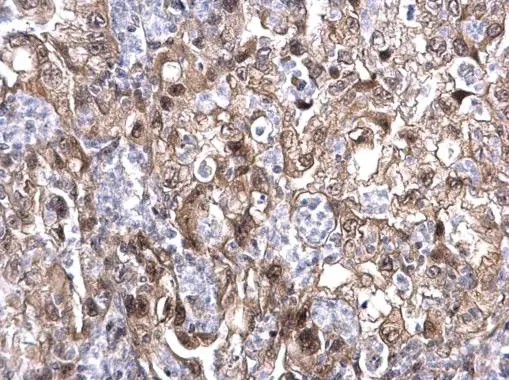
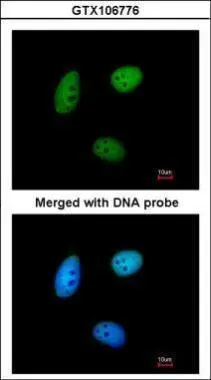
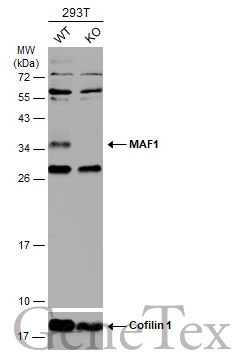
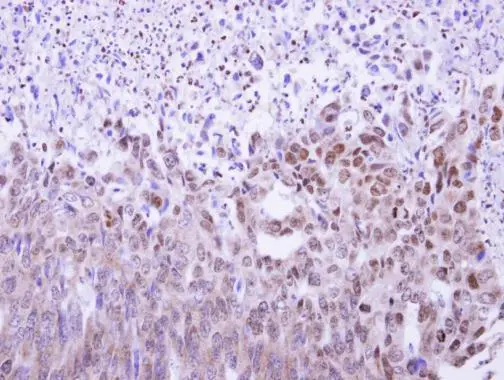
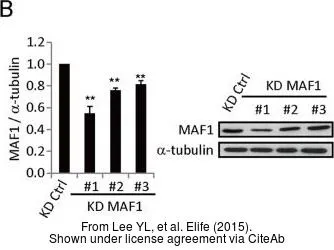
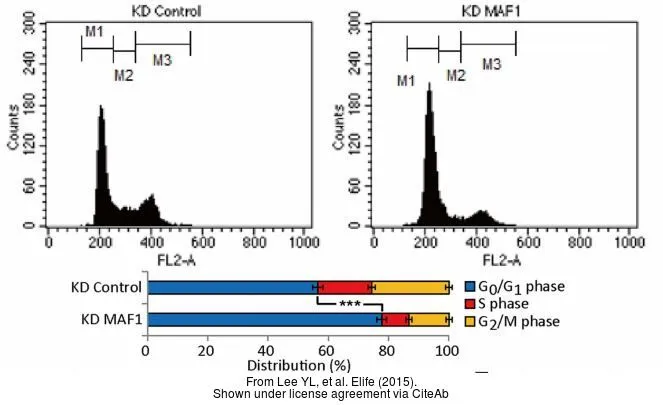
Various whole cell extracts (30 μg) were separated by 12% SDS-PAGE, and the membrane was blotted with MAF1 antibody (GTX106776) diluted at 1:1000. The HRP-conjugated anti-rabbit IgG antibody (GTX213110-01) was used to detect the primary antibody, and the signal was developed with Trident ECL plus-Enhanced.
MAF1 antibody
GTX106776

ApplicationsImmunoFluorescence, Western Blot, ImmunoCytoChemistry, ImmunoHistoChemistry, ImmunoHistoChemistry Paraffin
Product group Antibodies
ReactivityHuman, Mouse
TargetMAF1
Overview
- SupplierGeneTex
- Product NameMAF1 antibody
- Delivery Days Customer9
- Application Supplier NoteWB: 1:500-1:3000. ICC/IF: 1:100-1:1000. IHC-P: 1:100-1:1000. *Optimal dilutions/concentrations should be determined by the researcher.Not tested in other applications.
- ApplicationsImmunoFluorescence, Western Blot, ImmunoCytoChemistry, ImmunoHistoChemistry, ImmunoHistoChemistry Paraffin
- CertificationResearch Use Only
- ClonalityPolyclonal
- Concentration1 mg/ml
- ConjugateUnconjugated
- Gene ID84232
- Target nameMAF1
- Target descriptionMAF1 negative regulator of RNA polymerase III
- Target synonymsrepressor of RNA polymerase III transcription MAF1 homolog, MAF1 homolog, negative regulator of RNA polymerase III, homolog of yeast MAF1
- HostRabbit
- IsotypeIgG
- Protein IDQ9H063
- Protein NameRepressor of RNA polymerase III transcription MAF1 homolog
- Scientific DescriptionThis gene encodes a protein that is similar to Maf1, a Saccharomyces cerevisiae protein highly conserved in eukaryotic cells. Yeast Maf1 is a negative effector of RNA polymerase III (Pol III). It responds to changes in the cellular environment and represses pol III transcription. Biochemical studies identified the initiation factor TFIIIB as a target for Maf1-dependent repression. [provided by RefSeq]
- ReactivityHuman, Mouse
- Storage Instruction-20°C or -80°C,2°C to 8°C
- UNSPSC41116161
Datasheet
Related products
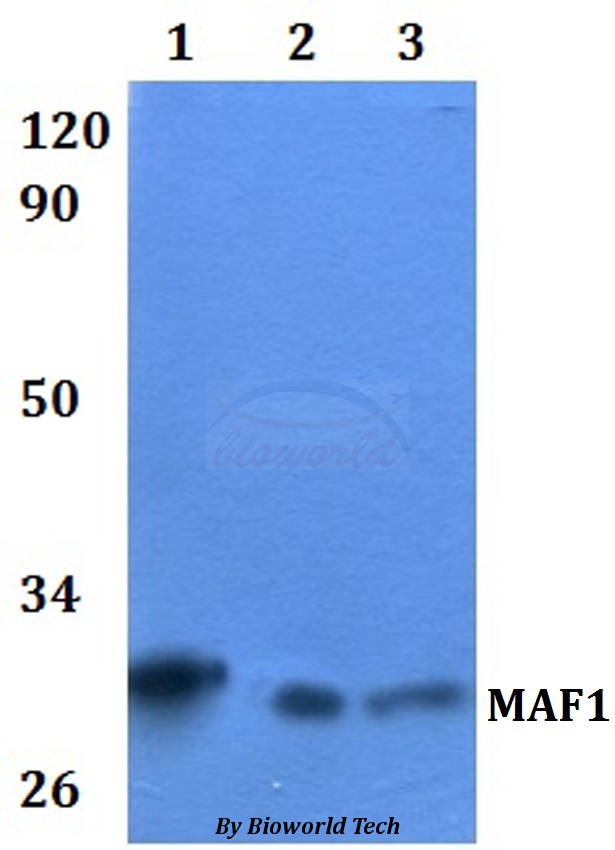
Product group Antibodies

Anti-MAF1 AntibodyA29132
ApplicationsWestern Blot
ReactivityHuman, Mouse, Rat
- SizePrice

Product group Antibodies

Anti-MAF1 AntibodyA03332
ApplicationsWestern Blot
ReactivityHuman, Mouse, Rat
TargetMAF1
- SizePrice
Product group Antibodies

Anti-MAF1 Antibody144-61098
ApplicationsWestern Blot
ReactivityHuman, Mouse
TargetMAF1
- SizePrice
Product group Antibodies

MAF1 AntibodyLS-C750501
ApplicationsWestern Blot
ReactivityHuman, Mouse
TargetMAF1
- SizePrice
Product group Antibodies

MAF1 Polyclonal AntibodyCAC12960
ApplicationsWestern Blot, ELISA
ReactivityMouse
TargetMAF1
- SizePrice
Product group Antibodies

MAF1 AntibodyCSB-PA070010
ApplicationsELISA, ImmunoHistoChemistry
ReactivityHuman, Mouse, Rat
TargetMAF1
- SizePrice

Product group Antibodies

Anti-MAF1 AntibodyHPA024821
ApplicationsImmunoHistoChemistry
ReactivityHuman
TargetMAF1
- SizePrice
Product group Antibodies

Anti-MAF1 AntibodyCAB15531
ApplicationsWestern Blot, ELISA
ReactivityHuman
TargetMAF1
- SizePrice