

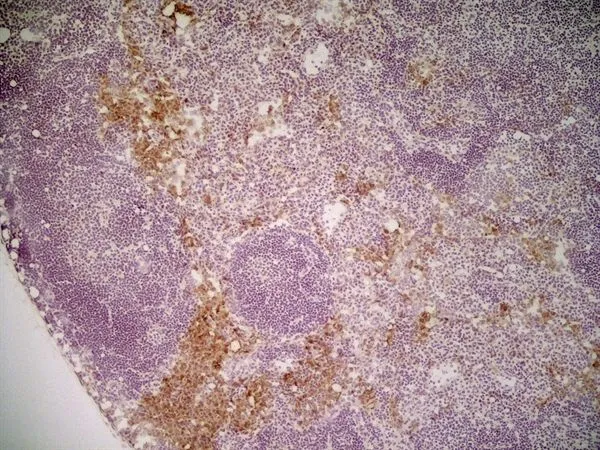
IHC-Fr analysis of mouse lymph node tissue using GTX42263 Mannose Receptor antibody [MR5D3].
![FACS analysis of J774 cells using GTX42263 Mannose Receptor antibody [MR5D3].](https://www.genetex.com/upload/website/prouct_img/normal/GTX42263/GTX42263_4776_FACS_w_23060820_354.webp "FACS analysis of J774 cells using GTX42263 Mannose Receptor antibody [MR5D3].")
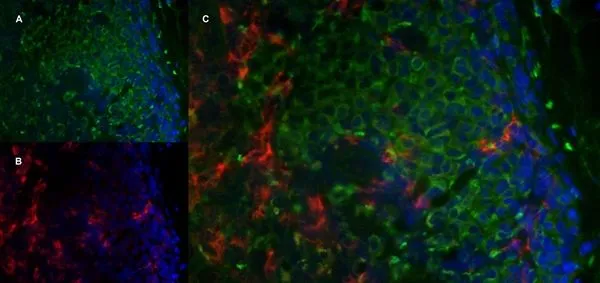
![IHC-Fr analysis of mouse lymph node tissue using GTX42263 Mannose Receptor antibody [MR5D3].](https://www.genetex.com/upload/website/prouct_img/normal/GTX42263/GTX42263_4781_IHC-Fr_w_23060820_798.webp "IHC-Fr analysis of mouse lymph node tissue using GTX42263 Mannose Receptor antibody [MR5D3].")
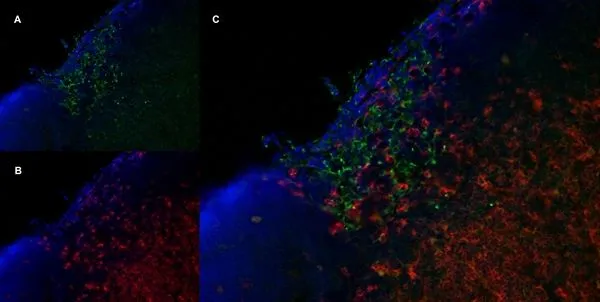
![IHC-Fr analysis of mouse lymph node tissue using GTX42263 Mannose Receptor antibody [MR5D3].](https://www.genetex.com/upload/website/prouct_img/normal/GTX42263/GTX42263_4783_IHC-Fr_w_23060820_941.webp "IHC-Fr analysis of mouse lymph node tissue using GTX42263 Mannose Receptor antibody [MR5D3].")
IHC-Fr analysis of mouse lymph node tissue using GTX42263 Mannose Receptor antibody [MR5D3].
Mannose Receptor antibody [MR5D3]
GTX42263

ApplicationsFlow Cytometry, ImmunoFluorescence, ImmunoPrecipitation, ImmunoCytoChemistry, ImmunoHistoChemistry, ImmunoHistoChemistry Frozen, ImmunoHistoChemistry Paraffin
Product group Antibodies
ReactivityMouse, Rat
TargetMrc1
Overview
- SupplierGeneTex
- Product NameMannose Receptor antibody [MR5D3]
- Delivery Days Customer9
- Application Supplier NoteFCM: 1/10-1/20. *Optimal dilutions/concentrations should be determined by the researcher.Not tested in other applications.
- ApplicationsFlow Cytometry, ImmunoFluorescence, ImmunoPrecipitation, ImmunoCytoChemistry, ImmunoHistoChemistry, ImmunoHistoChemistry Frozen, ImmunoHistoChemistry Paraffin
- CertificationResearch Use Only
- ClonalityMonoclonal
- Clone IDMR5D3
- Concentration1 mg/ml
- ConjugateUnconjugated
- Gene ID17533
- Target nameMrc1
- Target descriptionmannose receptor, C type 1
- Target synonymsCD206, MR, macrophage mannose receptor 1, MMR
- HostRat
- IsotypeIgG2a
- Protein IDQ61830
- Protein NameMacrophage mannose receptor 1
- ReactivityMouse, Rat
- Storage Instruction-20°C or -80°C,2°C to 8°C
- UNSPSC41116161
References
- Chromofungin, a chromogranin A-derived peptide, protects against sepsis-induced acute lung injury by inhibiting LBP/TLR4-dependent inflammatory signaling.Read this paper
- Role of Dectin-1 in peripheral nerve injury.Read this paper
- HYCO-3, a dual CO-releaser/Nrf2 activator, reduces tissue inflammation in mice challenged with lipopolysaccharide. Motterlini R et al., 2019 Jan, Redox BiolRead this paper
Datasheet
Related products
Product group Antibodies

ApplicationsFlow Cytometry
ReactivityMouse
TargetMrc1
- SizePrice
Product group Antibodies
ApplicationsFlow Cytometry
ReactivityMouse
TargetMrc1
- SizePrice

Product group Antibodies

ApplicationsImmunoPrecipitation, Western Blot, ImmunoCytoChemistry, ImmunoHistoChemistry
ReactivityMouse
TargetMrc1
- SizePrice
![IHC-Fr analysis of mouse lymph node tissue using GTX42264 Mannose Receptor antibody [MR5D3].](https://www.genetex.com/upload/website/prouct_img/normal/GTX42264/GTX42264_4790_IHC-Fr_w_23060820_814.webp)
Product group Antibodies
References
ApplicationsFlow Cytometry, ImmunoFluorescence, ImmunoPrecipitation, ImmunoCytoChemistry, ImmunoHistoChemistry, ImmunoHistoChemistry Frozen, ImmunoHistoChemistry Paraffin
ReactivityMouse, Rat
TargetMrc1
- SizePrice
Product group Antibodies
ApplicationsFlow Cytometry, ImmunoFluorescence, ImmunoPrecipitation, ImmunoCytoChemistry, ImmunoHistoChemistry, ImmunoHistoChemistry Frozen, ImmunoHistoChemistry Paraffin
ReactivityMouse, Rat
TargetMrc1
- SizePrice
Product group Antibodies
ApplicationsFlow Cytometry
ReactivityMouse
TargetMrc1
- SizePrice
Product group Antibodies
ApplicationsFlow Cytometry
ReactivityMouse
TargetMrc1
- SizePrice
Product group Antibodies
References
ApplicationsFlow Cytometry
ReactivityMouse, Rat
TargetMrc1
- SizePrice
Product group Antibodies
ApplicationsFlow Cytometry
ReactivityMouse
TargetMrc1
- SizePrice