

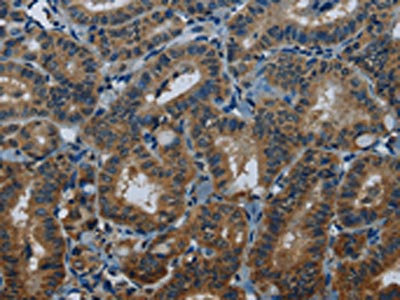
The image on the left is immunohistochemistry of paraffin-embedded Human thyroid cancer tissue using CSB-PA169796(MEI1 Antibody) at dilution 1/20, on the right is treated with fusion protein. (Original magnification: x200)
The image on the left is immunohistochemistry of paraffin-embedded Human thyroid cancer tissue using CSB-PA169796(MEI1 Antibody) at dilution 1/20, on the right is treated with fusion protein. (Original magnification: x200)
MEI1 Antibody
CSB-PA169796

ApplicationsELISA, ImmunoHistoChemistry
Product group Antibodies
ReactivityHuman
TargetMEI1
Overview
- SupplierCusabio
- Product NameMEI1 Antibody
- Delivery Days Customer20
- ApplicationsELISA, ImmunoHistoChemistry
- CertificationResearch Use Only
- ClonalityPolyclonal
- ConjugateUnconjugated
- Gene ID150365
- Target nameMEI1
- Target descriptionmeiotic double-stranded break formation protein 1
- Target synonymsHYDM3, SPATA38, meiosis inhibitor protein 1, meiosis defective 1, meiosis defective protein 1, meiosis inhibitor 1, spermatogenesis associated 38
- HostRabbit
- IsotypeIgG
- Protein IDQ5TIA1
- Protein NameMeiosis inhibitor protein 1
- Scientific DescriptionThe predominant cause of spermatogenic arrest of meiosis is the failure of homologous chromosomes to accurately synapse. MEI1 (Meiosis inhibitor protein 1), also designated Meiosis defective protein 1, is a 1274 amino acid protein that is likely required for the formation of genetically programmed double-strand breaks, the first step in the initiation of meiosis. With predominant expression in testis, it is likely that defects of the gene encoding MEI1 results in male infertility. Interestingly, studies show that genetic variation in the MEI gene possibly predisposes European Americans but not Israeli men to infertility by meiotic arrest. Human MEI1 shares 79% sequence similarity with its mouse homolog. There are seven isoforms of MEI1 that are produced as a result of alternative splicing events.
- ReactivityHuman
- Storage Instruction-20°C or -80°C
- UNSPSC41116161
Related products
Product group Antibodies

Anti-MEI1 AntibodyA91012
ApplicationsWestern Blot
ReactivityHuman, Mouse, Rat
- SizePrice
Product group Antibodies

MEI1 AntibodyLS-C377721
ApplicationsELISA, ImmunoHistoChemistry, ImmunoHistoChemistry Paraffin
ReactivityHuman
TargetMEI1
- SizePrice
Product group Antibodies

MEI-1 Polyclonal AntibodyBS-6387R
ApplicationsImmunoFluorescence, Western Blot, ELISA, ImmunoCytoChemistry, ImmunoHistoChemistry, ImmunoHistoChemistry Frozen, ImmunoHistoChemistry Paraffin
ReactivityBovine, Canine, Equine, Human, Mouse, Porcine, Rat, Sheep
TargetMEI1
- SizePrice

Product group Antibodies

Anti-MEI1 AntibodyHPA049240
ApplicationsImmunoHistoChemistry
ReactivityHuman
TargetMEI1
- SizePrice