

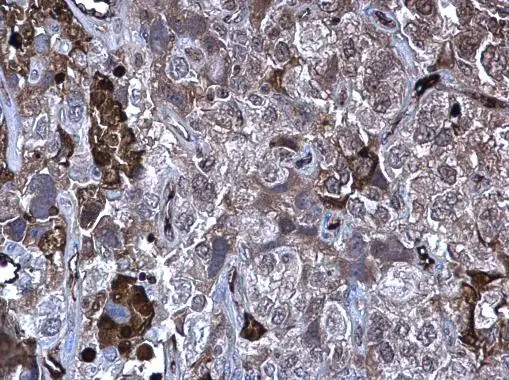
MMP10 antibody detects MMP10 protein at secreted on human cervical carcinoma by immunohistochemical analysis. Sample: Paraffin-embedded human cervical carcinoma. MMP10 antibody (GTX103287) diluted at 1:500.
Antigen Retrieval: Trilogy? (EDTA based, pH 8.0) buffer, 15min
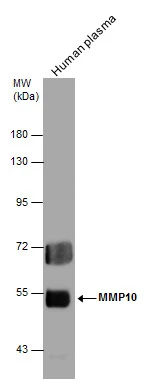
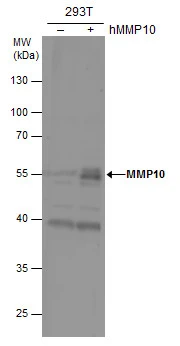
MMP10 antibody detects MMP10 protein at secreted on human cervical carcinoma by immunohistochemical analysis. Sample: Paraffin-embedded human cervical carcinoma. MMP10 antibody (GTX103287) diluted at 1:500.
Antigen Retrieval: Trilogy? (EDTA based, pH 8.0) buffer, 15min
MMP10 antibody
GTX103287

ApplicationsWestern Blot, ImmunoHistoChemistry, ImmunoHistoChemistry Paraffin
Product group Antibodies
ReactivityHuman
TargetMMP10
Overview
- SupplierGeneTex
- Product NameMMP10 antibody
- Delivery Days Customer9
- Application Supplier NoteWB: 1:500-1:3000. IHC-P: 1:100-1:1000. *Optimal dilutions/concentrations should be determined by the researcher.Not tested in other applications.
- ApplicationsWestern Blot, ImmunoHistoChemistry, ImmunoHistoChemistry Paraffin
- CertificationResearch Use Only
- ClonalityPolyclonal
- Concentration0.48 mg/ml
- ConjugateUnconjugated
- Gene ID4319
- Target nameMMP10
- Target descriptionmatrix metallopeptidase 10
- Target synonymsSL-2, STMY2, stromelysin-2, MMP-10, matrix metalloprotease 10, matrix metalloproteinase 10 (stromelysin 2), matrix metalloproteinase-10, transin 2
- HostRabbit
- IsotypeIgG
- Protein IDP09238
- Protein NameStromelysin-2
- Scientific DescriptionProteins of the matrix metalloproteinase (MMP) family are involved in the breakdown of extracellular matrix in normal physiological processes, such as embryonic development, reproduction, and tissue remodeling, as well as in disease processes, such as arthritis and metastasis. Most MMPs are secreted as inactive proproteins which are activated when cleaved by extracellular proteinases. The enzyme encoded by this gene degrades proteoglycans and fibronectin. The gene is part of a cluster of MMP genes which localize to chromosome 11q22.3. [provided by RefSeq]
- ReactivityHuman
- Storage Instruction-20°C or -80°C,2°C to 8°C
- UNSPSC41116161
Datasheet
Related products

Product group Antibodies

Anti-MMP-10 AntibodyA44578
ApplicationsImmunoFluorescence, ImmunoHistoChemistry
ReactivityHuman
- SizePrice
Product group Antibodies

MMP10 AntibodyCSB-PA010209
ApplicationsImmunoFluorescence, ELISA, ImmunoHistoChemistry
ReactivityHuman, Mouse, Rat
TargetMMP10
- SizePrice

Product group Antibodies

Anti-MMP10 Antibody Picoband(r)A03759-1-CARRIER-FREE
ApplicationsImmunoFluorescence, Western Blot, ELISA, ImmunoHistoChemistry
ReactivityHuman, Mouse, Rat
TargetMMP10
- SizePrice
Product group Antibodies

MMP10 AntibodyLS-C343054
ApplicationsWestern Blot, ELISA
ReactivityHuman
TargetMMP10
- SizePrice
Product group Antibodies

Mmp10 Polyclonal AntibodyCAC07021
ApplicationsWestern Blot, ELISA, ImmunoHistoChemistry
ReactivityMouse
TargetMMP10
- SizePrice
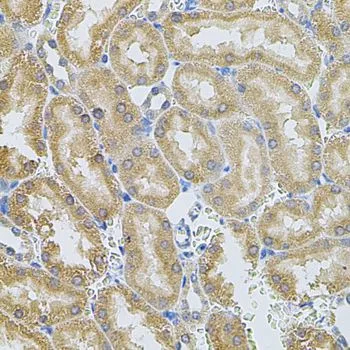
Product group Antibodies
MMP10 antibodyGTX64385
ApplicationsImmunoFluorescence, Western Blot, ImmunoCytoChemistry, ImmunoHistoChemistry, ImmunoHistoChemistry Paraffin
ReactivityHuman, Mouse, Rat
TargetMMP10
- SizePrice
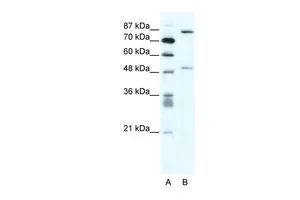
Product group Antibodies
MMP10 antibody, N-termGTX77732
ApplicationsWestern Blot
ReactivityHuman
TargetMMP10
- SizePrice
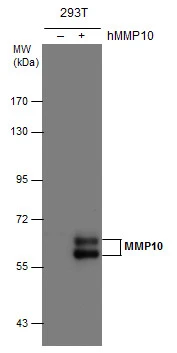
Product group Antibodies
MMP10 antibody [N1C1]GTX113496
ApplicationsWestern Blot, ImmunoHistoChemistry, ImmunoHistoChemistry Paraffin
ReactivityHuman
TargetMMP10
- SizePrice
![WB analysis of culture supernatant from HUVECs treated with different siRNA using GTX52477 MMP10 antibody [9G10].](https://www.genetex.com/upload/website/prouct_img/normal/GTX52477/GTX52477_20210416_WB_w_23060900_264.webp)
Product group Antibodies
MMP10 antibody [9G10]GTX52477
ApplicationsWestern Blot, ImmunoHistoChemistry, ImmunoHistoChemistry Paraffin
ReactivityHuman
TargetMMP10
- SizePrice