


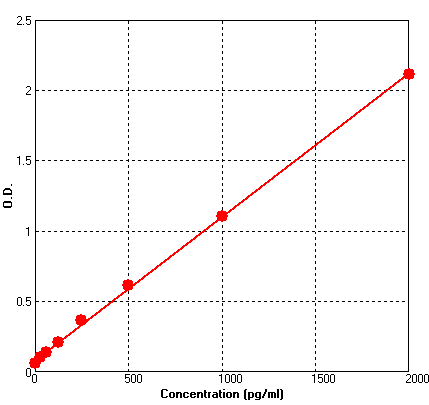
Mouse KIM1 PicoKine ELISA Kit standard curve
Mouse KIM1 PicoKine ELISA Kit standard curve
Mouse KIM1 / TIM1 ELISA Kit PicoKine(r)
EK0880

ReactivityMouse
Product group Assays
Overview
- SupplierBoster Bio
- Product NameMouse KIM1 / TIM1 ELISA Kit PicoKine(r)
- Delivery Days Customer9
- ApplicationsELISA
- Applications SupplierELI
- Assay Detection Range31.2 pg/ml - 2,000 pg/ml
- Assay Sensitivity<2 pg/ml
- Assay Time25-30
- CertificationResearch Use Only
- Scientific DescriptionMouse KIM1 / TIM1 ELISA Kit PicoKine® (96 Tests). Quantitate Mouse Havcr1 in cell culture supernatants, serum, plasma (heparin, EDTA) and urine. Sensitivity: 2pg/ml. The brand Picokine indicates this is a premium quality ELISA kit. Each Picokine kit delivers precise quantification, high sensitivity, and excellent reproducibility. Only our most reliable and effective kits qualify as Picokine, guaranteeing top-tier results for your assays.
- ReactivityMouse
- Reactivity SupplierMouse KIM1
- Storage Instruction-20°C,2°C to 8°C
- UNSPSC41116158
References
- Li Y, Wang Z, Xu H, et al. Targeting the transmembrane cytokine co-receptor neuropilin-1 in distal tubules improves renal injury and fibrosis. Nat Commun. 2024,15(1):5731. doi: 10.1038/s41467-024-50121-6Read this paper
- Brinks R, Wruck CJ, Schmitz J, et al. Nrf2 Activation Does Not Protect from Aldosterone-Induced Kidney Damage in Mice. Antioxidants (Basel). 2023,12(3). doi: 10.3390/antiox12030777Read this paper
- Su Y, Wang Y, Liu M, et al. Hydrogen sulfide attenuates renal I/R‑induced activation of the inflammatory response and apoptosis via regulating Nrf2‑mediated NLRP3 signaling pathway inhibition. Mol Med Rep. 2021,24(1):pii: 518. doi: 10.3892/mmr.2021.12157.Read this paper
- Tan C, Gu J, Li T, et al. Inhibition of aerobic glycolysis alleviates sepsis‑induced acute kidney injury by promoting lactate/Sirtuin 3/AMPK‑regulated autophagy. Int J Mol Med. 2021,47(3):pii: 19. doi: 10.3892/ijmm.2021.4852.Read this paper
- Xu MX, Qin YT, Ge CX, et al. Activated iRhom2 drives prolonged PM(2.5) exposure-triggered renal injury in Nrf2-defective mice. Nanotoxicology. 2018,12(9):1045-1067. doi: 10.1080/17435390.2018.1513093Read this paper
Datasheet
MSDS
Related products
Product group Assays

Assay Sample TypeSerum, plasma, urine, cell culture supernatants, and tissue samples.
ReactivityHuman
- SizePrice
Product group Assays

Assay Sample Typeserum, urine
ReactivityPrimate
- SizePrice