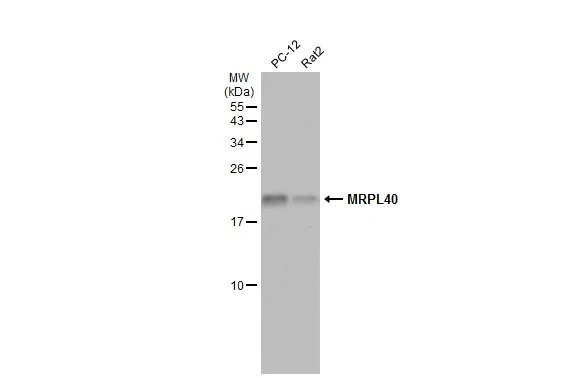
Various whole cell extracts (30 μg) were separated by 15% SDS-PAGE, and the membrane was blotted with MRPL40 antibody (GTX119564) diluted at 1:500. The HRP-conjugated anti-rabbit IgG antibody (GTX213110-01) was used to detect the primary antibody.
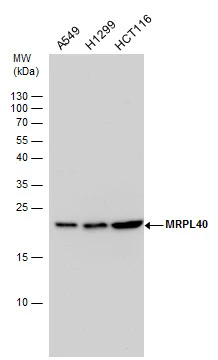
Various whole cell extracts (30 μg) were separated by 15% SDS-PAGE, and the membrane was blotted with MRPL40 antibody (GTX119564) diluted at 1:500. The HRP-conjugated anti-rabbit IgG antibody (GTX213110-01) was used to detect the primary antibody.
MRPL40 antibody
GTX119564

ApplicationsWestern Blot
Product group Antibodies
ReactivityHuman, Rat
TargetMRPL40
Overview
- SupplierGeneTex
- Product NameMRPL40 antibody
- Delivery Days Customer9
- Application Supplier NoteWB: 1:500-1:3000. *Optimal dilutions/concentrations should be determined by the researcher.Not tested in other applications.
- ApplicationsWestern Blot
- CertificationResearch Use Only
- ClonalityPolyclonal
- Concentration0.75 mg/ml
- ConjugateUnconjugated
- Gene ID64976
- Target nameMRPL40
- Target descriptionmitochondrial ribosomal protein L40
- Target synonymsL40mt, MRP-L22, MRP-L40, MRPL22, NLVCF, URIM, mL40, large ribosomal subunit protein mL40, 39S ribosomal protein L40, mitochondrial, mitochondrial large ribosomal subunit protein mL40, nuclear localization signal-containing protein deleted in velocardiofacial syndrome, up-regulated in metastasis
- HostRabbit
- IsotypeIgG
- Protein IDQ9NQ50
- Protein NameLarge ribosomal subunit protein mL40
- Scientific DescriptionMammalian mitochondrial ribosomal proteins are encoded by nuclear genes and help in protein synthesis within the mitochondrion. Mitochondrial ribosomes (mitoribosomes) consist of a small 28S subunit and a large 39S subunit. They have an estimated 75% protein to rRNA composition compared to prokaryotic ribosomes, where this ratio is reversed. Another difference between mammalian mitoribosomes and prokaryotic ribosomes is that the latter contain a 5S rRNA. Among different species, the proteins comprising the mitoribosome differ greatly in sequence, and sometimes in biochemical properties, which prevents easy recognition by sequence homology. This gene encodes a 39S subunit protein. Deletions in this gene may contribute to the etiology of velo-cardio-facial syndrome and DiGeorge syndrome. [provided by RefSeq]
- ReactivityHuman, Rat
- Storage Instruction-20°C or -80°C,2°C to 8°C
- UNSPSC41116161
Datasheet
Related products
Product group Antibodies

MRPL40 AntibodyCSB-PA003296
ApplicationsWestern Blot, ELISA, ImmunoHistoChemistry
ReactivityHuman
TargetMRPL40
- SizePrice

Product group Antibodies

Anti-MRP-L40 AntibodyA11512
ApplicationsImmunoFluorescence, Western Blot, ELISA, ImmunoHistoChemistry
ReactivityHuman, Mouse, Rat
TargetMRPL40
- SizePrice
Product group Antibodies

Anti-MRPL40 AntibodyA99285
ApplicationsWestern Blot, ELISA, ImmunoHistoChemistry
ReactivityHuman
- SizePrice
Product group Antibodies

MRPL40 AntibodyLS-C830926
ApplicationsWestern Blot, ELISA, ImmunoHistoChemistry
ReactivityHuman
TargetMRPL40
- SizePrice

Product group Antibodies

Anti-MRPL40 AntibodyHPA006181
ApplicationsWestern Blot, ImmunoCytoChemistry, ImmunoHistoChemistry
ReactivityHuman, Mouse, Rat
TargetMRPL40
- SizePrice
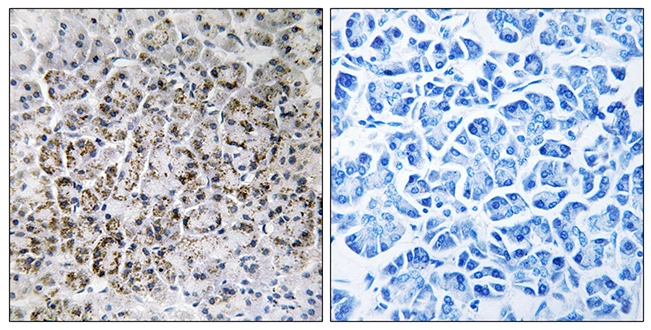
Product group Antibodies
MRPL40 antibodyGTX87165
ApplicationsWestern Blot, ImmunoHistoChemistry, ImmunoHistoChemistry Paraffin
ReactivityHuman
TargetMRPL40
- SizePrice