

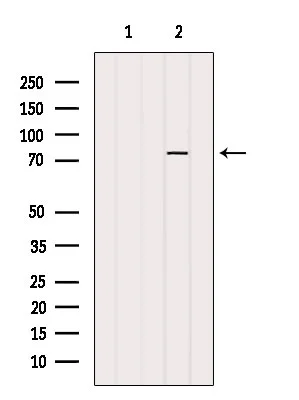
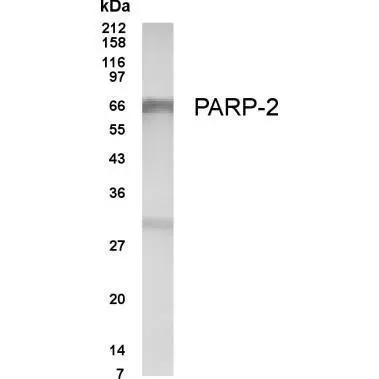
WB analysis of 3T3 cell lysate using GTX01558 PARP2 Antibody. The lane on the left was treated with blocking peptide.
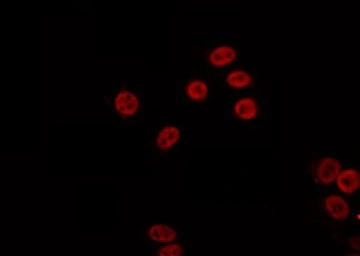
WB analysis of 3T3 cell lysate using GTX01558 PARP2 Antibody. The lane on the left was treated with blocking peptide.
PARP2 antibody
GTX01558

ApplicationsImmunoFluorescence, Western Blot, ImmunoCytoChemistry
Product group Antibodies
ReactivityHuman, Mouse
TargetPARP2
Overview
- SupplierGeneTex
- Product NamePARP2 antibody
- Delivery Days Customer9
- Application Supplier NoteWB: 1:500-1:1000. ICC/IF: 1:100-1:500. *Optimal dilutions/concentrations should be determined by the researcher.Not tested in other applications.
- ApplicationsImmunoFluorescence, Western Blot, ImmunoCytoChemistry
- CertificationResearch Use Only
- ClonalityPolyclonal
- Concentration1 mg/ml
- ConjugateUnconjugated
- Gene ID10038
- Target namePARP2
- Target descriptionpoly(ADP-ribose) polymerase 2
- Target synonymsADPRT2, ADPRTL2, ADPRTL3, ARTD2, PARP-2, pADPRT-2, poly [ADP-ribose] polymerase 2, ADP-ribosyltransferase (NAD+; poly(ADP-ribose) polymerase)-like 2, ADP-ribosyltransferase diphtheria toxin-like 2, ADPRT-2, DNA ADP-ribosyltransferase PARP2, NAD(+) ADP-ribosyltransferase 2, hPARP-2, poly (ADP-ribose) polymerase family, member 2, poly (ADP-ribosyl) transferase-like 2, poly[ADP-ribose] synthase 2, poly[ADP-ribose] synthetase 2, protein poly-ADP-ribosyltransferase PARP2
- HostRabbit
- IsotypeIgG
- Protein IDQ9UGN5
- Protein NamePoly [ADP-ribose] polymerase 2
- Scientific DescriptionThis gene encodes poly(ADP-ribosyl)transferase-like 2 protein, which contains a catalytic domain and is capable of catalyzing a poly(ADP-ribosyl)ation reaction. This protein has a catalytic domain which is homologous to that of poly (ADP-ribosyl) transferase, but lacks an N-terminal DNA binding domain which activates the C-terminal catalytic domain of poly (ADP-ribosyl) transferase. The basic residues within the N-terminal region of this protein may bear potential DNA-binding properties, and may be involved in the nuclear and/or nucleolar targeting of the protein. Two alternatively spliced transcript variants encoding distinct isoforms have been found. [provided by RefSeq, Jul 2008]
- ReactivityHuman, Mouse
- Storage Instruction-20°C or -80°C,2°C to 8°C
- UNSPSC41116161
Datasheet
Related products
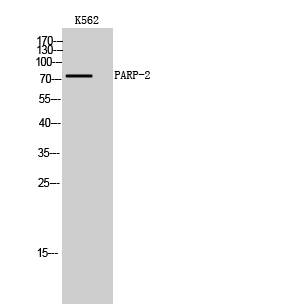
Product group Antibodies

Anti-PARP2 AntibodyA99012
ApplicationsWestern Blot, ELISA
ReactivityHuman, Mouse
- SizePrice

Product group Antibodies

Anti-PARP2 Antibody Picoband(r)A03270-2-CARRIER-FREE
ApplicationsFlow Cytometry, ImmunoFluorescence, Western Blot, ELISA, ImmunoCytoChemistry
ReactivityHuman, Rat
TargetPARP2
- SizePrice
Product group Antibodies

Anti-PARP2 Antibody144-64413
ApplicationsWestern Blot
ReactivityHuman, Mouse, Rat
TargetPARP2
- SizePrice

Product group Antibodies

PARP2 Recombinant Antibody, AbBy Fluor-647 ConjugatedBSM-61895R-BF647
ApplicationsWestern Blot
ReactivityHuman, Mouse, Rat
TargetPARP2
- SizePrice
Product group Antibodies

PARP2 AntibodyCSB-PA006369
ApplicationsWestern Blot, ELISA
ReactivityHuman, Mouse
TargetPARP2
- SizePrice
Product group Antibodies

Goat anti-PARP2EB07098
ApplicationsWestern Blot, ELISA, ImmunoHistoChemistry
ReactivityHuman
TargetPARP2
- SizePrice
Product group Antibodies

Parp2 Polyclonal AntibodyCAC11218
ApplicationsWestern Blot, ELISA
TargetPARP2
- SizePrice
Product group Antibodies
PARP2 antibodyGTX70456
ApplicationsWestern Blot
ReactivityHuman, Mouse
- SizePrice
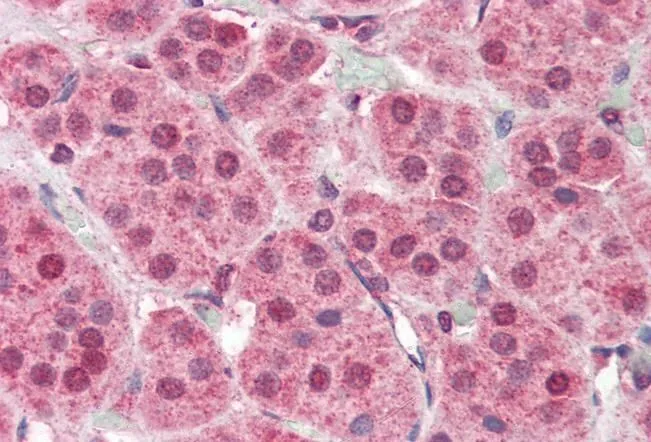
Product group Antibodies
PARP2 antibody, InternalGTX89417
ApplicationsWestern Blot, ImmunoHistoChemistry, ImmunoHistoChemistry Paraffin
ReactivityHuman
TargetPARP2
- SizePrice