

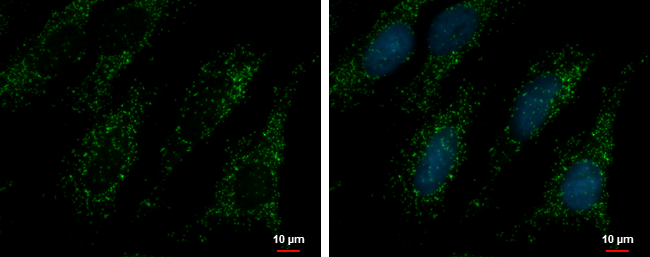
PEX14 antibody detects PEX14 protein at peroxisome by immunofluorescent analysis. Sample: HeLa cells were fixed in 4% paraformaldehyde at RT for 15 min. Green: PEX14 protein stained by PEX14 antibody (GTX129230) diluted at 1:500. Blue: Hoechst 33342 staining.
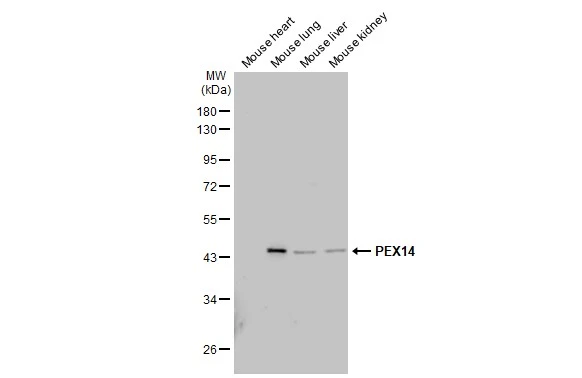
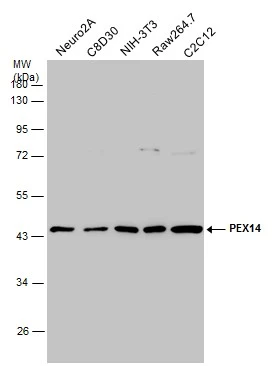
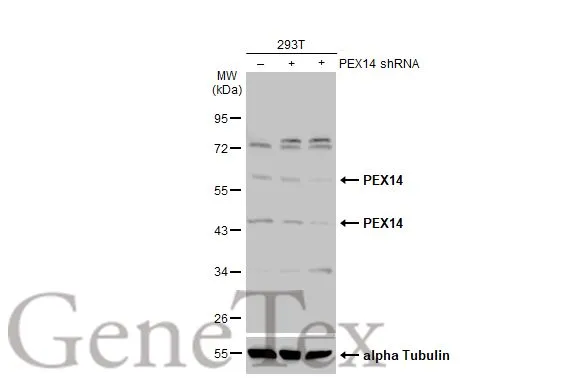
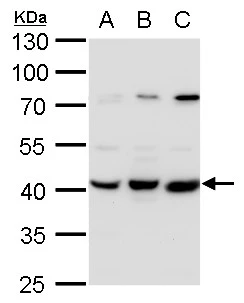
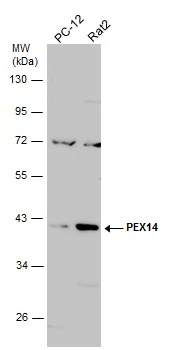
PEX14 antibody detects PEX14 protein at peroxisome by immunofluorescent analysis. Sample: HeLa cells were fixed in 4% paraformaldehyde at RT for 15 min. Green: PEX14 protein stained by PEX14 antibody (GTX129230) diluted at 1:500. Blue: Hoechst 33342 staining.
PEX14 antibody
GTX129230

ApplicationsImmunoFluorescence, Western Blot, ImmunoCytoChemistry
Product group Antibodies
ReactivityHuman, Mouse, Rat
TargetPEX14
Overview
- SupplierGeneTex
- Product NamePEX14 antibody
- Delivery Days Customer9
- Application Supplier NoteWB: 1:500-1:3000. ICC/IF: 1:100-1:1000. *Optimal dilutions/concentrations should be determined by the researcher.Not tested in other applications.
- ApplicationsImmunoFluorescence, Western Blot, ImmunoCytoChemistry
- CertificationResearch Use Only
- ClonalityPolyclonal
- Concentration1 mg/ml
- ConjugateUnconjugated
- Gene ID5195
- Target namePEX14
- Target descriptionperoxisomal biogenesis factor 14
- Target synonymsNAPP2, PBD13A, Pex14p, dJ734G22.2, peroxisomal membrane protein PEX14, NF-E2 associated polypeptide 2, PTS1 receptor docking protein, peroxin-14, peroxisomal membrane anchor protein PEX14, peroxisomal membrane anchor protein Pex14p
- HostRabbit
- IsotypeIgG
- Protein IDO75381
- Protein NamePeroxisomal membrane protein PEX14
- Scientific DescriptionThis gene encodes an essential component of the peroxisomal import machinery. The protein is integrated into peroxisome membranes with its C-terminus exposed to the cytosol, and interacts with the cytosolic receptor for proteins containing a PTS1 peroxisomal targeting signal. The protein also functions as a transcriptional corepressor and interacts with a histone deacetylase. A mutation in this gene results in one form of Zellweger syndrome. [provided by RefSeq]
- ReactivityHuman, Mouse, Rat
- Storage Instruction-20°C or -80°C,2°C to 8°C
- UNSPSC41116161
Datasheet
Related products
Product group Antibodies

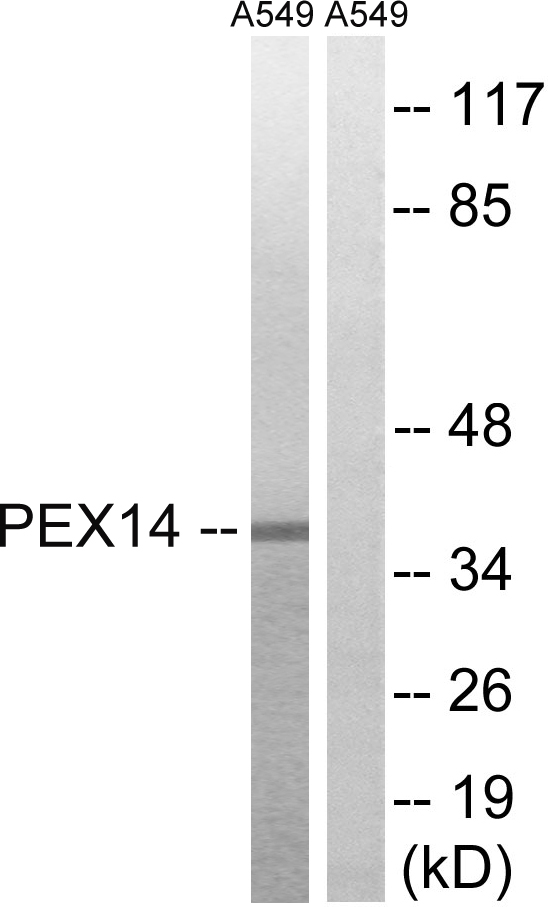
Anti-PEX14 AntibodyA95814
ApplicationsWestern Blot, ELISA, ImmunoHistoChemistry
ReactivityHuman, Mouse, Rat
- SizePrice
Product group Antibodies

Anti-PEX14 Antibody144-07336
ApplicationsImmunoFluorescence, Western Blot, ImmunoHistoChemistry
ReactivityHuman, Mouse, Rat
TargetPEX14
- SizePrice
Product group Antibodies

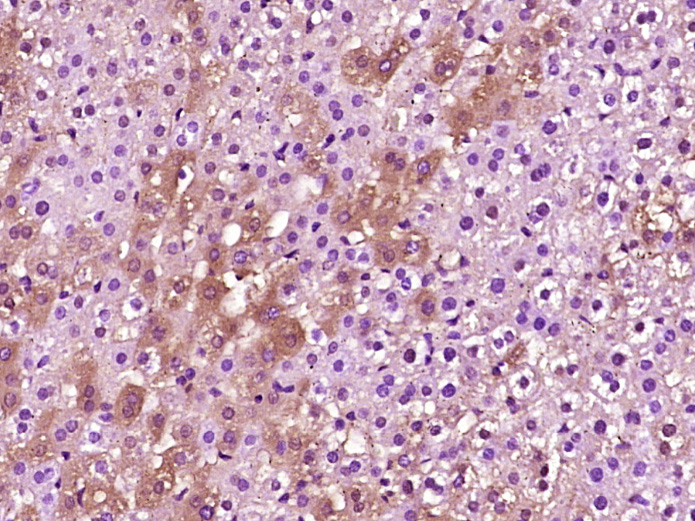
PEX14 Polyclonal AntibodyBS-12621R
ApplicationsImmunoFluorescence, ELISA, ImmunoCytoChemistry, ImmunoHistoChemistry, ImmunoHistoChemistry Frozen, ImmunoHistoChemistry Paraffin
ReactivityBovine, Canine, Chicken, Equine, Human, Mouse, Rabbit, Rat, Sheep
TargetPEX14
- SizePrice
Product group Antibodies

PEX14 AntibodyCSB-PA003741
ApplicationsWestern Blot, ELISA, ImmunoHistoChemistry
ReactivityHuman, Mouse, Rat
TargetPEX14
- SizePrice
Product group Antibodies

PEX14 AntibodyLS-C349063
ApplicationsImmunoFluorescence, Western Blot, ImmunoHistoChemistry
ReactivityHuman, Mouse, Rat
TargetPEX14
- SizePrice
Product group Antibodies
PEX14 antibody, C-termGTX80530
ApplicationsFlow Cytometry, Western Blot, ImmunoHistoChemistry, ImmunoHistoChemistry Paraffin
ReactivityHuman
TargetPEX14
- SizePrice
Product group Antibodies
PEX14 antibodyGTX87875
ApplicationsWestern Blot, ImmunoHistoChemistry, ImmunoHistoChemistry Paraffin
ReactivityHuman
TargetPEX14
- SizePrice

Product group Antibodies

Anti-PEX14 AntibodyHPA046104
ApplicationsImmunoCytoChemistry, ImmunoHistoChemistry
ReactivityHuman
TargetPEX14
- SizePrice
Product group Antibodies

Anti-PEX14Y058818
ApplicationsWestern Blot, ImmunoHistoChemistry
ReactivityHuman
- SizePrice
Product group Antibodies

Anti-PEX14 AntibodyCAB7336
ApplicationsWestern Blot, ELISA, ImmunoHistoChemistry, ImmunoHistoChemistry Paraffin
ReactivityHuman
TargetPEX14
- SizePrice