

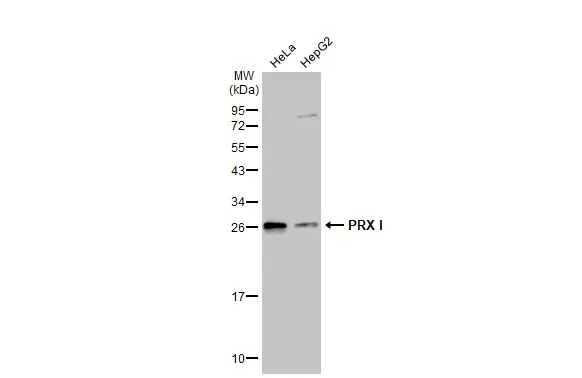
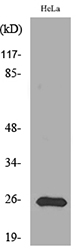
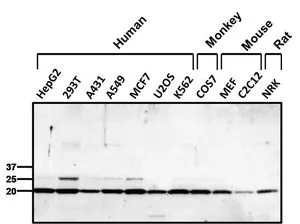
Various whole cell extracts (30 μg) were separated by 12% SDS-PAGE, and the membrane was blotted with PRX I antibody [N1C2] (GTX101705) diluted at 1:1000. The HRP-conjugated anti-rabbit IgG antibody (GTX213110-01) was used to detect the primary antibody.
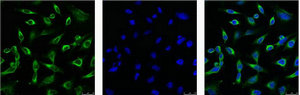
![PRX I antibody [N1C2] detects PRX I protein at cytoplasm by immunofluorescent analysis. Sample: HeLa cells were fixed in ice-cold MeOH for 5 min. Green: PRX I stained by PRX I antibody [N1C2] (GTX101705) diluted at 1:500. Red: alpha Tubulin, a cytoskeleton marker, stained by alpha Tubulin antibody [GT114] (GTX628802) diluted at 1:1000. Blue: Fluoroshield with DAPI (GTX30920).](https://www.genetex.com/upload/website/prouct_img/normal/GTX101705/GTX101705_44146_20220902_ICC_IF_22101718_948.webp "PRX I antibody [N1C2] detects PRX I protein at cytoplasm by immunofluorescent analysis. Sample: HeLa cells were fixed in ice-cold MeOH for 5 min. Green: PRX I stained by PRX I antibody [N1C2] (GTX101705) diluted at 1:500. Red: alpha Tubulin, a cytoskeleton marker, stained by alpha Tubulin antibody [GT114] (GTX628802) diluted at 1:1000. Blue: Fluoroshield with DAPI (GTX30920).")
![Various whole cell extracts (30 μg) were separated by 12% SDS-PAGE, and the membrane was blotted with PRX I antibody [N1C2] (GTX101705) diluted at 1:1000. The HRP-conjugated anti-rabbit IgG antibody (GTX213110-01) was used to detect the primary antibody.](https://www.genetex.com/upload/website/prouct_img/normal/GTX101705/GTX101705_39577_20221021_WB_R_22102723_903.webp "Various whole cell extracts (30 μg) were separated by 12% SDS-PAGE, and the membrane was blotted with PRX I antibody [N1C2] (GTX101705) diluted at 1:1000. The HRP-conjugated anti-rabbit IgG antibody (GTX213110-01) was used to detect the primary antibody.")
![PRX I antibody [N1C2] detects PRX I protein at cytosol on mouse lung by immunohistochemical analysis. Sample: Paraffin-embedded mouse lung. PRX I antibody [N1C2] (GTX101705) dilution: 1:500.
Antigen Retrieval: Trilogy? (EDTA based, pH 8.0) buffer, 15min](https://www.genetex.com/upload/website/prouct_img/normal/GTX101705/GTX101705_39577_IHC_M_w_23060100_935.webp "PRX I antibody [N1C2] detects PRX I protein at cytosol on mouse lung by immunohistochemical analysis. Sample: Paraffin-embedded mouse lung. PRX I antibody [N1C2] (GTX101705) dilution: 1:500.
Antigen Retrieval: Trilogy? (EDTA based, pH 8.0) buffer, 15min")
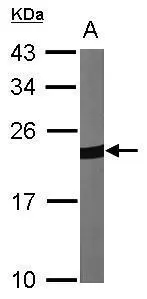
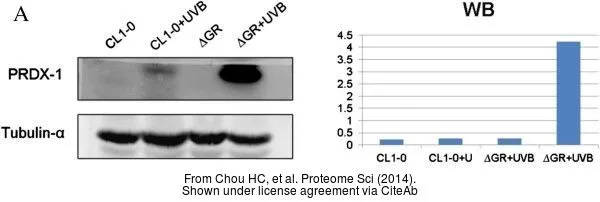
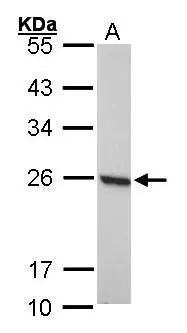
Various whole cell extracts (30 μg) were separated by 12% SDS-PAGE, and the membrane was blotted with PRX I antibody [N1C2] (GTX101705) diluted at 1:1000. The HRP-conjugated anti-rabbit IgG antibody (GTX213110-01) was used to detect the primary antibody.
PRX I antibody [N1C2]
GTX101705

ApplicationsImmunoFluorescence, Western Blot, ImmunoCytoChemistry, ImmunoHistoChemistry, ImmunoHistoChemistry Paraffin
Product group Antibodies
ReactivityHuman, Mouse, Rat
TargetPRDX1
Overview
- SupplierGeneTex
- Product NamePRX I antibody [N1C2]
- Delivery Days Customer9
- Application Supplier NoteWB: 1:500-1:3000. ICC/IF: 1:100-1:1000. IHC-P: 1:100-1:1000. *Optimal dilutions/concentrations should be determined by the researcher.Not tested in other applications.
- ApplicationsImmunoFluorescence, Western Blot, ImmunoCytoChemistry, ImmunoHistoChemistry, ImmunoHistoChemistry Paraffin
- CertificationResearch Use Only
- ClonalityPolyclonal
- Concentration0.22 mg/ml
- ConjugateUnconjugated
- Gene ID5052
- Target namePRDX1
- Target descriptionperoxiredoxin 1
- Target synonymsMSP23, NKEF-A, NKEFA, PAG, PAGA, PAGB, PRX1, PRXI, TDPX2, peroxiredoxin-1, epididymis secretory sperm binding protein, natural killer cell-enhancing factor A, natural killer-enhancing factor A, proliferation-associated gene A, proliferation-associated gene protein, thioredoxin peroxidase 2, thioredoxin-dependent peroxide reductase 2, thioredoxin-dependent peroxiredoxin 1
- HostRabbit
- IsotypeIgG
- Protein IDQ06830
- Protein NamePeroxiredoxin-1
- Scientific DescriptionThis gene encodes a member of the peroxiredoxin family of antioxidant enzymes, which reduce hydrogen peroxide and alkyl hydroperoxides. The encoded protein may play an antioxidant protective role in cells, and may contribute to the antiviral activity of CD8(+) T-cells. This protein may have a proliferative effect and play a role in cancer development or progression. Three transcript variants encoding the same protein have been identified for this gene. [provided by RefSeq]
- ReactivityHuman, Mouse, Rat
- Storage Instruction-20°C or -80°C,2°C to 8°C
- UNSPSC41116161
Datasheet
Related products
Product group Antibodies

Anti-PRDX1 AntibodyA97336
ApplicationsWestern Blot, ELISA
ReactivityHuman, Mouse, Rat
- SizePrice

Product group Antibodies

Anti-PRDX1 Antibody144-60374
ApplicationsImmunoFluorescence, Western Blot
ReactivityHuman, Mouse
TargetPRDX1
- SizePrice
Product group Antibodies

ApplicationsImmunoFluorescence, Western Blot, ImmunoHistoChemistry, ImmunoHistoChemistry Paraffin
ReactivityHuman, Mouse, Rat
TargetPRDX1
- SizePrice
Product group Antibodies
References

ApplicationsFlow Cytometry, ImmunoFluorescence, Western Blot, ELISA, ImmunoCytoChemistry, ImmunoHistoChemistry, ImmunoHistoChemistry Frozen, ImmunoHistoChemistry Paraffin
ReactivityBovine, Canine, Equine, Human, Mouse, Rabbit, Rat
TargetPRDX1
- SizePrice
Product group Antibodies

PRDX1 Monoclonal AntibodyCSB-MA000271
ApplicationsImmunoFluorescence, Western Blot, ELISA, ImmunoHistoChemistry
ReactivityHuman, Mouse, Rat
TargetPRDX1
- SizePrice
Product group Antibodies

Goat anti-PRDX1EB09018
ApplicationsWestern Blot, ELISA, ImmunoHistoChemistry
ReactivityBovine, Canine, Human, Mouse, Porcine, Rat
TargetPRDX1
- SizePrice
Product group Antibodies

PRDX1 Polyclonal AntibodyCAC13781
ApplicationsImmunoFluorescence, Western Blot, ELISA, ImmunoHistoChemistry
TargetPRDX1
- SizePrice
Product group Antibodies
References
PRX I antibodyGTX15571
ApplicationsImmunoFluorescence, Western Blot, ImmunoCytoChemistry, ImmunoHistoChemistry
ReactivityHuman, Monkey, Mouse, Rat
TargetPRDX1
- SizePrice
Product group Antibodies
PRX I antibody, InternalGTX88526
ApplicationsWestern Blot, ImmunoHistoChemistry, ImmunoHistoChemistry Paraffin
ReactivityHuman
TargetPRDX1
- SizePrice