

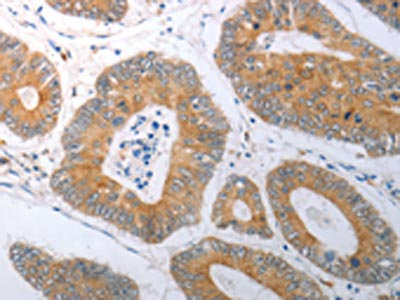
The image on the left is immunohistochemistry of paraffin-embedded Human colon cancer tissue using CSB-PA579163(RBMS3 Antibody) at dilution 1/25, on the right is treated with synthetic peptide. (Original magnification: x200)
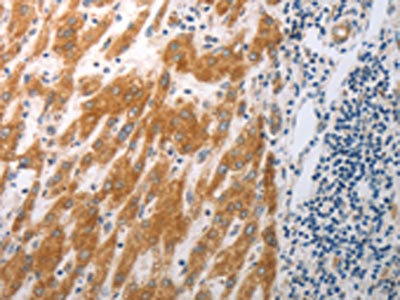

The image on the left is immunohistochemistry of paraffin-embedded Human colon cancer tissue using CSB-PA579163(RBMS3 Antibody) at dilution 1/25, on the right is treated with synthetic peptide. (Original magnification: x200)
RBMS3 Antibody
CSB-PA579163

ApplicationsWestern Blot, ELISA, ImmunoHistoChemistry
Product group Antibodies
ReactivityHuman, Mouse
TargetRBMS3
Overview
- SupplierCusabio
- Product NameRBMS3 Antibody
- Delivery Days Customer20
- ApplicationsWestern Blot, ELISA, ImmunoHistoChemistry
- CertificationResearch Use Only
- ClonalityPolyclonal
- ConjugateUnconjugated
- Gene ID27303
- Target nameRBMS3
- Target descriptionRNA binding motif single stranded interacting protein 3
- Target synonymsRNA-binding motif, single-stranded-interacting protein 3, RNA binding motif, single stranded interacting protein, RNA-binding protein
- HostRabbit
- IsotypeIgG
- Protein IDQ6XE24
- Protein NameRNA-binding motif, single-stranded-interacting protein 3
- Scientific DescriptionThis gene encodes an RNA-binding protein that belongs to the c-myc gene single-strand binding protein family. These proteins are characterized by the presence of two sets of ribonucleoprotein consensus sequence (RNP-CS) that contain conserved motifs, RNP1 and RNP2, originally described in RNA binding proteins, and required for DNA binding. These proteins have been implicated in such diverse functions as DNA replication, gene transcription, cell cycle progression and apoptosis. The encoded protein was isolated by virtue of its binding to an upstream element of the alpha2(I) collagen promoter. The observation that this protein localizes mostly in the cytoplasm suggests that it may be involved in a cytoplasmic function such as controlling RNA metabolism, rather than transcription. Multiple alternatively spliced transcript variants encoding different isoforms have been found for this gene.
- ReactivityHuman, Mouse
- Storage Instruction-20°C or -80°C
- UNSPSC41116161
Related products

Product group Antibodies

Anti-RBMS3 Antibody Picoband(r)A12416-3-CARRIER-FREE
ApplicationsImmunoFluorescence, Western Blot, ELISA, ImmunoCytoChemistry, ImmunoHistoChemistry
ReactivityHuman, Mouse, Rat
TargetRBMS3
- SizePrice
Product group Antibodies

Anti-RBMS3 AntibodyA98992
ApplicationsWestern Blot, ELISA
ReactivityHuman, Mouse
- SizePrice
Product group Antibodies

Anti-RBMS3 AntibodyHPA034719
ApplicationsWestern Blot, ImmunoCytoChemistry, ImmunoHistoChemistry
ReactivityHuman
TargetRBMS3
- SizePrice
Product group Antibodies

RBMS3 AntibodyLS-C405790
ApplicationsWestern Blot, ELISA, ImmunoHistoChemistry
ReactivityHuman, Mouse
TargetRBMS3
- SizePrice
Product group Antibodies

Anti-RBMS3 Antibody101-11420
ApplicationsWestern Blot, ELISA
TargetRBMS3
- SizePrice
Product group Antibodies

RBMS3 antibodyGTX00791
ApplicationsImmunoFluorescence, Western Blot, ImmunoCytoChemistry
ReactivityHuman, Mouse
TargetRBMS3
- SizePrice
Product group Antibodies

Rbms3 Polyclonal AntibodyCAC11334
ApplicationsImmunoFluorescence, ELISA
TargetRBMS3
- SizePrice