

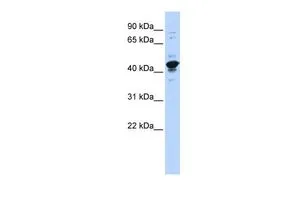
WB analysis of 293T cells using GTX47319 RBMXL2 antibody at 0.2-1microg/ml.
WB analysis of 293T cells using GTX47319 RBMXL2 antibody at 0.2-1microg/ml.
RBMXL2 antibody, Internal
GTX47319

ApplicationsWestern Blot
Product group Antibodies
ReactivityHuman
TargetRBMXL2
Overview
- SupplierGeneTex
- Product NameRBMXL2 antibody, Internal
- Delivery Days Customer9
- Application Supplier NoteWB: 0.2-2.5 ug/ml. *Optimal dilutions/concentrations should be determined by the researcher.Not tested in other applications.
- ApplicationsWestern Blot
- CertificationResearch Use Only
- ClonalityPolyclonal
- Concentration0.5-1 mg/ml
- ConjugateUnconjugated
- Gene ID27288
- Target nameRBMXL2
- Target descriptionRBMX like 2
- Target synonymsHNRNPG-T, HNRNPGT, HNRPGT, RNA-binding motif protein, X-linked-like-2, RNA binding motif protein, X-linked like 2, heterogeneous nuclear ribonucleoprotein G T, hnRNP G-T, testes-specific heterogenous nuclear ribonucleoprotein G-T, testis-specific heterogeneous nuclear ribonucleoprotein G-T
- HostRabbit
- IsotypeIgG
- Protein IDO75526
- Protein NameRNA-binding motif protein, X-linked-like-2
- Scientific DescriptionThis gene belongs to the HNRPG subfamily of ubiquitously expressed heterogeneous nuclear ribonucleoproteins (hnRNPs). The hnRNPs are RNA binding proteins and they complex with heterogeneous nuclear RNA (hnRNA). These proteins are associated with pre-mRNAs in the nucleus and appear to influence pre-mRNA processing and other aspects of mRNA metabolism and transport. While all of the hnRNPs are present in the nucleus, some seem to shuttle between the nucleus and the cytoplasm. The hnRNP proteins have distinct nucleic acid binding properties. The protein encoded by this gene has two RRM domains that bind RNAs. This gene is intronless and is thought to be derived from a processed retroposon. However, unlike many retroposon-derived genes, this gene is not a pseudogene. The encoded protein has similarity to HNRPG and RBMY proteins and it is suggested to replace HNRPG protein function during meiotic prophase or act as a germ cell-specific splicing regulator. It primarily localizes to the nuclei of meiotic spermatocytes. This gene is a candidate for autosomal male infertility. [provided by RefSeq, Jul 2008]
- ReactivityHuman
- Storage Instruction-20°C or -80°C,2°C to 8°C
- UNSPSC12352203
Datasheet
Related products
Product group Antibodies

RBMXL2 Recombinant AntibodyBSM-62673R
ApplicationsImmunoFluorescence, ImmunoPrecipitation, Western Blot, ImmunoCytoChemistry
ReactivityHuman, Mouse, Rat
TargetRBMXL2
- SizePrice
Product group Antibodies

Anti-HNRNPG-T Antibody101-10727
ApplicationsImmunoFluorescence, Western Blot, ELISA, ImmunoHistoChemistry
TargetRBMXL2
- SizePrice
Product group Antibodies

RBMXL2 Antibody (clone 6F11)LS-C133727
ApplicationsImmunoFluorescence, Western Blot, ELISA, ImmunoHistoChemistry, ImmunoHistoChemistry Paraffin
ReactivityHuman
TargetRBMXL2
- SizePrice


Product group Antibodies

Anti-RBMXL2 AntibodyHPA038912
ApplicationsImmunoHistoChemistry
ReactivityHuman
TargetRBMXL2
- SizePrice

Product group Antibodies

ApplicationsImmunoFluorescence, ImmunoPrecipitation, Western Blot, ImmunoCytoChemistry
ReactivityHuman, Mouse, Rat
TargetRBMXL2
- SizePrice