

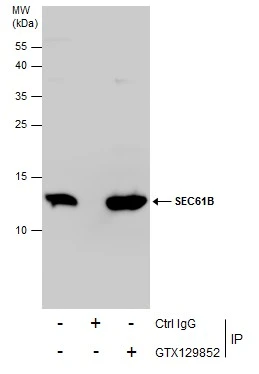
Immunoprecipitation of SEC61B protein from HepG2 whole cell extracts using 5 μg of SEC61B antibody (GTX129852). Western blot analysis was performed using SEC61B antibody (GTX129852). EasyBlot anti-Rabbit IgG (GTX221666-01) was used as a secondary reagent.
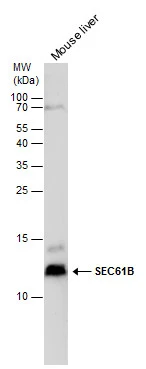
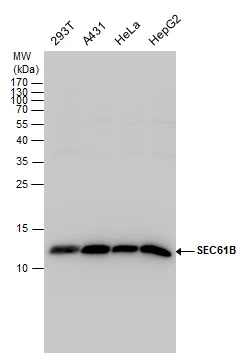
Immunoprecipitation of SEC61B protein from HepG2 whole cell extracts using 5 μg of SEC61B antibody (GTX129852). Western blot analysis was performed using SEC61B antibody (GTX129852). EasyBlot anti-Rabbit IgG (GTX221666-01) was used as a secondary reagent.
SEC61B antibody
GTX129852

ApplicationsImmunoPrecipitation, Western Blot
Product group Antibodies
ReactivityHuman, Mouse
TargetSEC61B
Overview
- SupplierGeneTex
- Product NameSEC61B antibody
- Delivery Days Customer9
- Application Supplier NoteWB: 1:500-1:3000. IP: 1:100-1:500. *Optimal dilutions/concentrations should be determined by the researcher.Not tested in other applications.
- ApplicationsImmunoPrecipitation, Western Blot
- CertificationResearch Use Only
- ClonalityPolyclonal
- Concentration0.77 mg/ml
- ConjugateUnconjugated
- Gene ID10952
- Target nameSEC61B
- Target descriptionSEC61 translocon subunit beta
- Target synonymsprotein transport protein Sec61 subunit beta, SEC61 translocon beta subunit, Sec61 beta subunit, Sec61 complex, beta subunit, protein translocation complex beta, protein transport protein SEC61 beta subunit
- HostRabbit
- IsotypeIgG
- Protein IDP60468
- Protein NameProtein transport protein Sec61 subunit beta
- Scientific DescriptionThe Sec61 complex is the central component of the protein translocation apparatus of the endoplasmic reticulum (ER) membrane. Oligomers of the Sec61 complex form a transmembrane channel where proteins are translocated across and integrated into the ER membrane. This complex consists of three membrane proteins- alpha, beta, and gamma. This gene encodes the beta-subunit protein. The Sec61 subunits are also observed in the post-ER compartment, suggesting that these proteins can escape the ER and recycle back. There is evidence for multiple polyadenylated sites for this transcript. [provided by RefSeq]
- ReactivityHuman, Mouse
- Storage Instruction-20°C or -80°C,2°C to 8°C
- UNSPSC41116161
Datasheet
Related products
Product group Antibodies

Anti-SEC61B AntibodyA307609
ApplicationsImmunoFluorescence, Western Blot, ImmunoCytoChemistry
ReactivityHuman
- SizePrice

Product group Antibodies

Anti-SEC61B Antibody Picoband(r)A07334-2-CARRIER-FREE
ApplicationsFlow Cytometry, Western Blot, ELISA
ReactivityHuman, Mouse, Rat
TargetSEC61B
- SizePrice
Product group Antibodies

Anti-SEC61B Antibody144-61204
ApplicationsWestern Blot
ReactivityHuman, Mouse, Rat
TargetSEC61B
- SizePrice
Product group Antibodies

SEC61B Polyclonal AntibodyBS-55194R
ApplicationsImmunoFluorescence, Western Blot, ImmunoCytoChemistry
ReactivityHuman, Mouse, Rat
TargetSEC61B
- SizePrice
Product group Antibodies

SEC61B AntibodyCSB-PA020958GA01HU
ApplicationsWestern Blot, ELISA, ImmunoHistoChemistry
ReactivityHuman, Mouse
TargetSEC61B
- SizePrice
Product group Antibodies
SEC61B antibodyGTX15576
ApplicationsImmunoFluorescence, ImmunoPrecipitation, Western Blot, ImmunoCytoChemistry
ReactivityCanine, Human, Mouse, Porcine, Rat
TargetSEC61B
- SizePrice

Product group Antibodies

Anti-SEC61B AntibodyHPA049407
ApplicationsImmunoCytoChemistry, ImmunoHistoChemistry
ReactivityHuman
TargetSEC61B
- SizePrice
Product group Antibodies

SEC61B Antibody (Internal)LS-C353809
ApplicationsWestern Blot
ReactivityBovine, Canine, Human, Mouse, Rat
TargetSEC61B
- SizePrice