

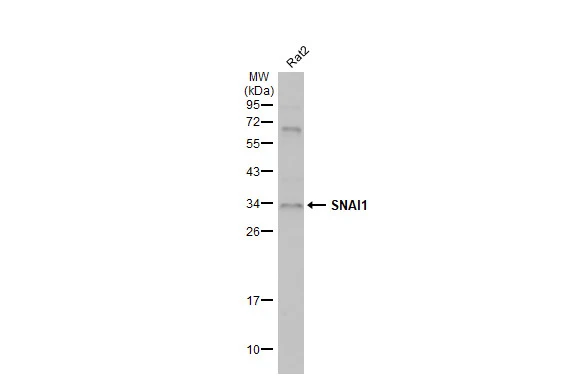
Whole cell extract (30 μg) was separated by 12% SDS-PAGE, and the membrane was blotted with SNAI1 antibody (GTX100754) diluted at 1:1000. The HRP-conjugated anti-rabbit IgG antibody (GTX213110-01) was used to detect the primary antibody.
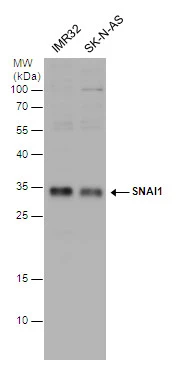
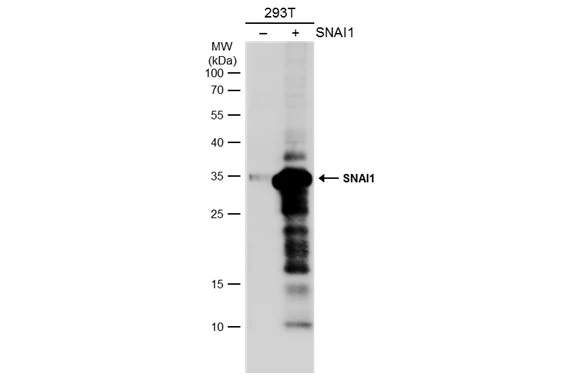
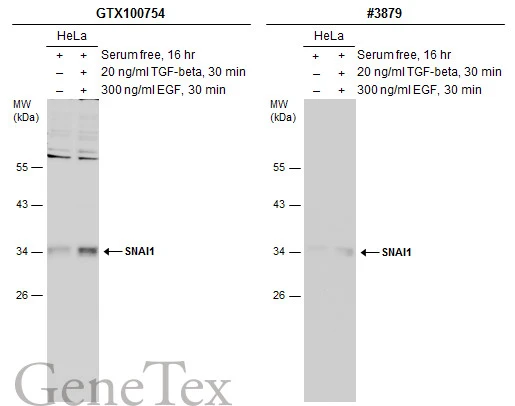
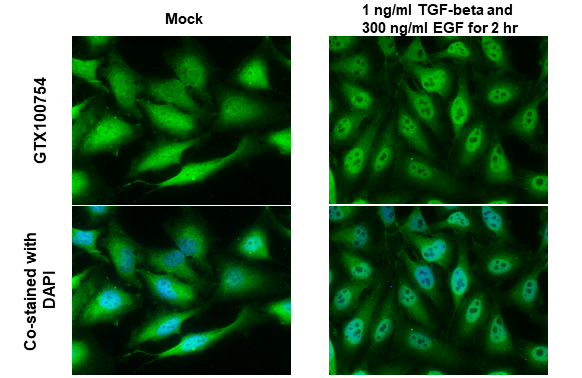
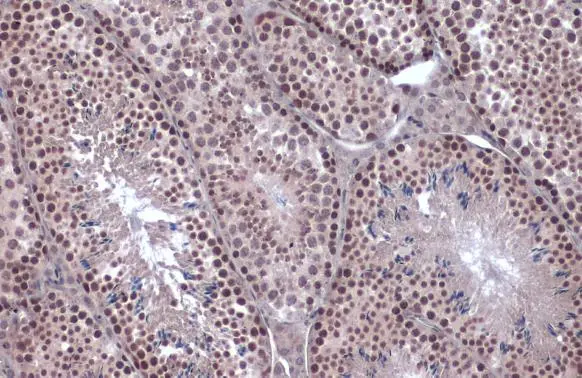
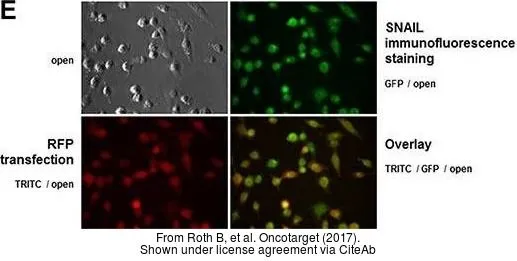
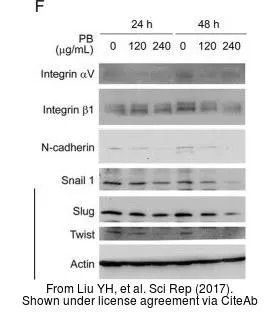
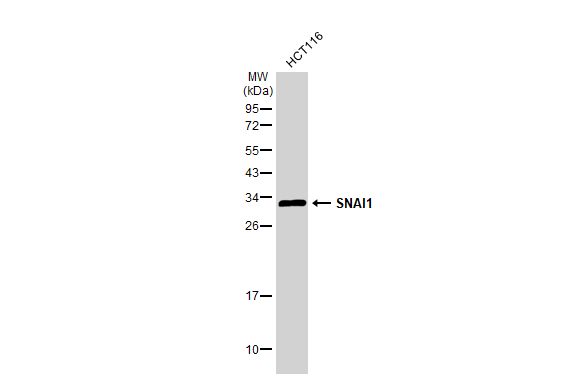
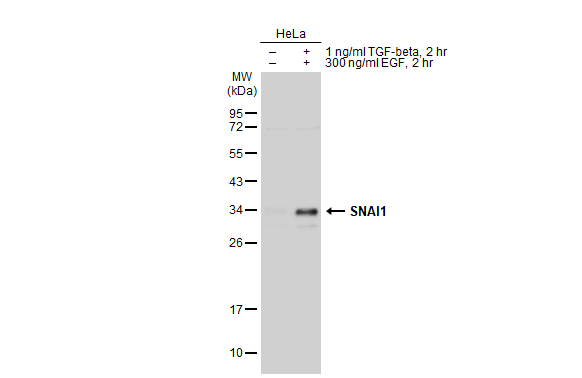
Whole cell extract (30 μg) was separated by 12% SDS-PAGE, and the membrane was blotted with SNAI1 antibody (GTX100754) diluted at 1:1000. The HRP-conjugated anti-rabbit IgG antibody (GTX213110-01) was used to detect the primary antibody.
SNAI1 antibody
GTX100754

ApplicationsImmunoFluorescence, Western Blot, ImmunoCytoChemistry, ImmunoHistoChemistry, ImmunoHistoChemistry Paraffin
Product group Antibodies
ReactivityHuman, Mouse, Rat
TargetSNAI1
Overview
- SupplierGeneTex
- Product NameSNAI1 antibody
- Delivery Days Customer9
- Application Supplier NoteWB: 1:500-1:3000. ICC/IF: 1:100-1:1000. *Optimal dilutions/concentrations should be determined by the researcher.Not tested in other applications.
- ApplicationsImmunoFluorescence, Western Blot, ImmunoCytoChemistry, ImmunoHistoChemistry, ImmunoHistoChemistry Paraffin
- CertificationResearch Use Only
- ClonalityPolyclonal
- Concentration0.94 mg/ml
- ConjugateUnconjugated
- Gene ID6615
- Target nameSNAI1
- Target descriptionsnail family transcriptional repressor 1
- Target synonymsSLUGH2, SNA, SNAH, SNAIL, SNAIL1, dJ710H13.1, zinc finger protein SNAI1, protein sna, protein snail homolog 1, snail 1 homolog, snail 1 zinc finger protein, snail family zinc finger 1, snail homolog 1
- HostRabbit
- IsotypeIgG
- Protein IDO95863
- Protein NameZinc finger protein SNAI1
- Scientific DescriptionThe Drosophila embryonic protein snail is a zinc finger transcriptional repressor which downregulates the expression of ectodermal genes within the mesoderm. The nuclear protein encoded by this gene is structurally similar to the Drosophila snail protein, and is also thought to be critical for mesoderm formation in the developing embryo. At least two variants of a similar processed pseudogene have been found on chromosome 2. [provided by RefSeq]
- ReactivityHuman, Mouse, Rat
- Storage Instruction-20°C or -80°C,2°C to 8°C
- UNSPSC41116161
Datasheet
Related products

Product group Antibodies

SNAI1 AntibodyCSB-PA004123
ApplicationsImmunoFluorescence, Western Blot, ELISA, ImmunoHistoChemistry
ReactivityHuman, Monkey, Mouse
TargetSNAI1
- SizePrice

Product group Antibodies

Anti-SNAIL/SNAI1 Antibody Picoband(r)A00716-2-CARRIER-FREE
ApplicationsFlow Cytometry, Western Blot, ELISA
ReactivityHuman, Mouse, Rat
TargetSNAI1
- SizePrice
Product group Antibodies

ApplicationsWestern Blot, ELISA
ReactivityHuman, Mouse
- SizePrice
Product group Antibodies

SNAI1 (Phospho-Ser246) AntibodyABX012522
ApplicationsImmunoFluorescence, Western Blot, ELISA, ImmunoCytoChemistry
- SizePrice

Product group Antibodies

Anti-SNAI1 AntibodyAMAB91215
ApplicationsImmunoCytoChemistry, ImmunoHistoChemistry
ReactivityHuman
TargetSNAI1
- SizePrice
Product group Antibodies

ApplicationsWestern Blot, ELISA, ImmunoHistoChemistry
ReactivityHuman, Mouse, Rat
TargetSNAI1
- SizePrice
Product group Antibodies

SNAI1 / SNAIL-1 AntibodyLS-C404293
ApplicationsWestern Blot, ELISA, ImmunoHistoChemistry
ReactivityHuman, Mouse
TargetSNAI1
- SizePrice
Product group Antibodies

ApplicationsImmunoPrecipitation, Western Blot, ImmunoCytoChemistry, ImmunoHistoChemistry
TargetSNAI1
- SizePrice
![Untreated (–) and treated (+) HeLa whole cell extract (30 μg) were separated by 12% SDS-PAGE, and the membrane was blotted with SNAI1 antibody [HL2303] (GTX638370) diluted at 1:1000. The HRP-conjugated anti-rabbit IgG antibody (GTX213110-01) was used to detect the primary antibody.](https://www.genetex.com/upload/website/prouct_img/normal/GTX638370/GTX638370_T-44991_20230414_WB_treatmemt_TGF-beta_EGF_23041723_265.webp)
Product group Antibodies
SNAI1 antibody [HL2303]GTX638370
ApplicationsImmunoFluorescence, Western Blot, ImmunoCytoChemistry
ReactivityHuman
TargetSNAI1
- SizePrice