

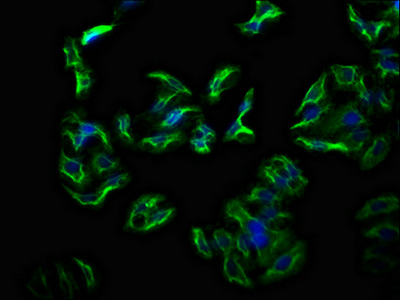
Immunofluorescence staining of HepG2 cells with CSB-PA857003LA01HU at 1:133, counter-stained with DAPI. The cells were fixed in 4% formaldehyde, permeabilized using 0.2% Triton X-100 and blocked in 10% normal Goat Serum. The cells were then incubated with the antibody overnight at 4°C. The secondary antibody was Alexa Fluor 488-congugated AffiniPure Goat Anti-Rabbit IgG(H+L).
Immunofluorescence staining of HepG2 cells with CSB-PA857003LA01HU at 1:133, counter-stained with DAPI. The cells were fixed in 4% formaldehyde, permeabilized using 0.2% Triton X-100 and blocked in 10% normal Goat Serum. The cells were then incubated with the antibody overnight at 4°C. The secondary antibody was Alexa Fluor 488-congugated AffiniPure Goat Anti-Rabbit IgG(H+L).
TECTB Antibody
CSB-PA857003LA01HU

ApplicationsImmunoFluorescence, ELISA
Product group Antibodies
ReactivityHuman
TargetTECTB
Overview
- SupplierCusabio
- Product NameTECTB Antibody
- Delivery Days Customer20
- ApplicationsImmunoFluorescence, ELISA
- CertificationResearch Use Only
- ClonalityPolyclonal
- ConjugateUnconjugated
- Gene ID6975
- Target nameTECTB
- Target descriptiontectorin beta
- Target synonymsbeta-tectorin
- HostRabbit
- IsotypeIgG
- Protein IDQ96PL2
- Protein NameBeta-tectorin
- Scientific DescriptionOne of the major non-collagenous components of the tectorial membrane (By similarity). The tectorial membrane is an extracellular matrix of the inner ear that covers the neuroepithelium of the cochlea and contacts the stereocilia bundles of specialized sensory hair cells. Sound induces movement of these hair cells relative to the tectorial membrane, deflects the stereocilia and leads to fluctuations in hair-cell membrane potential, transducing sound into electrical signals.
- ReactivityHuman
- Storage Instruction-20°C or -80°C
- UNSPSC41116161
Related products
Product group Antibodies

Anti-TECTB (N-term) Antibody102-20448
ApplicationsWestern Blot, ImmunoHistoChemistry, ImmunoHistoChemistry Paraffin
TargetTECTB
- SizePrice
Product group Antibodies

TECTB Polyclonal AntibodyBS-11067R
ApplicationsImmunoFluorescence, Western Blot, ELISA, ImmunoCytoChemistry, ImmunoHistoChemistry, ImmunoHistoChemistry Frozen, ImmunoHistoChemistry Paraffin
- SizePrice
Product group Antibodies

ApplicationsImmunoPrecipitation, Western Blot, ImmunoCytoChemistry, ImmunoHistoChemistry
ReactivityMouse, Rat
TargetTECTB
- SizePrice
Product group Antibodies

TECTB Antibody (aa18-329)LS-C374702
ApplicationsWestern Blot
ReactivityHuman
TargetTECTB
- SizePrice
Product group Antibodies

TECTB AntibodyPACO61129
ApplicationsImmunoFluorescence, ELISA
ReactivityHuman
TargetTECTB
- SizePrice