

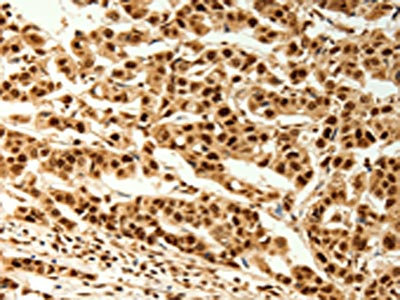
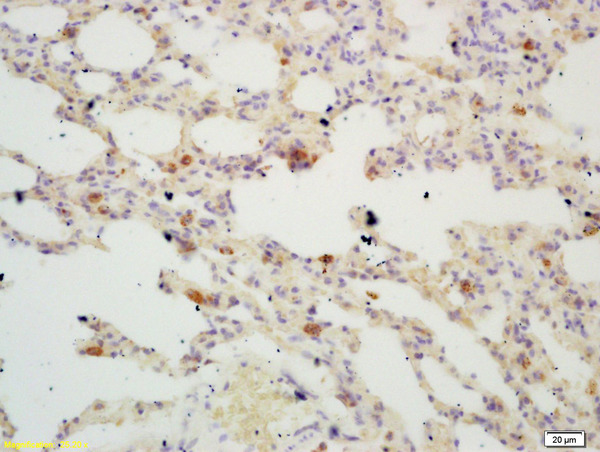
The image on the left is immunohistochemistry of paraffin-embedded Human cervical cancer tissue using CSB-PA162542(TIGAR Antibody) at dilution 1/80, on the right is treated with synthetic peptide. (Original magnification: x200)
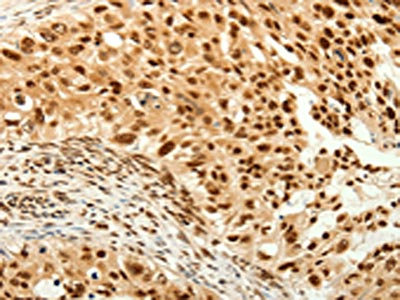
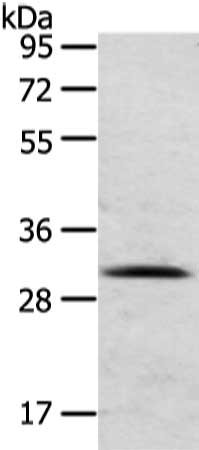
The image on the left is immunohistochemistry of paraffin-embedded Human cervical cancer tissue using CSB-PA162542(TIGAR Antibody) at dilution 1/80, on the right is treated with synthetic peptide. (Original magnification: x200)
TIGAR Antibody
CSB-PA162542

ApplicationsWestern Blot, ELISA, ImmunoHistoChemistry
Product group Antibodies
ReactivityHuman
TargetTIGAR
Overview
- SupplierCusabio
- Product NameTIGAR Antibody
- Delivery Days Customer20
- ApplicationsWestern Blot, ELISA, ImmunoHistoChemistry
- CertificationResearch Use Only
- ClonalityPolyclonal
- ConjugateUnconjugated
- Gene ID57103
- Target nameTIGAR
- Target descriptionTP53 induced glycolysis regulatory phosphatase
- Target synonymsC12orf5, FR2BP, fructose-2,6-bisphosphatase TIGAR, TP53-induced glycolysis and apoptosis regulator, fructose-2,6-bisphosphate 2-phosphatase, probable fructose-2,6-bisphosphatase TIGAR, transactivated by NS3TP2 protein
- HostRabbit
- IsotypeIgG
- Protein IDQ9NQ88
- Protein NameFructose-2,6-bisphosphatase TIGAR
- Scientific DescriptionThis gene is regulated as part of the p53 tumor suppressor pathway and encodes a protein with sequence similarity to the bisphosphate domain of the glycolytic enzyme that degrades fructose-2,6-bisphosphate. The protein functions by blocking glycolysis and directing the pathway into the pentose phosphate shunt. Expression of this protein also protects cells from DNA damaging reactive oxygen species and provides some protection from DNA damage-induced apoptosis.
- ReactivityHuman
- Storage Instruction-20°C or -80°C
- UNSPSC41116161
Related products
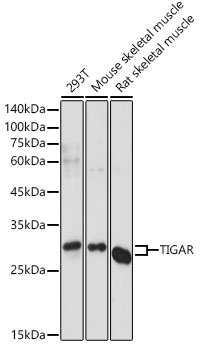
Product group Antibodies

Anti-TIGAR AntibodyA306725
ApplicationsImmunoFluorescence, Western Blot, ImmunoCytoChemistry
ReactivityHuman, Mouse, Rat
- SizePrice
Product group Antibodies

Anti-TIGAR (aa140-190) Antibody119-15938
ApplicationsImmunoHistoChemistry, ImmunoHistoChemistry Paraffin
ReactivityHuman, Mouse, Primate, Rat
TargetTIGAR
- SizePrice

Product group Antibodies

Anti-TIGAR AntibodyA05811-1
ApplicationsWestern Blot, ELISA, ImmunoHistoChemistry, ImmunoHistoChemistry Paraffin
ReactivityBovine, Human, Mouse, Rat
TargetTIGAR
- SizePrice
Product group Antibodies

TIGAR Polyclonal AntibodyBS-0640R
ApplicationsImmunoFluorescence, Western Blot, ELISA, ImmunoCytoChemistry, ImmunoHistoChemistry, ImmunoHistoChemistry Frozen, ImmunoHistoChemistry Paraffin
ReactivityHuman
TargetTIGAR
- SizePrice
Product group Antibodies

TIGAR Polyclonal AntibodyCAC13534
ApplicationsImmunoFluorescence, ELISA, ImmunoHistoChemistry
TargetTIGAR
- SizePrice
Product group Antibodies

TIGAR AntibodyLS-C406067
ApplicationsELISA, ImmunoHistoChemistry
ReactivityHuman
TargetTIGAR
- SizePrice

Product group Antibodies

Anti-TIGAR AntibodyHPA044111
ApplicationsImmunoHistoChemistry
ReactivityHuman
TargetTIGAR
- SizePrice
Product group Antibodies

TIGAR antibody [C2C3], C-termGTX110514
ApplicationsWestern Blot, ImmunoHistoChemistry, ImmunoHistoChemistry Paraffin
ReactivityHuman
TargetTIGAR
- SizePrice
Product group Antibodies

Anti-TIGARY158383
ApplicationsELISA, ImmunoHistoChemistry
ReactivityHuman
- SizePrice
Product group Antibodies

Anti-TIGAR AntibodyCAB20416
ApplicationsImmunoFluorescence, Western Blot, ELISA, ImmunoCytoChemistry
ReactivityHuman
TargetTIGAR
- SizePrice