

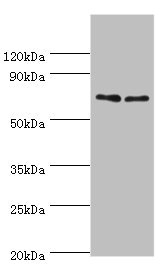
Western blot All lanes: TNFRSF21 antibody at 4ug/ml Lane 1: K562 whole cell lysate Lane 2: Jurkat whole cell lysate Secondary Goat polyclonal to rabbit IgG at 1/10000 dilution Predicted band size: 72 kDa Observed band size: 72 kDa
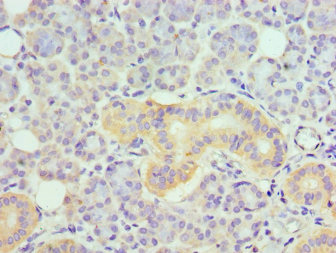
Western blot All lanes: TNFRSF21 antibody at 4ug/ml Lane 1: K562 whole cell lysate Lane 2: Jurkat whole cell lysate Secondary Goat polyclonal to rabbit IgG at 1/10000 dilution Predicted band size: 72 kDa Observed band size: 72 kDa
TNFRSF21 Antibody
CSB-PA023979DSR2HU

ApplicationsWestern Blot, ELISA, ImmunoHistoChemistry
Product group Antibodies
ReactivityHuman
TargetTNFRSF21
Overview
- SupplierCusabio
- Product NameTNFRSF21 Antibody
- Delivery Days Customer20
- ApplicationsWestern Blot, ELISA, ImmunoHistoChemistry
- CertificationResearch Use Only
- ClonalityPolyclonal
- ConjugateUnconjugated
- Gene ID27242
- Target nameTNFRSF21
- Target descriptionTNF receptor superfamily member 21
- Target synonymsBM-018, CD358, DR6, tumor necrosis factor receptor superfamily member 21, TNFR-related death receptor 6, death receptor 6
- HostRabbit
- IsotypeIgG
- Protein IDO75509
- Protein NameTumor necrosis factor receptor superfamily member 21
- Scientific DescriptionPromotes apoptosis, possibly via a pathway that involves the activation of NF-kappa-B. Can also promote apoptosis mediated by BAX and by the release of cytochrome c from the mitochondria into the cytoplasm. Plays a role in neuronal apoptosis, including apoptosis in response to amyloid peptides derived from APP, and is required for both normal cell body death and axonal pruning. Trophic-factor deprivation triggers the cleavage of surface APP by beta-secretase to release sAPP-beta which is further cleaved to release an N-terminal fragment of APP (N-APP). N-APP binds TNFRSF21; this triggers caspase activation and degeneration of both neuronal cell bodies (via caspase-3) and axons (via caspase-6). Negatively regulates oligodendrocyte survival, maturation and myelination. Plays a role in signaling cascades triggered by stimulation of T-cell receptors, in the adaptive immune response and in the regulation of T-cell differentiation and proliferation. Negatively regulates T-cell responses and the release of cytokines such as IL4, IL5, IL10, IL13 and IFNG by Th2 cells. Negatively regulates the production of IgG, IgM and IgM in response to antigens. May inhibit the activation of JNK in response to T-cell stimulation.
- ReactivityHuman
- Storage Instruction-20°C or -80°C
- UNSPSC41116161
Related products
Product group Antibodies

Anti-TNFRSF21 AntibodyA44995
ApplicationsImmunoHistoChemistry
ReactivityHuman
- SizePrice

Product group Antibodies

Anti-DR6/TNFRSF21 Antibody Picoband(r)A04348-2-CARRIER-FREE
ApplicationsFlow Cytometry, Western Blot, ImmunoHistoChemistry
ReactivityHuman, Mouse, Rat
TargetTNFRSF21
- SizePrice
Product group Antibodies

TNFRSF21 / DR6 AntibodyLS-C402242
ApplicationsWestern Blot, ELISA
ReactivityHuman
TargetTNFRSF21
- SizePrice
Product group Antibodies

DR6 antibodyGTX28417
ApplicationsWestern Blot, ELISA
ReactivityHuman
TargetTNFRSF21
- SizePrice
Product group Antibodies

Tnfrsf21 Polyclonal AntibodyCAC10692
ApplicationsWestern Blot, ELISA, ImmunoHistoChemistry
TargetTNFRSF21
- SizePrice
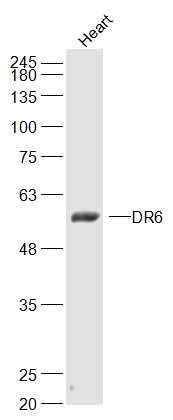
Product group Antibodies
References

DR6 Polyclonal AntibodyBS-7678R
ApplicationsImmunoFluorescence, Western Blot, ELISA, ImmunoCytoChemistry, ImmunoHistoChemistry, ImmunoHistoChemistry Frozen, ImmunoHistoChemistry Paraffin
ReactivityBovine, Canine, Chicken, Equine, Human, Mouse, Rabbit, Rat
TargetTNFRSF21
- SizePrice
Product group Antibodies

Anti-TNFRSF21 (Center) Antibody102-22680
ApplicationsWestern Blot
TargetTNFRSF21
- SizePrice