

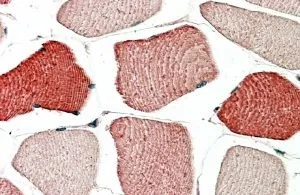
IHC-P analysis of human skeletal muscle using GTX89650 TOM1L2 antibody, C-term. Antigen retrieval : citrate buffer pH 6 Dilution : 5μg/ml
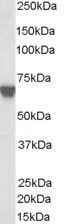
IHC-P analysis of human skeletal muscle using GTX89650 TOM1L2 antibody, C-term. Antigen retrieval : citrate buffer pH 6 Dilution : 5μg/ml
TOM1L2 antibody, C-term
GTX89650

ApplicationsWestern Blot, ImmunoHistoChemistry, ImmunoHistoChemistry Paraffin
Product group Antibodies
ReactivityHuman
TargetTOM1L2
Overview
- SupplierGeneTex
- Product NameTOM1L2 antibody, C-term
- Delivery Days Customer9
- Application Supplier NoteWB: 0.1-1microg/ml. IHC-P: 5-10microg/ml. *Optimal dilutions/concentrations should be determined by the researcher.Not tested in other applications.
- ApplicationsWestern Blot, ImmunoHistoChemistry, ImmunoHistoChemistry Paraffin
- CertificationResearch Use Only
- ClonalityPolyclonal
- Concentration0.50 mg/ml
- ConjugateUnconjugated
- Gene ID146691
- Target nameTOM1L2
- Target descriptiontarget of myb1 like 2 membrane trafficking protein
- Target synonymsTOM1-like protein 2, target of Myb-like protein 2, target of myb1-like 2
- HostGoat
- IsotypeIgG
- Protein IDQ6ZVM7
- Protein NameTOM1-like protein 2
- Scientific DescriptionThis gene belongs to a small gene family whose members have an N-terminal VHS domain followed by a GAT domain; domains which typically participate in vesicular trafficking. The canonical protein encoded by this gene also has a C-terminal clathrin binding motif. This protein has been shown to interact with Tollip, clathrin and ubiquitin and is thought to play a role in endosomal sorting. This gene resides in the 3.7 Mb deletion of chromosome region 17p11.2 that is associated with Smith-Magenis syndrome. Alternative splicing results in multiple transcript variants encoding distinct proteins. [provided by RefSeq, Apr 2017]
- ReactivityHuman
- Storage Instruction-20°C or -80°C,2°C to 8°C
- UNSPSC41116161
Datasheet
Related products
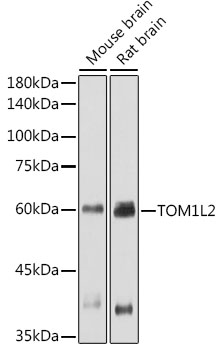
Product group Antibodies

Anti-TOM1L2 AntibodyA308678
ApplicationsWestern Blot
ReactivityHuman, Mouse, Rat
- SizePrice
Product group Antibodies

ApplicationsWestern Blot, ELISA, ImmunoHistoChemistry, ImmunoHistoChemistry Paraffin
ReactivityBovine, Canine, Equine, Hamster, Human, Monkey, Rat
TargetTOM1L2
- SizePrice
Product group Antibodies

Goat anti-TOM1L2EB06556
ApplicationsWestern Blot, ELISA, ImmunoHistoChemistry
ReactivityCanine, Human, Mouse
TargetTOM1L2
- SizePrice

Product group Antibodies

Anti-TOM1L2 AntibodyHPA022541
ApplicationsWestern Blot, ImmunoHistoChemistry
ReactivityHuman, Mouse, Rat
TargetTOM1L2
- SizePrice
![Various whole cell extracts (30 μg) were separated by 7.5% SDS-PAGE, and the membrane was blotted with TOM1L2 antibody [C3], C-term (GTX106295) diluted at 1:1000. The HRP-conjugated anti-rabbit IgG antibody (GTX213110-01) was used to detect the primary antibody.](https://www.genetex.com/upload/website/prouct_img/normal/GTX106295/GTX106295_39721_20230714_WB_23071822_230.webp)
Product group Antibodies
TOM1L2 antibody [C3], C-termGTX106295
ApplicationsWestern Blot
ReactivityHuman
TargetTOM1L2
- SizePrice
Product group Antibodies

Anti-TOM1L2 (C-term) Antibody102-23302
ApplicationsWestern Blot
TargetTOM1L2
- SizePrice