

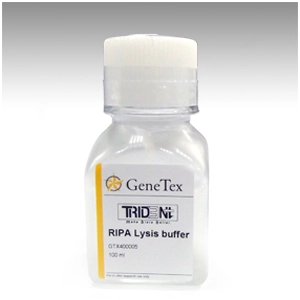
Trident RIPA Lysis Buffer
GTX400005

Product group Chemicals
Overview
- SupplierGeneTex
- Product NameTrident RIPA Lysis Buffer
- Delivery Days Customer9
- Application Supplier NoteThis product contains 1% SDS, which is higher than what is in some other commercial RIPA lysis buffers, and should facilitate a more thorough extraction of nuclear protein. The sample may be viscous following extraction due to unsheared DNA. To decrease this viscosity, we recommend increasing the volume of GTX400005 and trying either sonication or drawing the sample back-and-forth gently (to avoid bubbles) ten times through an 18G blunt needle attached to a 1ml syringe.
- ApplicationsWestern Blot
- CertificationResearch Use Only
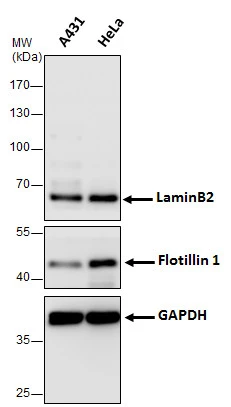
- Scientific DescriptionRIPA lysis buffer is used to efficiently lyse most adherent and non-adherent mammalian cells. The extraction of cytosolic, membrane and nuclear proteins can be achieved by using GTX 400005 RIPA Lysis buffer. As the reagent would not adversely affect the antibodies and protein antigens, it often can be used for immunoprecipitation assay.
- Storage Instruction2°C to 8°C
- UNSPSC12161700
References
- Curcumin suppresses cell proliferation and triggers apoptosis in vemurafenib-resistant melanoma cells by downregulating the EGFR signaling pathway. Chiu YJ et al., 2022 Apr, Environ ToxicolRead this paper
- Novel quinazolinone MJ-33 induces AKT/mTOR-mediated autophagy-associated apoptosis in 5FU-resistant colorectal cancer cells. Ha HA et al., 2021 Feb, Oncol RepRead this paper
- NAD(P)H:quinone oxidoreductase 1 determines radiosensitivity of triple negative breast cancer cells and is controlled by long non-coding RNA NEAT1. Lin LC et al., 2020, Int J Med SciRead this paper
- BMI1-Mediated Pemetrexed Resistance in Non-Small Cell Lung Cancer Cells Is Associated with Increased SP1 Activation and Cancer Stemness. Shen HT et al., 2020 Jul 27, Cancers (Basel)Read this paper
- Reciprocal Regulation Between Indoleamine 2,3-Dioxigenase 1 and Notch1 Involved in Radiation Response of Cervical Cancer Stem Cells. Low HY et al., 2020 Jun 12, Cancers (Basel)Read this paper
- Cepharanthine Hydrochloride Improves Cisplatin Chemotherapy and Enhances Immunity by Regulating Intestinal Microbes in Mice. Zhou P et al., 2019, Front Cell Infect MicrobiolRead this paper
- Novel Combination of Arsenic Trioxide (As2O3) Plus Resveratrol in Inducing Programmed Cell Death of Human Neuroblastoma SK-N-SH Cells. Yen CM et al., 2018 Nov-Dec, Cancer Genomics ProteomicsRead this paper
- Benzyl isothiocyanate (BITC) triggers mitochondria-mediated apoptotic machinery in human cisplatin-resistant oral cancer CAR cells. Lee CF et al., 2018 Sep, Biomedicine (Taipei)Read this paper
- cDNA Microarray Analysis and Influx Transporter OATP1B1 in Liver Cells After Exposure to Gadoxetate Disodium, a Gadolinium-based Contrast Agent in MRI Liver Imaging. Lu CC et al., 2018 May-Jun, In VivoRead this paper