

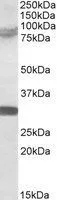
WB analysis of rat brain lysate using GTX89871 TRIM2 antibody, C-term. Dilution : 0.5μg/ml Loading : 35μg protein in RIPA buffer
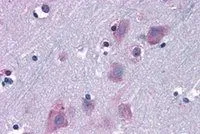
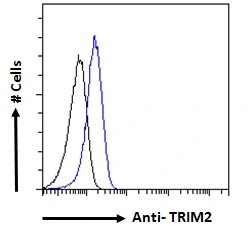
WB analysis of rat brain lysate using GTX89871 TRIM2 antibody, C-term. Dilution : 0.5μg/ml Loading : 35μg protein in RIPA buffer
TRIM2 antibody, C-term
GTX89871

ApplicationsFlow Cytometry, Western Blot, ELISA, ImmunoHistoChemistry, ImmunoHistoChemistry Paraffin
Product group Antibodies
ReactivityHuman, Rat
TargetTRIM2
Overview
- SupplierGeneTex
- Product NameTRIM2 antibody, C-term
- Delivery Days Customer7
- Application Supplier NoteWB: 0.5-2microg/ml. IHC-P: 6-12microg/ml. FCM: 10 microg/ml. ELISA: <1:16000. *Optimal dilutions/concentrations should be determined by the researcher.Not tested in other applications.
- ApplicationsFlow Cytometry, Western Blot, ELISA, ImmunoHistoChemistry, ImmunoHistoChemistry Paraffin
- CertificationResearch Use Only
- ClonalityPolyclonal
- Concentration0.50 mg/ml
- ConjugateUnconjugated
- Gene ID23321
- Target nameTRIM2
- Target descriptiontripartite motif containing 2
- Target synonymsCMT2R, RNF86, tripartite motif-containing protein 2, Charcot-Marie-Tooth disease, type 2R, E3 ubiquitin-protein ligase TRIM2, RING finger protein 86, RING-type E3 ubiquitin transferase TRIM2, tripartite motif protein TRIM2
- HostGoat
- IsotypeIgG
- Protein IDQ9C040
- Protein NameTripartite motif-containing protein 2
- Scientific DescriptionThe protein encoded by this gene is a member of the tripartite motif (TRIM) family. The TRIM motif includes three zinc-binding domains, a RING, a B-box type 1 and a B-box type 2, and a coiled-coil region. The protein localizes to cytoplasmic filaments. It plays a neuroprotective role and functions as an E3-ubiquitin ligase in proteasome-mediated degradation of target proteins. Mutations in this gene can cause early-onset axonal neuropathy. Alternative splicing results in multiple transcript variants. [provided by RefSeq, Nov 2014]
- ReactivityHuman, Rat
- Storage Instruction-20°C or -80°C,2°C to 8°C
- UNSPSC41116161
Datasheet
Related products
Product group Antibodies

TRIM2 AntibodyCSB-PA024456GA01HU
ApplicationsImmunoFluorescence, Western Blot, ELISA
ReactivityHuman, Mouse, Rat
TargetTRIM2
- SizePrice

Product group Antibodies

Anti-TRIM2 Antibody Picoband(r)A08957-CARRIER-FREE
ApplicationsWestern Blot, ELISA, ImmunoHistoChemistry
ReactivityHuman, Mouse, Rat
TargetTRIM2
- SizePrice
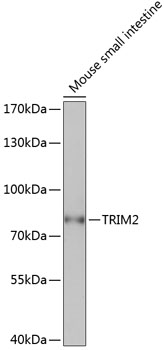
Product group Antibodies

Anti-TRIM2 AntibodyA91301
ApplicationsWestern Blot, ImmunoHistoChemistry
ReactivityMouse, Rat
- SizePrice
Product group Antibodies

KIAA0517 / TRIM2 AntibodyLS-C749397
ApplicationsWestern Blot
ReactivityHuman
TargetTRIM2
- SizePrice
Product group Antibodies

Goat anti-TRIM2EB05914
ApplicationsFlow Cytometry, Western Blot, ELISA, ImmunoHistoChemistry
ReactivityBovine, Canine, Human, Mouse, Rat
TargetTRIM2
- SizePrice

Product group Antibodies

Anti-TRIM2 AntibodyHPA035854
ApplicationsImmunoCytoChemistry, ImmunoHistoChemistry
ReactivityHuman
TargetTRIM2
- SizePrice

Product group Antibodies

Anti-TRIM2 (C-term) Antibody102-22073
ApplicationsWestern Blot
TargetTRIM2
- SizePrice