

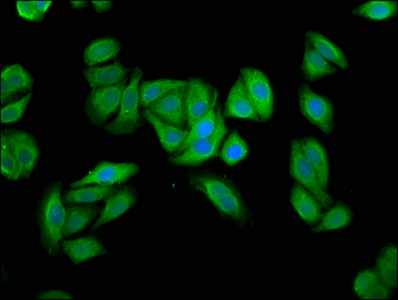
Immunofluorescence staining of HepG2 cells with CSB-PA23029A0Rb at 1:66, counter-stained with DAPI. The cells were fixed in 4% formaldehyde, permeabilized using 0.2% Triton X-100 and blocked in 10% normal Goat Serum. The cells were then incubated with the antibody overnight at 4°C. The secondary antibody was Alexa Fluor 488-congugated AffiniPure Goat Anti-Rabbit IgG(H+L).
Immunofluorescence staining of HepG2 cells with CSB-PA23029A0Rb at 1:66, counter-stained with DAPI. The cells were fixed in 4% formaldehyde, permeabilized using 0.2% Triton X-100 and blocked in 10% normal Goat Serum. The cells were then incubated with the antibody overnight at 4°C. The secondary antibody was Alexa Fluor 488-congugated AffiniPure Goat Anti-Rabbit IgG(H+L).
UBIAD1 Antibody
CSB-PA23029A0RB

ApplicationsImmunoFluorescence, ELISA
Product group Antibodies
ReactivityHuman
TargetUBIAD1
Overview
- SupplierCusabio
- Product NameUBIAD1 Antibody
- Delivery Days Customer20
- ApplicationsImmunoFluorescence, ELISA
- CertificationResearch Use Only
- ClonalityPolyclonal
- ConjugateUnconjugated
- Gene ID29914
- Target nameUBIAD1
- Target descriptionUbiA prenyltransferase domain containing 1
- Target synonymsSCCD, TERE1, ubiA prenyltransferase domain-containing protein 1, transitional epithelia response protein, transitional epithelial response protein 1
- HostRabbit
- IsotypeIgG
- Protein IDQ9Y5Z9
- Protein NameUbiA prenyltransferase domain-containing protein 1
- Scientific DescriptionPrenyltransferase that mediates the formation of menaquinone-4 (MK-4) and coenzyme Q10. MK-4 is a vitamin K2 isoform present at high concentrations in the brain, kidney and pancreas, and is required for endothelial cell development. Mediates the conversion of phylloquinone (PK) into MK-4, probably by cleaving the side chain of phylloquinone (PK) to release 2-methyl-1,4-naphthoquinone (menadione; K3) and then prenylating it with geranylgeranyl pyrophosphate (GGPP) to form MK-4. Also plays a role in cardiovascular development independently of MK-4 biosynthesis, by acting as a coenzyme Q10 biosyntetic enzyme: coenzyme Q10, also named ubiquinone, plays a important antioxidant role in the cardiovascular system. Mediates biosynthesis of coenzyme Q10 in the Golgi membrane, leading to protect cardiovascular tissues from NOS3/eNOS-dependent oxidative stress.
- ReactivityHuman
- Storage Instruction-20°C or -80°C
- UNSPSC41116161
Related products
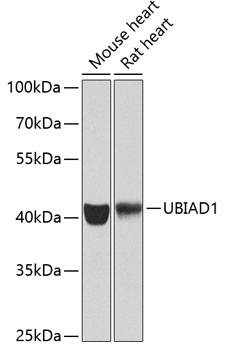
Product group Antibodies

Anti-UBIAD1 AntibodyA15820
ApplicationsWestern Blot, ImmunoHistoChemistry
ReactivityHuman, Mouse, Rat
- SizePrice

Product group Antibodies

Anti-UBIAD1 AntibodyA04437
ApplicationsImmunoFluorescence, Western Blot, ELISA, ImmunoHistoChemistry, ImmunoHistoChemistry Paraffin
ReactivityChicken, Human, Mouse, Rat
TargetUBIAD1
- SizePrice
Product group Antibodies

Anti-UBIAD1 Antibody144-07640
ApplicationsImmunoFluorescence, Western Blot, ImmunoHistoChemistry
ReactivityHuman, Mouse, Rat
TargetUBIAD1
- SizePrice
Product group Antibodies

TERE1 / UBIAD1 AntibodyLS-C829996
ApplicationsELISA, ImmunoHistoChemistry
ReactivityHuman, Mouse, Rat
TargetUBIAD1
- SizePrice
Product group Antibodies

Anti-TERE1 AntibodyBS-70923R
ApplicationsWestern Blot
ReactivityHuman
TargetUBIAD1
- SizePrice

Product group Antibodies

Anti-UBIAD1 AntibodyHPA044862
ApplicationsWestern Blot, ImmunoCytoChemistry
ReactivityHuman
TargetUBIAD1
- SizePrice
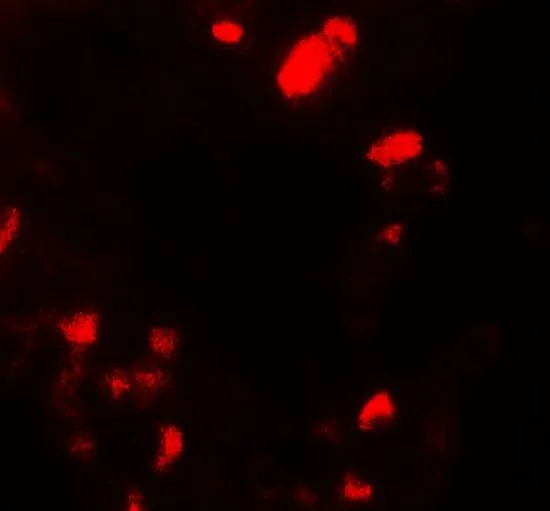
Product group Antibodies

UBIAD1 antibodyGTX32134
ApplicationsWestern Blot, ELISA, ImmunoHistoChemistry, ImmunoHistoChemistry Paraffin
ReactivityHuman, Mouse, Rat
TargetUBIAD1
- SizePrice
Product group Antibodies

Anti-UBIAD1 AntibodyCAB7640
ApplicationsWestern Blot, ELISA, ImmunoHistoChemistry, ImmunoHistoChemistry Paraffin
ReactivityHuman
TargetUBIAD1
- SizePrice