

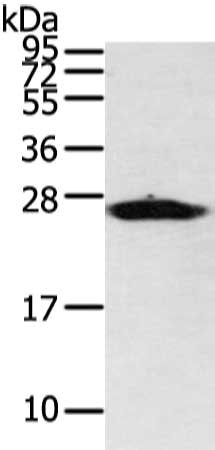
Gel: 12%SDS-PAGE, Lysate: 40 ug, Lane: Mouse heart tissue, Primary antibody: CSB-PA162897(VDAC3 Antibody) at dilution 1/400 dilution, Secondary antibody: Goat anti rabbit IgG at 1/8000 dilution, Exposure time: 3 minutes
Gel: 12%SDS-PAGE, Lysate: 40 ug, Lane: Mouse heart tissue, Primary antibody: CSB-PA162897(VDAC3 Antibody) at dilution 1/400 dilution, Secondary antibody: Goat anti rabbit IgG at 1/8000 dilution, Exposure time: 3 minutes
VDAC3 Antibody
CSB-PA162897

ApplicationsWestern Blot, ELISA
Product group Antibodies
ReactivityHuman, Mouse, Rat
TargetVDAC3
Overview
- SupplierCusabio
- Product NameVDAC3 Antibody
- Delivery Days Customer20
- ApplicationsWestern Blot, ELISA
- CertificationResearch Use Only
- ClonalityPolyclonal
- ConjugateUnconjugated
- Gene ID7419
- Target nameVDAC3
- Target descriptionvoltage dependent anion channel 3
- Target synonymsHD-VDAC3, VDAC-3, non-selective voltage-gated ion channel VDAC3, outer mitochondrial membrane protein porin 3, voltage-dependent anion-selective channel protein 3
- HostRabbit
- IsotypeIgG
- Protein IDQ9Y277
- Protein NameNon-selective voltage-gated ion channel VDAC3
- Scientific DescriptionThis gene encodes a voltage-dependent anion channel (VDAC), and belongs to the mitochondrial porin family. VDACs are small, integral membrane proteins that traverse the outer mitochondrial membrane and conduct ATP and other small metabolites. They are known to bind several kinases of intermediary metabolism, thought to be involved in translocation of adenine nucleotides, and are hypothesized to form part of the mitochondrial permeability transition pore, which results in the release of cytochrome c at the onset of apoptotic cell death. Alternatively transcript variants encoding different isoforms have been described for this gene. [provided by
- ReactivityHuman, Mouse, Rat
- Storage Instruction-20°C or -80°C
- UNSPSC41116161
Related products
Product group Antibodies

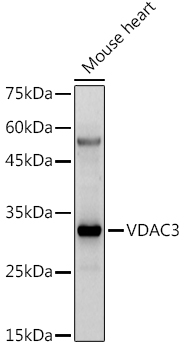
Anti-VDAC3 AntibodyA8647
ApplicationsImmunoFluorescence, Western Blot, ImmunoCytoChemistry, ImmunoHistoChemistry
ReactivityHuman, Mouse, Rat
- SizePrice

Product group Antibodies

Anti-VDAC3 Antibody Picoband(r)A04802-2-CARRIER-FREE
ApplicationsFlow Cytometry, Western Blot, ELISA, ImmunoHistoChemistry
ReactivityHuman, Mouse, Rat
TargetVDAC3
- SizePrice
Product group Antibodies

Anti-VDAC3 Antibody144-61932
ApplicationsImmunoFluorescence, Western Blot
ReactivityHuman
TargetVDAC3
- SizePrice
Product group Antibodies

VDAC3 AntibodyLS-C771719
ApplicationsWestern Blot, ELISA
ReactivityHuman, Mouse, Rat
TargetVDAC3
- SizePrice
Product group Antibodies
References

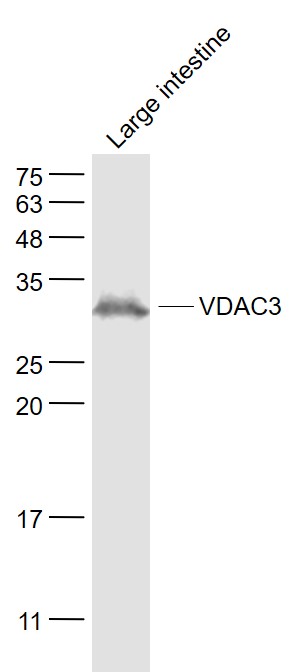
VDAC3 Polyclonal AntibodyBS-7647R
ApplicationsImmunoFluorescence, Western Blot, ELISA, ImmunoCytoChemistry, ImmunoHistoChemistry, ImmunoHistoChemistry Frozen, ImmunoHistoChemistry Paraffin
ReactivityBovine, Canine, Equine, Human, Mouse, Porcine, Rabbit, Rat, Sheep
TargetVDAC3
- SizePrice
Product group Antibodies

VDAC3 Polyclonal AntibodyCAC12967
ApplicationsImmunoFluorescence, Western Blot, ELISA
TargetVDAC3
- SizePrice
Product group Antibodies

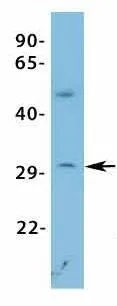
VDAC3 antibody, N-termGTX47681
ApplicationsWestern Blot, ImmunoHistoChemistry, ImmunoHistoChemistry Paraffin
ReactivityHuman
TargetVDAC3
- SizePrice