

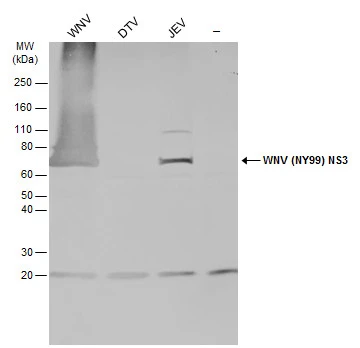
Non-infected (–) and infected Vero whole cell extracts were separated by SDS-PAGE, and the membrane was blotted with West Nile virus NS3 protein antibody (GTX131955).
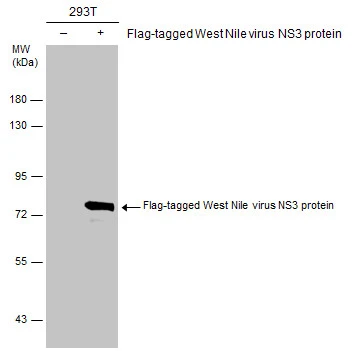
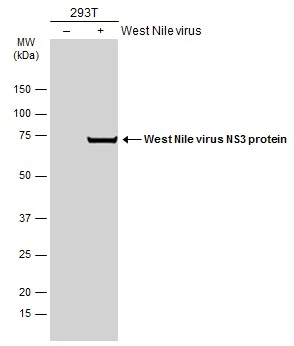
Non-infected (–) and infected Vero whole cell extracts were separated by SDS-PAGE, and the membrane was blotted with West Nile virus NS3 protein antibody (GTX131955).
West Nile virus NS3 protein antibody
GTX131955

ApplicationsImmunoFluorescence, Western Blot, ImmunoCytoChemistry
Product group Antibodies
ReactivityVirus
Overview
- SupplierGeneTex
- Product NameWest Nile virus NS3 protein antibody
- Delivery Days Customer9
- Application Supplier NoteWB: 1:500-1:3000. *Optimal dilutions/concentrations should be determined by the researcher.Not tested in other applications.
- ApplicationsImmunoFluorescence, Western Blot, ImmunoCytoChemistry
- CertificationResearch Use Only
- ClonalityPolyclonal
- Concentration0.94 mg/ml
- ConjugateUnconjugated
- HostRabbit
- IsotypeIgG
- ReactivityVirus
- Storage Instruction-20°C or -80°C,2°C to 8°C
- UNSPSC12352203
References
- Roy P, Walter Z, Berish L, et al. Motif-VI Loop Acts as a Nucleotide Valve in the West Nile Virus NS3 Helicase. bioRxiv. 2023,:pii: 2023.11.30.569434. doi: 10.1101/2023.11.30.569434.Read this paper
- Tseng AC, Nerurkar VR, Neupane KR, et al. Potential Dual Role of West Nile Virus NS2B in Orchestrating NS3 Enzymatic Activity in Viral Replication. Viruses. 2021,13(2). doi: 10.3390/v13020216Read this paper
- Boys IN, Xu E, Mar KB, et al. RTP4 Is a Potent IFN-Inducible Anti-flavivirus Effector Engaged in a Host-Virus Arms Race in Bats and Other Mammals. Cell Host Microbe. 2020,28(5):712-723.e9. doi: 10.1016/j.chom.2020.09.014Read this paper