

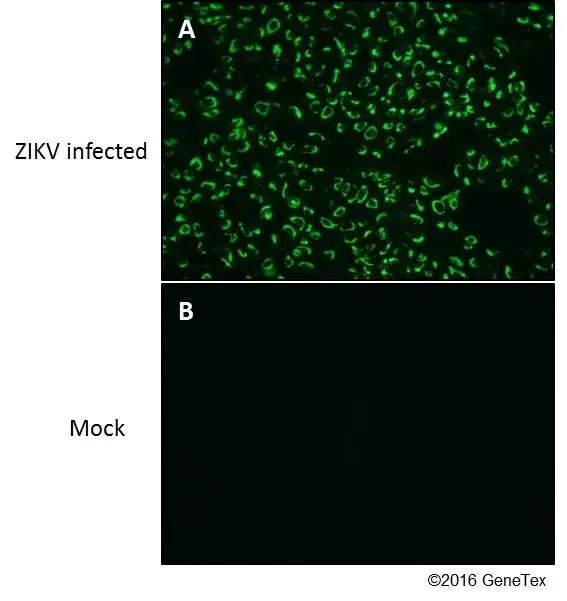
Immunofluorescent analysis of Zika Virus-PRVABC59 infected (A) and non-infected (B) vero cells using Zika virus Envelope protein antibody (GTX133314). Green: Zika virus Envelope protein antibody (GTX133314) diluted at 1:4000.
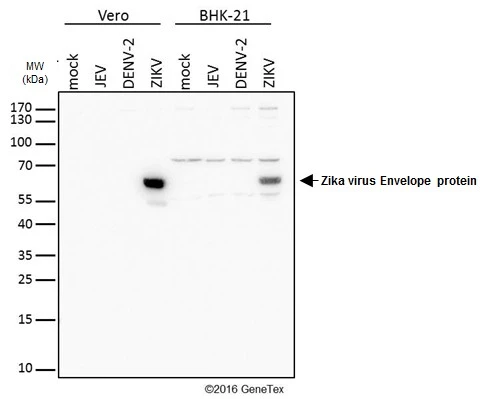
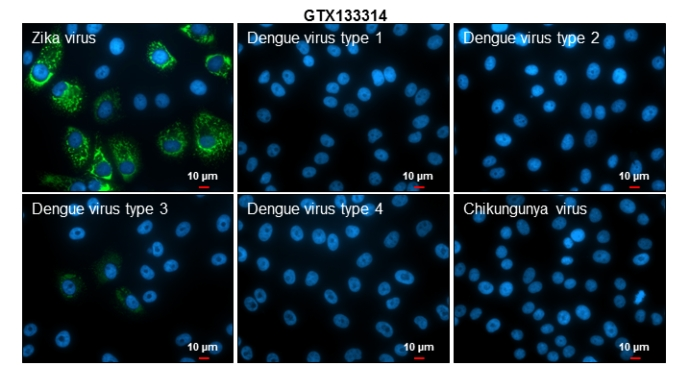
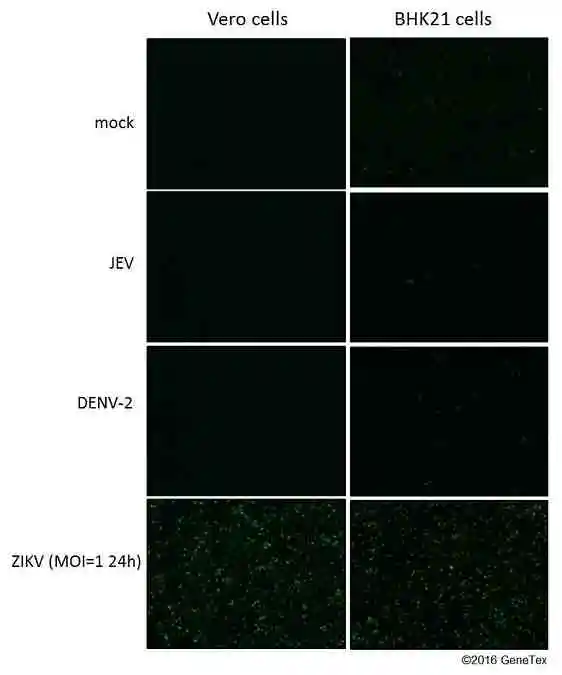
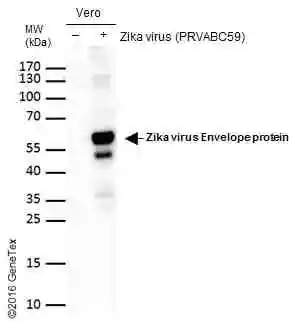
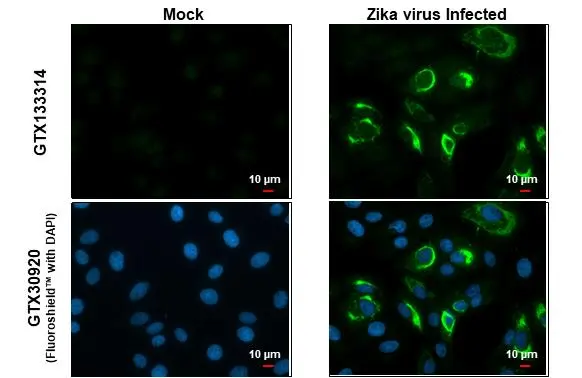
Immunofluorescent analysis of Zika Virus-PRVABC59 infected (A) and non-infected (B) vero cells using Zika virus Envelope protein antibody (GTX133314). Green: Zika virus Envelope protein antibody (GTX133314) diluted at 1:4000.
Zika virus Envelope protein antibody
GTX133314

ApplicationsImmunoFluorescence, Western Blot, ImmunoCytoChemistry, ImmunoHistoChemistry, ImmunoHistoChemistry Paraffin
Product group Antibodies
ReactivityVirus
Overview
- SupplierGeneTex
- Product NameZika virus Envelope protein antibody
- Delivery Days Customer9
- Application Supplier NoteWB: 1:500-1:3000. ICC/IF: 1:100-1:1000. *Optimal dilutions/concentrations should be determined by the researcher.Not tested in other applications.
- ApplicationsImmunoFluorescence, Western Blot, ImmunoCytoChemistry, ImmunoHistoChemistry, ImmunoHistoChemistry Paraffin
- CertificationResearch Use Only
- ClonalityPolyclonal
- Concentration1.43 mg/ml
- ConjugateUnconjugated
- HostRabbit
- IsotypeIgG
- ReactivityVirus
- Storage Instruction-20°C or -80°C,2°C to 8°C
- UNSPSC12352203
References
- Zhang B, Yu J, Zhu G, et al. Dapoxetine, a Selective Serotonin Reuptake Inhibitor, Suppresses Zika Virus Infection In Vitro. Molecules. 2023,28(24). doi: 10.3390/molecules28248142Read this paper
- Jaratsittisin J, Sornjai W, Chailangkarn T, et al. The vitamin D receptor agonist EB1089 can exert its antiviral activity independently of the vitamin D receptor. PLoS One. 2023,18(10):e0293010. doi: 10.1371/journal.pone.0293010Read this paper
- Tabata K, Itakura Y, Ariizumi T, et al. Development of flavivirus subviral particles with low cross-reactivity by mutations of a distinct antigenic domain. Appl Microbiol Biotechnol. 2023,107(24):7515-7529. doi: 10.1007/s00253-023-12817-5Read this paper
- Li H, Wang X, Wang Y, et al. Secreted LRPAP1 binds and triggers IFNAR1 degradation to facilitate virus evasion from cellular innate immunity. Signal Transduct Target Ther. 2023,8(1):374. doi: 10.1038/s41392-023-01630-1Read this paper
- Wu H, Huang XY, Sun MX, et al. Zika virus targets human trophoblast stem cells and prevents syncytialization in placental trophoblast organoids. Nat Commun. 2023,14(1):5541. doi: 10.1038/s41467-023-41158-0Read this paper
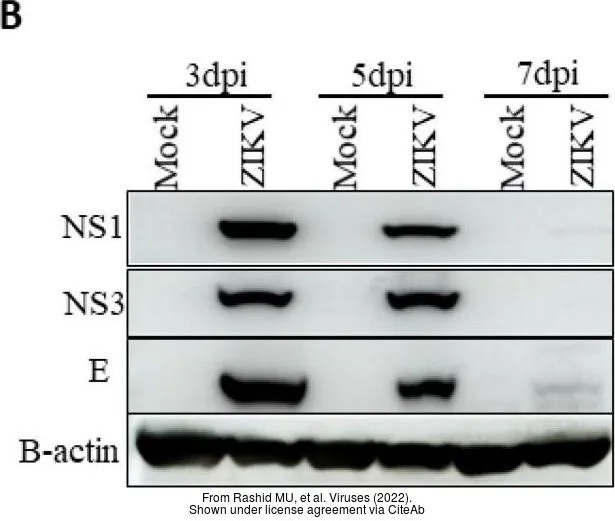
- Kaur G, Pant P, Bhagat R, et al. Zika virus E protein modulates functions of human brain microvascular endothelial cells and astrocytes: implications on blood-brain barrier properties. Front Cell Neurosci. 2023,17:1173120. doi: 10.3389/fncel.2023.1173120Read this paper
- Narayan R, Sharma M, Yadav R, et al. Picolinic acid is a broad-spectrum inhibitor of enveloped virus entry that restricts SARS-CoV-2 and influenza A virus in vivo. Cell Rep Med. 2023,4(8):101127. doi: 10.1016/j.xcrm.2023.101127Read this paper
- Zhu Y, Liang M, Yu J, et al. Repurposing of Doramectin as a New Anti-Zika Virus Agent. Viruses. 2023,15(5). doi: 10.3390/v15051068Read this paper
- Lin DC, Weng SC, Tsao PN, et al. Co-infection of dengue and Zika viruses mutually enhances viral replication in the mosquito Aedes aegypti. Parasit Vectors. 2023,16(1):160. doi: 10.1186/s13071-023-05778-1Read this paper
- Pan P, Ge W, Lei Z, et al. SARS-CoV-2 N protein enhances the anti-apoptotic activity of MCL-1 to promote viral replication. Signal Transduct Target Ther. 2023,8(1):194. doi: 10.1038/s41392-023-01459-8Read this paper