

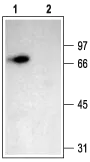
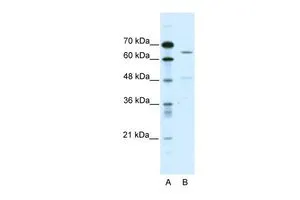
WB analysis of rat brain membrane lysate using GTX54802 ACCN1 antibody preincubated with or without immunogen peptide. Dilution : 1:200
WB analysis of rat brain membrane lysate using GTX54802 ACCN1 antibody preincubated with or without immunogen peptide. Dilution : 1:200
ACCN1 antibody
GTX54802

ApplicationsImmunoFluorescence, ImmunoPrecipitation, Western Blot, ImmunoCytoChemistry, ImmunoHistoChemistry
Product group Antibodies
ReactivityHuman, Mouse, Rat
TargetASIC2
Overview
- SupplierGeneTex
- Product NameACCN1 antibody
- Delivery Days Customer7
- ApplicationsImmunoFluorescence, ImmunoPrecipitation, Western Blot, ImmunoCytoChemistry, ImmunoHistoChemistry
- CertificationResearch Use Only
- ClonalityPolyclonal
- Concentration0.3 mg/ml
- ConjugateUnconjugated
- Gene ID40
- Target nameASIC2
- Target descriptionacid sensing ion channel subunit 2
- Target synonymsACCN, ACCN1, ASIC2a, BNC1, BNaC1, MDEG, hBNaC1, acid-sensing ion channel 2, acid sensing (proton gated) ion channel 2, amiloride-sensitive cation channel 1, neuronal, brain Na+ channel-1, brain sodium channel 1, mammalian degenerin homolog, neuronal amiloride-sensitive cation channel 1
- HostRabbit
- IsotypeIgG
- Protein IDQ16515
- Protein NameAcid-sensing ion channel 2
- Scientific DescriptionThis gene encodes a member of the degenerin/epithelial sodium channel (DEG/ENaC) superfamily. The members of this family are amiloride-sensitive sodium channels that contain intracellular N and C termini, 2 hydrophobic transmembrane regions, and a large extracellular loop, which has many cysteine residues with conserved spacing. The member encoded by this gene may play a role in neurotransmission. In addition, a heteromeric association between this member and acid-sensing (proton-gated) ion channel 3 has been observed to co-assemble into proton-gated channels sensitive to gadolinium. Alternative splicing has been observed at this locus and two variants, encoding distinct isoforms, have been identified. [provided by RefSeq, Feb 2012]
- ReactivityHuman, Mouse, Rat
- Storage Instruction-20°C or -80°C,2°C to 8°C
- UNSPSC41116161
Datasheet
Related products
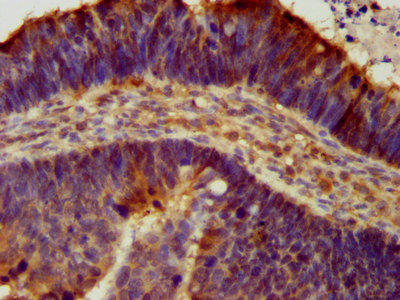
Product group Antibodies

ASIC2 AntibodyCSB-PA613683LA01HU
ApplicationsImmunoFluorescence, ELISA, ImmunoHistoChemistry
ReactivityHuman
TargetASIC2
- SizePrice
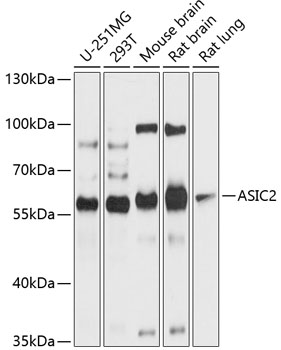
Product group Antibodies

Anti-ASIC2 AntibodyA12964
ApplicationsWestern Blot
ReactivityHuman, Mouse, Rat
- SizePrice

Product group Antibodies

Anti-ASIC2 AntibodyHPA052112
ApplicationsWestern Blot, ImmunoHistoChemistry
ReactivityHuman
TargetASIC2
- SizePrice

Product group Antibodies

Anti-ACCN1/ASIC2 Antibody Picoband(r)A04055-1-CARRIER-FREE
ApplicationsFlow Cytometry, ImmunoFluorescence, Western Blot, ELISA, ImmunoCytoChemistry
ReactivityHuman, Mouse, Rat
TargetASIC2
- SizePrice
Product group Antibodies

ACCN1 / ASIC2 AntibodyLS-C497204
ApplicationsWestern Blot
ReactivityHuman, Mouse, Rat
TargetASIC2
- SizePrice
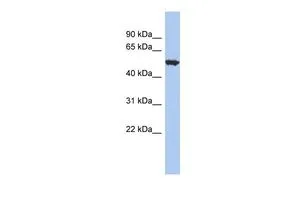
Product group Antibodies
ACCN1 antibody, InternalGTX47614
ApplicationsWestern Blot
ReactivityHuman
TargetASIC2
- SizePrice
Product group Antibodies
ACCN1 antibody, C-termGTX47700
ApplicationsWestern Blot
ReactivityHuman
TargetASIC2
- SizePrice
Product group Antibodies

Anti-ACCN1 (Center) Antibody102-27681
ApplicationsFlow Cytometry, Western Blot, ImmunoHistoChemistry, ImmunoHistoChemistry Paraffin
TargetASIC2
- SizePrice