

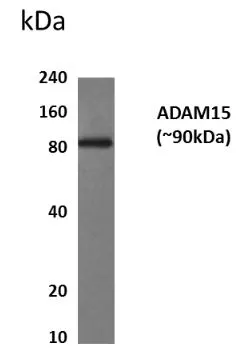
WB analysis of HEK293 cells overexpressing human ADAM15 using GTX52529 ADAM15 antibody [9H34].
WB analysis of HEK293 cells overexpressing human ADAM15 using GTX52529 ADAM15 antibody [9H34].
ADAM15 antibody [9H34]
GTX52529

ApplicationsWestern Blot
Product group Antibodies
ReactivityHuman
TargetADAM15
Overview
- SupplierGeneTex
- Product NameADAM15 antibody [9H34]
- Delivery Days Customer9
- Application Supplier NoteWB: 1:500 - 1:1000. *Optimal dilutions/concentrations should be determined by the researcher.Not tested in other applications.
- ApplicationsWestern Blot
- CertificationResearch Use Only
- ClonalityMonoclonal
- Clone ID9H34
- Concentration500 ug/ml
- ConjugateUnconjugated
- Gene ID8751
- Target nameADAM15
- Target descriptionADAM metallopeptidase domain 15
- Target synonymsMDC15, disintegrin and metalloproteinase domain-containing protein 15, MDC-15, a disintegrin and metalloproteinase domain 15 (metargidin), metalloprotease RGD disintegrin protein, metalloproteinase-like, disintegrin-like, and cysteine-rich protein 15
- HostMouse
- IsotypeIgG1
- Protein IDQ13444
- Protein NameDisintegrin and metalloproteinase domain-containing protein 15
- Scientific DescriptionThe protein encoded by this gene is a member of the ADAM (a disintegrin and metalloproteinase) protein family. ADAM family members are type I transmembrane glycoproteins known to be involved in cell adhesion and proteolytic ectodomain processing of cytokines and adhesion molecules. This protein contains multiple functional domains including a zinc-binding metalloprotease domain, a disintegrin-like domain, as well as a EGF-like domain. Through its disintegrin-like domain, this protein specifically interacts with the integrin beta chain, beta 3. It also interacts with Src family protein-tyrosine kinases in a phosphorylation-dependent manner, suggesting that this protein may function in cell-cell adhesion as well as in cellular signaling. Multiple alternatively spliced transcript variants encoding distinct isoforms have been observed. [provided by RefSeq, Jul 2008]
- ReactivityHuman
- Storage Instruction-20°C or -80°C,2°C to 8°C
- UNSPSC12352203
Datasheet
Related products
Product group Antibodies

Anti-ADAM15 Antibody144-07756
ApplicationsWestern Blot
ReactivityHuman, Mouse, Rat
TargetADAM15
- SizePrice

Product group Antibodies

Anti-ADAM15 Antibody Picoband(r)A02593-4-CARRIER-FREE
ApplicationsFlow Cytometry, Western Blot, ELISA
ReactivityHuman
TargetADAM15
- SizePrice
Product group Antibodies
References
ADAM15 antibody [N1N2], N-termGTX101599
ApplicationsWestern Blot, ImmunoHistoChemistry, ImmunoHistoChemistry Paraffin
ReactivityHuman, Mouse, Rat
TargetADAM15
- SizePrice

Product group Antibodies

ApplicationsImmunoPrecipitation, Western Blot, ImmunoCytoChemistry, ImmunoHistoChemistry
TargetADAM15
- SizePrice
Product group Antibodies

ADAM15 Polyclonal AntibodyBS-5848R
ApplicationsImmunoFluorescence, Western Blot, ELISA, ImmunoCytoChemistry, ImmunoHistoChemistry, ImmunoHistoChemistry Frozen, ImmunoHistoChemistry Paraffin
ReactivityHuman
TargetADAM15
- SizePrice
Product group Antibodies

ADAM15 AntibodyCSB-PA01915A0RB
ApplicationsELISA, ImmunoHistoChemistry
ReactivityHuman
TargetADAM15
- SizePrice

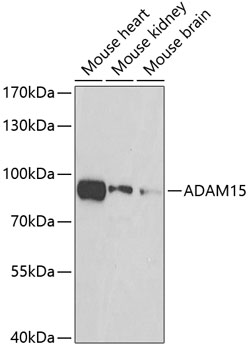
Product group Antibodies

Anti-ADAM15 AntibodyA15874
ApplicationsImmunoFluorescence, Western Blot, ImmunoCytoChemistry
ReactivityHuman, Mouse, Rat
- SizePrice
Product group Antibodies

ApplicationsFlow Cytometry, ELISA
ReactivityHuman
TargetADAM15
- SizePrice