

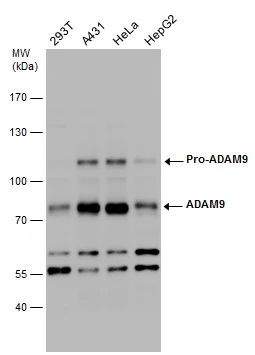
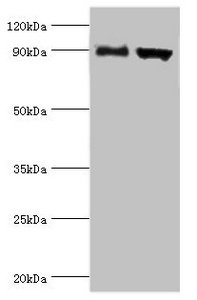
Various whole cell extracts (30 μg) were separated by 7.5% SDS-PAGE, and the membrane was blotted with ADAM9 antibody (GTX130081) diluted at 1:1000.
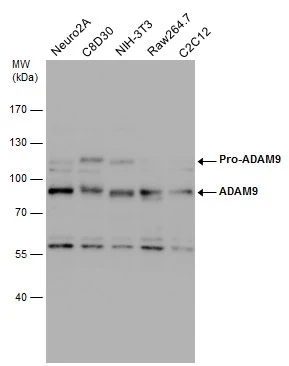
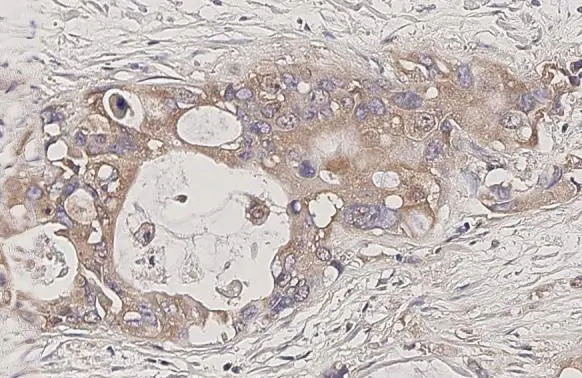
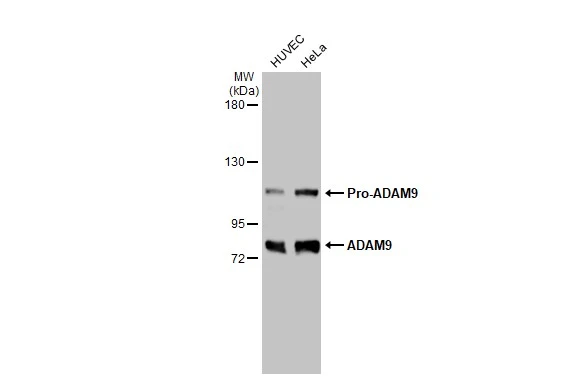
Various whole cell extracts (30 μg) were separated by 7.5% SDS-PAGE, and the membrane was blotted with ADAM9 antibody (GTX130081) diluted at 1:1000.
ADAM9 antibody
GTX130081

ApplicationsWestern Blot, ImmunoHistoChemistry, ImmunoHistoChemistry Paraffin
Product group Antibodies
ReactivityHuman, Mouse
TargetADAM9
Overview
- SupplierGeneTex
- Product NameADAM9 antibody
- Delivery Days Customer9
- Application Supplier NoteWB: 1:500-1:3000. *Optimal dilutions/concentrations should be determined by the researcher.Not tested in other applications.
- ApplicationsWestern Blot, ImmunoHistoChemistry, ImmunoHistoChemistry Paraffin
- CertificationResearch Use Only
- ClonalityPolyclonal
- Concentration0.79 mg/ml
- ConjugateUnconjugated
- Gene ID8754
- Target nameADAM9
- Target descriptionADAM metallopeptidase domain 9
- Target synonymsCORD9, MCMP, MDC9, Mltng, disintegrin and metalloproteinase domain-containing protein 9, ADAM metallopeptidase domain 9 (meltrin gamma), cellular disintegrin-related protein, cone rod dystrophy 9, metalloprotease/disintegrin/cysteine-rich protein 9, myeloma cell metalloproteinase
- HostRabbit
- IsotypeIgG
- Protein IDQ13443
- Protein NameDisintegrin and metalloproteinase domain-containing protein 9
- Scientific DescriptionThis gene encodes a member of the ADAM (a disintegrin and metalloprotease domain) family. Members of this family are membrane-anchored proteins structurally related to snake venom disintegrins, and have been implicated in a variety of biological processes involving cell-cell and cell-matrix interactions, including fertilization, muscle development, and neurogenesis. The protein encoded by this gene interacts with SH3 domain-containing proteins, binds mitotic arrest deficient 2 beta protein, and is also involved in TPA-induced ectodomain shedding of membrane-anchored heparin-binding EGF-like growth factor. Two alternative splice variants have been identified, encoding distinct isoforms. [provided by RefSeq]
- ReactivityHuman, Mouse
- Storage Instruction-20°C or -80°C,2°C to 8°C
- UNSPSC41116161
Datasheet
Related products

Product group Antibodies

ADAM9 Polyclonal AntibodyCAC13346
ApplicationsWestern Blot, ELISA, ImmunoHistoChemistry
ReactivityMouse
TargetADAM9
- SizePrice
Product group Antibodies

ADAM9 AntibodyCSB-PA618774ESR1HU
ApplicationsWestern Blot, ELISA, ImmunoHistoChemistry
ReactivityHuman, Mouse
TargetADAM9
- SizePrice
Product group Antibodies

Anti-ADAM9 Antibody144-05388
ApplicationsImmunoFluorescence, Western Blot
ReactivityHuman, Mouse, Rat
TargetADAM9
- SizePrice

Product group Antibodies

Anti-ADAM9 Antibody Picoband(r)A03074-1-CARRIER-FREE
ApplicationsImmunoFluorescence, Western Blot, ELISA, ImmunoCytoChemistry, ImmunoHistoChemistry
ReactivityHuman
TargetADAM9
- SizePrice
Product group Antibodies

Anti-ADAM9 AntibodyA35279
ApplicationsImmunoFluorescence, Western Blot, ImmunoHistoChemistry
ReactivityHuman, Mouse, Rat
- SizePrice

Product group Antibodies

ADAM9 AntibodyLS-C334028
ApplicationsImmunoFluorescence, Western Blot, ImmunoHistoChemistry
ReactivityHuman, Mouse, Rat
TargetADAM9
- SizePrice
Product group Antibodies
References
ADAM9 antibodyGTX30025
ApplicationsImmunoFluorescence, Western Blot, ImmunoCytoChemistry
ReactivityHuman, Mouse, Rat
TargetADAM9
- SizePrice
Product group Antibodies
ADAM9 antibody, C-termGTX81448
ApplicationsFlow Cytometry, Western Blot, ImmunoHistoChemistry, ImmunoHistoChemistry Paraffin
ReactivityHuman
TargetADAM9
- SizePrice