

Anti-AKR7A2 Antibody
R1408-3

ApplicationsImmunoFluorescence, Western Blot
Product group Antibodies
ReactivityHuman, Mouse, Rat
TargetAKR7A2
Overview
- SupplierHUABIO
- Product NameAnti-AKR7A2 Antibody
- Delivery Days Customer7
- ApplicationsImmunoFluorescence, Western Blot
- Applications SupplierWB,IF-Cell
- CertificationResearch Use Only
- ClonalityPolyclonal
- Concentration1 mg/ml
- ConjugateUnconjugated
- Gene ID8574
- Target nameAKR7A2
- Target descriptionaldo-keto reductase family 7 member A2
- Target synonymsAFAR, AFAR1, AFB1-AR1, AKR7, aflatoxin B1 aldehyde reductase member 2, AFB1 aldehyde reductase 1, AFB1-AR 1, HEL-S-166mP, SSA reductase, aflatoxin aldehyde reductase, aflatoxin beta1 aldehyde reductase, aldoketoreductase 7, epididymis secretory sperm binding protein Li 166mP, succinic semialdehyde reductase
- HostRabbit
- IsotypeIgG
- Protein IDO43488
- Protein NameAflatoxin B1 aldehyde reductase member 2
- Scientific DescriptionCatalyzes the NADPH-dependent reduction of succinic semialdehyde to gamma-hydroxybutyrate. May have an important role in producing the neuromodulator gamma-hydroxybutyrate (GHB). Has broad substrate specificity. Has NADPH-dependent aldehyde reductase activity towards 2-carboxybenzaldehyde, 2-nitrobenzaldehyde and pyridine-2-aldehyde (in vitro). Can reduce 1,2-naphthoquinone and 9,10-phenanthrenequinone (in vitro). Can reduce the dialdehyde protein-binding form of aflatoxin B1 (AFB1) to the non-binding AFB1 dialcohol. May be involved in protection of liver against the toxic and carcinogenic effects of AFB1, a potent hepatocarcinogen. The protein encoded by this gene belongs to the aldo/keto reductase (AKR) superfamily and AKR7 family, which are involved in the detoxification of aldehydes and ketones. The AKR7 family consists of 3 genes that are present in a cluster on the p arm of chromosome 1. This protein, thought to be localized in the golgi, catalyzes the NADPH-dependent reduction of succinic semialdehyde to the endogenous neuromodulator, gamma-hydroxybutyrate. It may also function as a detoxication enzyme in the reduction of aflatoxin B1 and 2-carboxybenzaldehyde. Alternative splicing results in multiple transcript variants.
- ReactivityHuman, Mouse, Rat
- Reactivity SupplierHuman,Mouse,Rat
- Storage Instruction-20°C,2°C to 8°C
- UNSPSC41116161
Datasheet
Related products

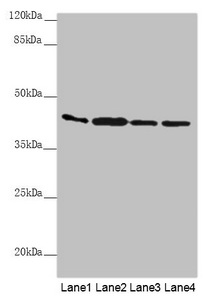
Product group Antibodies

AKR7A2 AntibodyCSB-PA001550ESR1HU
ApplicationsWestern Blot, ELISA, ImmunoHistoChemistry
ReactivityHuman, Mouse
TargetAKR7A2
- SizePrice

Product group Antibodies

Anti-AKR7A2 Picoband(r) AntibodyA06949-1-CARRIER-FREE
ApplicationsFlow Cytometry, Western Blot, ELISA, ImmunoHistoChemistry
ReactivityHuman, Mouse, Rat
TargetAKR7A2
- SizePrice
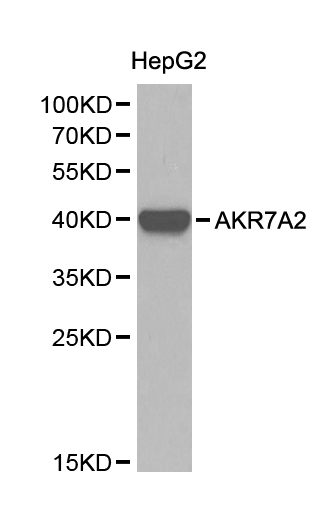
Product group Antibodies

Anti-AKR7A2 AntibodyA29518
ApplicationsWestern Blot, ImmunoHistoChemistry
ReactivityHuman, Mouse, Rat
- SizePrice

Product group Antibodies

Anti-AKR7A2 AntibodyHPA064638
ApplicationsWestern Blot, ImmunoCytoChemistry
ReactivityHuman
TargetAKR7A2
- SizePrice
Product group Antibodies

AKR7A2 / AFAR AntibodyLS-C331369
ApplicationsImmunoFluorescence, Western Blot, ImmunoHistoChemistry
ReactivityHuman, Mouse
TargetAKR7A2
- SizePrice
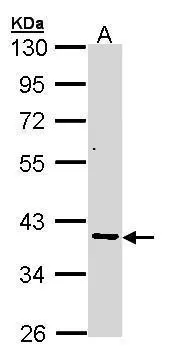
Product group Antibodies

AKR7A2 antibodyGTX104299
ApplicationsImmunoFluorescence, Western Blot, ImmunoCytoChemistry, ImmunoHistoChemistry, ImmunoHistoChemistry Paraffin
ReactivityHuman, Mouse
TargetAKR7A2
- SizePrice
Product group Antibodies

Anti-AKR7A2Y058468
ApplicationsWestern Blot, ImmunoHistoChemistry
ReactivityHuman, Other Species
- SizePrice
Product group Antibodies

Anti-AKR7A2 Antibody144-01227
ApplicationsImmunoFluorescence, Western Blot, ImmunoHistoChemistry
ReactivityHuman, Mouse
TargetAKR7A2
- SizePrice