Anti-CLIC1 Antibody
ER2001-32

ApplicationsImmunoFluorescence, Western Blot, ImmunoHistoChemistry, ImmunoHistoChemistry Paraffin
Product group Antibodies
ReactivityHuman, Mouse, Rat
TargetCLIC1
Overview
- SupplierHUABIO
- Product NameAnti-CLIC1 Antibody
- Delivery Days Customer7
- ApplicationsImmunoFluorescence, Western Blot, ImmunoHistoChemistry, ImmunoHistoChemistry Paraffin
- Applications SupplierWB,IF-Cell,IHC-P
- CertificationResearch Use Only
- ClonalityPolyclonal
- Concentration1 mg/ml
- ConjugateUnconjugated
- Gene ID1192
- Target nameCLIC1
- Target descriptionchloride intracellular channel 1
- Target synonymsCL1C1, CLCNL1, G6, NCC27, chloride intracellular channel protein 1, RNCC protein, chloride channel ABP, glutaredoxin-like oxidoreductase CLIC1, glutathione-dependent dehydroascorbate reductase CLIC1, hRNCC, nuclear chloride ion channel 27, nuclear chloride ion channel protein, p64CLCP, regulatory nuclear chloride ion channel protein
- HostRabbit
- IsotypeIgG
- Protein IDO00299
- Protein NameChloride intracellular channel protein 1
- Scientific DescriptionChloride intracellular channel protein 1 is a protein that in humans is encoded by the CLIC1 gene. Chloride channels are a diverse group of proteins that regulate fundamental cellular processes including stabilization of cell membrane potential, transepithelial transport, maintenance of intracellular pH, and regulation of cell volume. Chloride intracellular channel 1 is a member of the p64 family; the protein localizes principally to the cell nucleus and exhibits both nuclear and plasma membrane chloride ion channel activity. Membrane insertion seems to be redox-regulated and may occur only under oxydizing conditions. Involved in regulation of the cell cycle. Mainly cytoplasmic expression in most glandular epithelial cells, also membranous expression in renal tubules. CLIC1 is frequently upregulated in multiple human malignancies and has been demonstrated to play a critical role in cell proliferation, apoptosis, and invasion. However, limited is known about its expression, biological functions, and action mechanism in oral malignancies.
- ReactivityHuman, Mouse, Rat
- Reactivity SupplierHuman,Mouse,Rat
- Storage Instruction-20°C,2°C to 8°C
- UNSPSC41116161
Datasheet
Related products

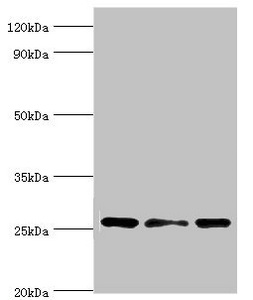
Product group Antibodies

CLIC1 AntibodyCSB-PA005545ESR1HU
ApplicationsWestern Blot, ELISA, ImmunoHistoChemistry
ReactivityHuman
TargetCLIC1
- SizePrice
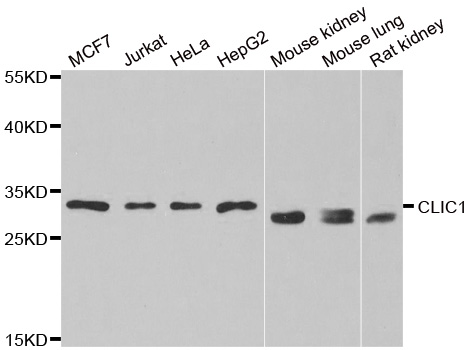
Product group Antibodies

Anti-CLIC1 AntibodyA31324
ApplicationsWestern Blot, ImmunoHistoChemistry
ReactivityHuman
- SizePrice

Product group Antibodies

Anti-CLIC1 Antibody Picoband(r)A02397-1-CARRIER-FREE
ApplicationsFlow Cytometry, Western Blot, ELISA
ReactivityHuman, Monkey, Rat
TargetCLIC1
- SizePrice

Product group Antibodies

ApplicationsWestern Blot, ELISA
ReactivityBovine, Canine, Human, Mouse, Rat
TargetCLIC1
- SizePrice
Product group Antibodies

CLIC1 / NCC27 AntibodyLS-C405179
ApplicationsWestern Blot, ELISA, ImmunoHistoChemistry
ReactivityHuman, Mouse, Rat
TargetCLIC1
- SizePrice
Product group Antibodies

ApplicationsImmunoPrecipitation, Western Blot, ImmunoCytoChemistry, ImmunoHistoChemistry
ReactivityMouse
TargetCLIC1
- SizePrice
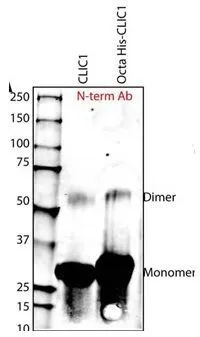
Product group Antibodies

CLIC1 antibody, N-termGTX48722
ApplicationsWestern Blot, ImmunoHistoChemistry, ImmunoHistoChemistry Paraffin
ReactivityHuman, Mouse
TargetCLIC1
- SizePrice