

Anti-SIRT3 Antibody
R1511-3

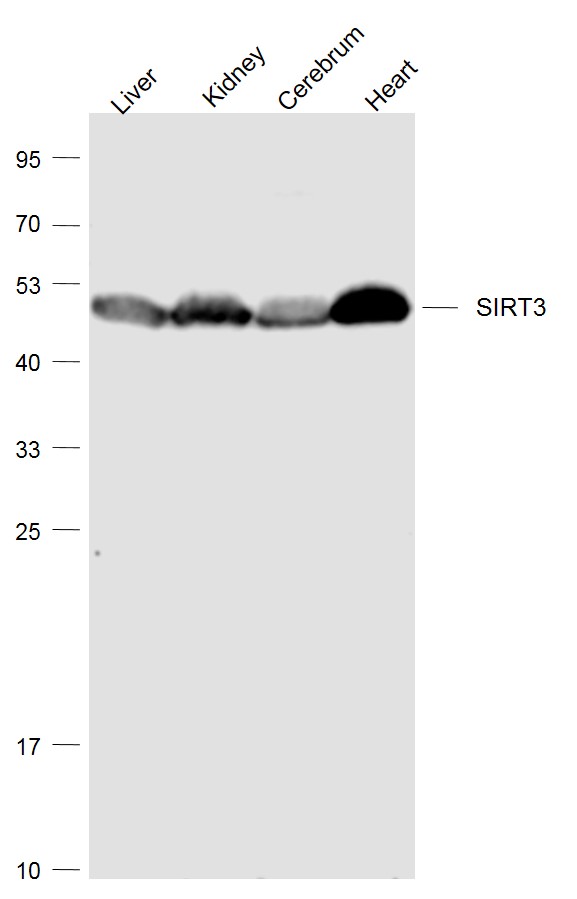
ApplicationsWestern Blot
Product group Antibodies
ReactivityHuman, Mouse
TargetSIRT3
Overview
- SupplierHUABIO
- Product NameAnti-SIRT3 Antibody
- Delivery Days Customer7
- ApplicationsWestern Blot
- Applications SupplierWB,IF-Cell,IHC-P,FC
- CertificationResearch Use Only
- ClonalityPolyclonal
- Concentration1 mg/ml
- ConjugateUnconjugated
- Gene ID23410
- Target nameSIRT3
- Target descriptionsirtuin 3
- Target synonymsSIR2L3, NAD-dependent protein deacetylase sirtuin-3, mitochondrial, NAD-dependent deacetylase sirtuin-3, mitochondrial, NAD-dependent protein delactylase sirtuin-3, SIR2-like protein 3, mitochondrial nicotinamide adenine dinucleotide-dependent deacetylase, regulatory protein SIR2 homolog 3, silent mating type information regulation 2, S.cerevisiae, homolog 3, sir2-like 3, sirtuin type 3
- HostRabbit
- IsotypeIgG
- Protein IDQ8R104
- Protein NameNAD-dependent protein deacetylase sirtuin-3
- Scientific DescriptionThe Silent Information Regulator (SIR2) family of genes are highly conserved from prokaryotes to eukaryotes and are involved in diverse processes, including transcriptional regulation, cell cycle progression, DNA-damage repair and aging. In S. cerevisiae, Sir2p deacetylates histones in an NAD-dependent manner, which regulates silencing at the telomeric, rDNA and silent mating-type loci. Sir2p is the founding member of a large family, designated sirtuins, which contain a conserved catalytic domain. The human homologues, which include SIRT1-7, are divided into four main branches: SIRT1-3 are class I, SIRT4 is class II, SIRT5 is class III and SIRT6-7 are class IV. SIRT3 is a NAD-dependent deacetylase that contains one deacetylase sirtuin-type domain. The SIRT3 protein is widely expressed and localizes to the mitochondira where it is processed by mitochondrial processing peptidase (MPP) to yield a final product. This processing is most-likely necessary for its enzymatic activity.
- ReactivityHuman, Mouse
- Reactivity SupplierHuman,Mouse
- Storage Instruction-20°C,2°C to 8°C
- UNSPSC41116161
Datasheet
Related products
Product group Antibodies

SIRT3 AntibodyCSB-PA008365
ApplicationsWestern Blot, ELISA
ReactivityHuman
TargetSIRT3
- SizePrice

Product group Antibodies

Anti-SIRT3 AntibodyA100764
ApplicationsWestern Blot, ELISA
ReactivityHuman
- SizePrice


Product group Antibodies

Anti-SIRT3 Antibody Picoband(r)A01061-3-CARRIER-FREE
ApplicationsWestern Blot
ReactivityHuman
TargetSIRT3
- SizePrice
Product group Antibodies

Goat anti-SIRT3EB06973
ApplicationsWestern Blot, ELISA
ReactivityHuman
TargetSIRT3
- SizePrice

Product group Antibodies

Anti-SIRT3 AntibodyHPA026809
ApplicationsWestern Blot, ImmunoHistoChemistry
ReactivityHuman
TargetSIRT3
- SizePrice
Product group Antibodies

SIRT3 / Sirtuin 3 AntibodyLS-C404278
ApplicationsWestern Blot, ELISA, ImmunoHistoChemistry
ReactivityHuman, Mouse
TargetSIRT3
- SizePrice
Product group Antibodies
References

SIRT3 Polyclonal AntibodyBS-6105R
ApplicationsImmunoFluorescence, Western Blot, ELISA, ImmunoCytoChemistry, ImmunoHistoChemistry, ImmunoHistoChemistry Frozen, ImmunoHistoChemistry Paraffin
ReactivityCanine, Human, Mouse, Porcine, Rabbit, Rat
TargetSIRT3
- SizePrice
Product group Antibodies

SIRT3 Polyclonal AntibodyCAC14798
ApplicationsImmunoFluorescence, Western Blot, ELISA
ReactivityMouse
TargetSIRT3
- SizePrice