

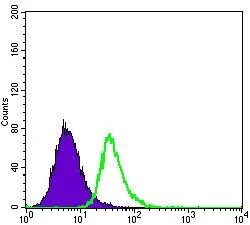
FACS analysis of HepG2 cells using GTX60446 Apolipoprotein E antibody [1H4]. Green : Apolipoprotein E Purple : negative control
![ELISA analysis of antigen using GTX60446 Apolipoprotein E antibody [1H4].
Red : Control antigen 100ng
Purple : Antigen 10ng
Green : Antigen 50ng
Blue : Antigen 100ng](https://www.genetex.com/upload/website/prouct_img/normal/GTX60446/GTX60446_20170912_ELISA_w_23061123_742.webp "ELISA analysis of antigen using GTX60446 Apolipoprotein E antibody [1H4].
Red : Control antigen 100ng
Purple : Antigen 10ng
Green : Antigen 50ng
Blue : Antigen 100ng")
![WB analysis of HEK293 (1) and ApoE (AA: 20-267)-hIgGFc transfected HEK293 (2) cell lysate using GTX60446 Apolipoprotein E antibody [1H4].](https://www.genetex.com/upload/website/prouct_img/normal/GTX60446/GTX60446_20170912_WB_w_23061123_965.webp "WB analysis of HEK293 (1) and ApoE (AA: 20-267)-hIgGFc transfected HEK293 (2) cell lysate using GTX60446 Apolipoprotein E antibody [1H4].")
![IHC-P analysis of liver cancer tissue (left) and brain tissue (right) using GTX60446 Apolipoprotein E antibody [1H4].](https://www.genetex.com/upload/website/prouct_img/normal/GTX60446/GTX60446_20170912_IHC-P_w_23061123_574.webp "IHC-P analysis of liver cancer tissue (left) and brain tissue (right) using GTX60446 Apolipoprotein E antibody [1H4].")
FACS analysis of HepG2 cells using GTX60446 Apolipoprotein E antibody [1H4]. Green : Apolipoprotein E Purple : negative control
Apolipoprotein E antibody [1H4]
GTX60446

ApplicationsFlow Cytometry, Western Blot, ELISA, ImmunoHistoChemistry, ImmunoHistoChemistry Paraffin
Product group Antibodies
ReactivityHuman
TargetAPOE
Overview
- SupplierGeneTex
- Product NameApolipoprotein E antibody [1H4]
- Delivery Days Customer9
- Application Supplier NoteWB: 1/500 - 1/2000. IHC-P: 1/200 - 1/1000. FACS: 1/200 - 1/400. ELISA: 1/10000. *Optimal dilutions/concentrations should be determined by the researcher.Not tested in other applications.
- ApplicationsFlow Cytometry, Western Blot, ELISA, ImmunoHistoChemistry, ImmunoHistoChemistry Paraffin
- CertificationResearch Use Only
- ClonalityMonoclonal
- Clone ID1H4
- ConjugateUnconjugated
- Gene ID348
- Target nameAPOE
- Target descriptionapolipoprotein E
- Target synonymsAD2, APO-E, ApoE4, LDLCQ5, LPG, apolipoprotein E, apolipoprotein E3
- HostMouse
- IsotypeIgG1
- Protein IDP02649
- Protein NameApolipoprotein E
- Scientific DescriptionThe protein encoded by this gene is a major apoprotein of the chylomicron. It binds to a specific liver and peripheral cell receptor, and is essential for the normal catabolism of triglyceride-rich lipoprotein constituents. This gene maps to chromosome 19 in a cluster with the related apolipoprotein C1 and C2 genes. Mutations in this gene result in familial dysbetalipoproteinemia, or type III hyperlipoproteinemia (HLP III), in which increased plasma cholesterol and triglycerides are the consequence of impaired clearance of chylomicron and VLDL remnants. Alternative splicing results in multiple transcript variants. [provided by RefSeq, Nov 2014]
- ReactivityHuman
- Storage Instruction-20°C or -80°C,2°C to 8°C
- UNSPSC12352203
References
- Sarhan MA, Abdel-Hakeem MS, Mason AL, et al. Glycogen synthase kinase 3β inhibitors prevent hepatitis C virus release/assembly through perturbation of lipid metabolism. Sci Rep. 2017,7(1):2495. doi: 10.1038/s41598-017-02648-6Read this paper
Datasheet
Related products
Product group Antibodies

Anti-Apo E [1D7]Ab01194-1.1
ApplicationsELISA, Other Application, RadioImmunoAssay
ReactivityHuman
TargetAPOE
- SizePrice
Product group Antibodies

Anti-APOE (233-252aa) Antibody130-10506
ApplicationsELISA
ReactivityHuman
TargetAPOE
- SizePrice

Product group Antibodies

Anti-APOE Antibody Picoband(r)A00015-5-CARRIER-FREE
ApplicationsFlow Cytometry, ImmunoFluorescence, Western Blot, ELISA, ImmunoCytoChemistry
ReactivityHuman
TargetAPOE
- SizePrice

Product group Antibodies

ApplicationsWestern Blot, ELISA, ELISpot Assay
ReactivityHuman
TargetAPOE
- SizePrice
![Sandwich ELISA analysis of monkey apoE protein using GTX02906 Apolipoprotein E antibody [E981] as coating antibody and GTX02905-02 Apolipoprotein E antibody [E887] (Biotin) as detecting antibody.](https://www.genetex.com/upload/website/prouct_img/normal/GTX02905-02/GTX02905-02_20210507_ELISA_4_w_23053123_138.webp)
Product group Antibodies
Apolipoprotein E antibody [E887] (Biotin)GTX02905-02
ApplicationsImmunoPrecipitation, Western Blot, ELISA
ReactivityHuman, Monkey
TargetAPOE
- SizePrice
![Sandwich ELISA analysis of monkey apoE protein using GTX02906 Apolipoprotein E antibody [E981] as coating antibody and GTX02905-02 Apolipoprotein E antibody [E887] (Biotin) as detecting antibody.](https://www.genetex.com/upload/website/prouct_img/normal/GTX02906/GTX02906_20210507_ELISA_w_23053123_676.webp)
Product group Antibodies
Apolipoprotein E antibody [E981]GTX02906
ApplicationsWestern Blot, ELISA
ReactivityHuman, Monkey
TargetAPOE
- SizePrice
![Sandwich ELISA analysis of monkey apoE protein using GTX02906 Apolipoprotein E antibody [E981] as coating antibody and GTX02905-02 Apolipoprotein E antibody [E887] (Biotin) as detecting antibody.](https://www.genetex.com/upload/website/prouct_img/normal/GTX03051/GTX03051_20210507_ELISA_w_23053123_346.webp)
Product group Antibodies
ApplicationsELISA
ReactivityHuman, Monkey
TargetAPOE
- SizePrice
![Apolipoprotein E antibody [C2C3], C-term detects Apolipoprotein E protein at cytoplasm by immunofluorescent analysis. Sample: HepG2 cells were fixed in 4% paraformaldehyde at RT for 15 min. Green: Apolipoprotein E stained by Apolipoprotein E antibody [C2C3], C-term (GTX100053) diluted at 1:500. Blue: Hoechst 33342 staining.](https://www.genetex.com/upload/website/prouct_img/normal/GTX100053/GTX100053_43006_20171220_ICC_IF_w_23053123_454.webp)
Product group Antibodies
References
ApplicationsImmunoFluorescence, ImmunoPrecipitation, Western Blot, ELISA, ImmunoCytoChemistry, ImmunoHistoChemistry, ImmunoHistoChemistry Frozen, ImmunoHistoChemistry Paraffin
ReactivityHuman
TargetAPOE
- SizePrice
Product group Antibodies
Apolipoprotein E antibodyGTX101456
ApplicationsImmunoFluorescence, Western Blot, ImmunoCytoChemistry, ImmunoHistoChemistry, ImmunoHistoChemistry Paraffin
ReactivityHuman
TargetAPOE
- SizePrice
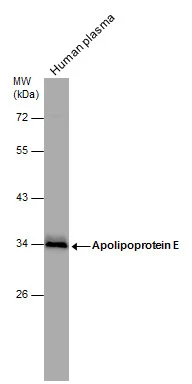
![Human plasma (30 μg) was separated by 10% SDS-PAGE, and the membrane was blotted with Apolipoprotein E antibody [GT27711] (GTX635889) diluted at 1:25000. The HRP-conjugated anti-mouse IgG antibody (GTX213111-01) was used to detect the primary antibody.](https://www.genetex.com/upload/website/prouct_img/normal/GTX635889/GTX635889_44195_20220225_WB_plasma_w_23061202_472.webp)
Product group Antibodies
Apolipoprotein E antibody [GT27711]GTX635889
ApplicationsImmunoPrecipitation, Western Blot, ELISA
ReactivityHuman, Rat
TargetAPOE
- SizePrice