

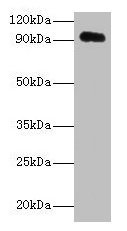
Western blot All lanes: APP antibody at 2microg/ml + HL60 whole cell lysate Secondary Goat polyclonal to rabbit IgG at 1/10000 dilution Predicted band size: 87, 35, 77, 79, 81, 83, 85, 86, 73 kDa Observed band size: 95 kDa
Western blot All lanes: APP antibody at 2microg/ml + HL60 whole cell lysate Secondary Goat polyclonal to rabbit IgG at 1/10000 dilution Predicted band size: 87, 35, 77, 79, 81, 83, 85, 86, 73 kDa Observed band size: 95 kDa
APP Antibody
CSB-PA001950NJ01HU

ApplicationsWestern Blot, ELISA
Product group Antibodies
ReactivityHuman
TargetAPP
Overview
- SupplierCusabio
- Product NameAPP Antibody
- Delivery Days Customer20
- ApplicationsWestern Blot, ELISA
- CertificationResearch Use Only
- ClonalityPolyclonal
- ConjugateUnconjugated
- Gene ID351
- Target nameAPP
- Target descriptionamyloid beta precursor protein
- Target synonymsAAA, ABETA, ABPP, AD1, APPI, CTFgamma, CVAP, PN-II, PN2, alpha-sAPP, preA4, amyloid-beta precursor protein, alzheimer disease amyloid A4 protein homolog, alzheimer disease amyloid protein, amyloid beta (A4) precursor protein, amyloid beta A4 protein, amyloid precursor protein, beta-amyloid peptide, beta-amyloid peptide(1-40), beta-amyloid peptide(1-42), beta-amyloid precursor protein, cerebral vascular amyloid peptide, peptidase nexin-II, protease nexin-II, testicular tissue protein Li 2
- HostRabbit
- IsotypeIgG
- Protein IDP05067
- Protein NameAmyloid-beta precursor protein
- Scientific DescriptionFunctions as a cell surface receptor and performs physiological functions on the surface of neurons relevant to neurite growth, neuronal adhesion and axonogenesis. Involved in cell mobility and transcription regulation through protein-protein interactions. Can promote transcription activation through binding to APBB1-KAT5 and inhibits Notch signaling through interaction with Numb. Couples to apoptosis-inducing pathways such as those mediated by G(O) and JIP. Inhibits G(o) alpha ATPase activity By similarity. Acts as a kinesin I membrane receptor, mediating the axonal transport of beta-secretase and presenilin 1. Involved in copper homeostasis/oxidative stress through copper ion reduction. In vitro, copper-metallated APP induces neuronal death directly or is potentiated through Cu2+-mediated low-density lipoprotein oxidation. Can regulate neurite outgrowth through binding to components of the extracellular matrix such as heparin and collagen I and IV. The splice isoforms that contain the BPTI domain possess protease inhibitor activity. Induces a AGER-dependent pathway that involves activation of p38 MAPK, resulting in internalization of amyloid-beta peptide and leading to mitochondrial dysfunction in cultured cortical neurons. Provides Cu2+ ions for GPC1 which are required for release of nitric oxide (NO) and subsequent degradation of the heparan sulfate chains on GPC1.
- ReactivityHuman
- Storage Instruction-20°C or -80°C
- UNSPSC41116161
Related products
Product group Antibodies

ApplicationsWestern Blot, ImmunoCytoChemistry
ReactivityHuman, Mouse, Rat
- SizePrice
Product group Antibodies

Anti-amyloid beta [6E10]Ab00714-1.1
ApplicationsElectron Microscopy, ImmunoPrecipitation, Western Blot, ELISA, ImmunoHistoChemistry
ReactivityHuman
TargetAPP
- SizePrice

Product group Antibodies

ApplicationsWestern Blot, ELISA, ImmunoCytoChemistry
ReactivityHuman
TargetAPP
- SizePrice



Product group Antibodies

APP / Beta Amyloid Precursor AntibodyLS-C831406
ApplicationsImmunoHistoChemistry
ReactivityHuman, Mouse, Rat
TargetAPP
- SizePrice
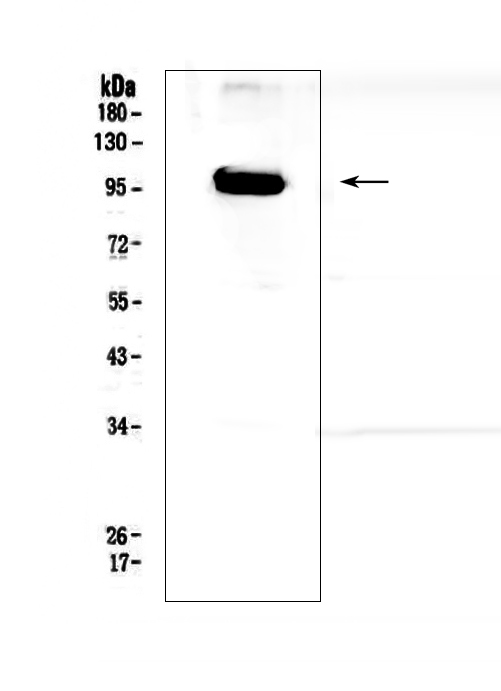
Product group Antibodies

Anti-APP/C99 Antibody Picoband(r)A00081-3-CARRIER-FREE
ApplicationsWestern Blot, ImmunoHistoChemistry
ReactivityHuman
TargetAPP
- SizePrice
Product group Antibodies
References

ApplicationsFlow Cytometry, ImmunoFluorescence, Western Blot, ELISA, ImmunoCytoChemistry, ImmunoHistoChemistry, ImmunoHistoChemistry Frozen, ImmunoHistoChemistry Paraffin
ReactivityBovine, Canine, Chicken, Human, Mouse, Porcine, Rabbit, Rat
TargetAPP
- SizePrice
Product group Antibodies
APP AntibodyCSB-PA000875
ApplicationsImmunoFluorescence, Western Blot, ELISA, ImmunoHistoChemistry
ReactivityHuman, Mouse, Rat
TargetAPP
- SizePrice