

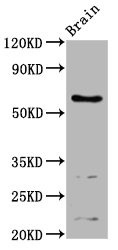
Western Blot Positive WB detected in: Mouse brain tissue All lanes: ASIC1 antibody at 4.24ug/ml Secondary Goat polyclonal to rabbit IgG at 1/50000 dilution Predicted band size: 60, 65, 63 kDa Observed band size: 60 kDa
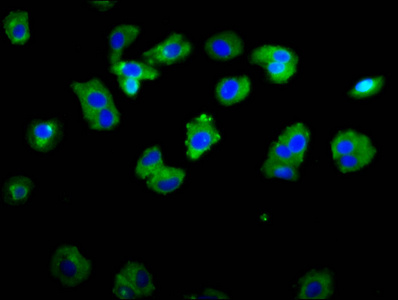
Western Blot Positive WB detected in: Mouse brain tissue All lanes: ASIC1 antibody at 4.24ug/ml Secondary Goat polyclonal to rabbit IgG at 1/50000 dilution Predicted band size: 60, 65, 63 kDa Observed band size: 60 kDa
ASIC1 Antibody
CSB-PA001142LA01HU

ApplicationsImmunoFluorescence, Western Blot, ELISA
Product group Antibodies
ReactivityHuman, Mouse
TargetASIC1
Overview
- SupplierCusabio
- Product NameASIC1 Antibody
- Delivery Days Customer20
- ApplicationsImmunoFluorescence, Western Blot, ELISA
- CertificationResearch Use Only
- ClonalityPolyclonal
- ConjugateUnconjugated
- Gene ID41
- Target nameASIC1
- Target descriptionacid sensing ion channel subunit 1
- Target synonymsACCN2, ASIC, BNaC2, acid-sensing ion channel 1, Cation channel, amiloride-sensitive, neuronal, 2, acid sensing (proton gated) ion channel 1, acid-sensing ion channel 1a protein, amiloride-sensitive cation channel 2, neuronal, brain sodium channel 2
- HostRabbit
- IsotypeIgG
- Protein IDP78348
- Protein NameAcid-sensing ion channel 1
- Scientific DescriptionIsoform 2 and isoform 3 function as proton-gated sodium channels; they are activated by a drop of the extracellular pH and then become rapidly desensitized. The channel generates a biphasic current with a fast inactivating and a slow sustained phase. Has high selectivity for sodium ions and can also transport lithium ions with high efficiency. Isoform 2 can also transport potassium, but with lower efficiency. It is nearly impermeable to the larger rubidium and cesium ions. Isoform 3 can also transport calcium ions. Mediates glutamate-independent Ca(2+) entry into neurons upon acidosis. This Ca(2+) overloading is toxic for cortical neurons and may be in part responsible for ischemic brain injury. Heteromeric channel assembly seems to modulate channel properties. Functions as a postsynaptic proton receptor that influences intracellular Ca(2+) concentration and calmodulin-dependent protein kinase II phosphorylation and thereby the density of dendritic spines. Modulates activity in the circuits underlying innate fear.
- ReactivityHuman, Mouse
- Storage Instruction-20°C or -80°C
- UNSPSC41116161
Related products
Product group Antibodies

Anti-ACCN2 (C-term) Antibody102-27693
ApplicationsFlow Cytometry, Western Blot, ImmunoHistoChemistry, ImmunoHistoChemistry Paraffin
TargetASIC1
- SizePrice
Product group Antibodies

ASIC1 Polyclonal AntibodyCAC15421
ApplicationsImmunoFluorescence, Western Blot, ELISA
ReactivityMouse
TargetASIC1
- SizePrice
Product group Antibodies

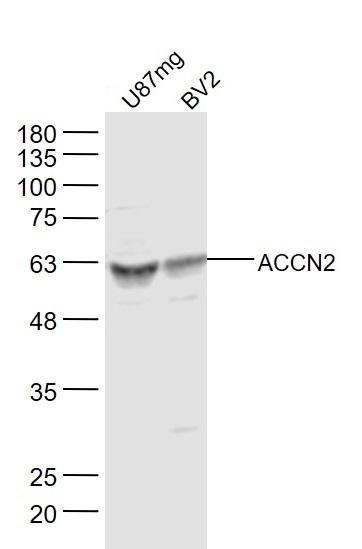
ACCN2 Polyclonal AntibodyBS-12128R
ApplicationsImmunoFluorescence, Western Blot, ELISA, ImmunoHistoChemistry, ImmunoHistoChemistry Paraffin
ReactivityBovine, Canine, Chicken, Equine, Human, Mouse, Porcine, Rabbit, Rat, Sheep
- SizePrice
Product group Antibodies

ASIC1 antibody [N1C2]GTX105373
ApplicationsWestern Blot
ReactivityHuman
TargetASIC1
- SizePrice

Product group Antibodies

Anti-ASIC1 AntibodyHPA058870
ApplicationsImmunoCytoChemistry
ReactivityHuman
TargetASIC1
- SizePrice
Product group Antibodies

Goat anti-ASIC1 AntibodyEB12627
ApplicationsWestern Blot, ELISA, ImmunoHistoChemistry
ReactivityBovine, Canine, Human, Mouse, Porcine, Rat
TargetASIC1
- SizePrice
Product group Antibodies

ASIC1 / ACCN2 AntibodyLS-C680181
ApplicationsImmunoFluorescence, Western Blot, ELISA
ReactivityHuman
TargetASIC1
- SizePrice

Product group Antibodies

Anti-ASIC1 Antibody Picoband(r)A02332-2-CARRIER-FREE
ApplicationsWestern Blot, ELISA
ReactivityHuman
TargetASIC1
- SizePrice