

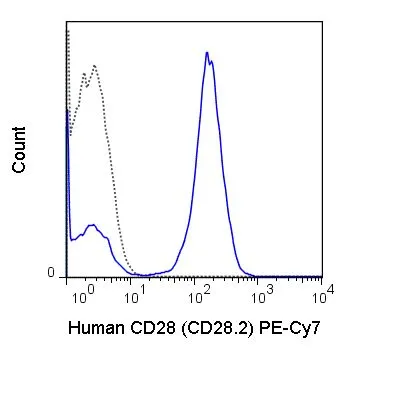
FACS analysis of human peripheral blood lymphocytes using GTX00602-10 CD28 antibody [CD28.2] (PE-Cy7). Solid line : Primary antibody Dashed line : PE-Cy7 mouse IgG1 isotype control Antibody amount : 0.25 μg
FACS analysis of human peripheral blood lymphocytes using GTX00602-10 CD28 antibody [CD28.2] (PE-Cy7). Solid line : Primary antibody Dashed line : PE-Cy7 mouse IgG1 isotype control Antibody amount : 0.25 μg
CD28 antibody [CD28.2] (PE-Cy7)
GTX00602-10

ApplicationsFlow Cytometry
Product group Antibodies
ReactivityHuman, Monkey, Primate
TargetCD28
Overview
- SupplierGeneTex
- Product NameCD28 antibody [CD28.2] (PE-Cy7)
- Delivery Days Customer9
- Application Supplier NoteFACS: 0.25 microg (5 microl) for 105-108 cells in 100 microl sample per test. *Optimal dilutions/concentrations should be determined by the researcher.Not tested in other applications.
- ApplicationsFlow Cytometry
- CertificationResearch Use Only
- ClonalityMonoclonal
- Clone IDCD28.2
- Concentration0.05 mg/ml
- ConjugateDouble Conjugated
- Gene ID940
- Target nameCD28
- Target descriptionCD28 molecule
- Target synonymsIMD123, Tp44, T-cell-specific surface glycoprotein CD28
- HostMouse
- IsotypeIgG1
- Protein IDP10747
- Protein NameT-cell-specific surface glycoprotein CD28
- Scientific DescriptionThe protein encoded by this gene is essential for T-cell proliferation and survival, cytokine production, and T-helper type-2 development. Several alternatively spliced transcript variants encoding different isoforms have been found for this gene.[provided by RefSeq, Jul 2011]
- ReactivityHuman, Monkey, Primate
- Storage Instruction2°C to 8°C
- UNSPSC12352203
References
- Ohainle M, Kim K, Komurlu Keceli S, et al. TRIM34 restricts HIV-1 and SIV capsids in a TRIM5α-dependent manner. PLoS Pathog. 2020,16(4):e1008507. doi: 10.1371/journal.ppat.1008507Read this paper
- Sánchez-Villanueva JA, Rodríguez-Jorge O, Ramírez-Pliego O, et al. Contribution of ROS and metabolic status to neonatal and adult CD8+ T cell activation. PLoS One. 2019,14(12):e0226388. doi: 10.1371/journal.pone.0226388Read this paper
- Nau GJ, Horzempa J, O'Dee D, et al. A predicted Francisella tularensis DXD-motif glycosyltransferase blocks immune activation. Virulence. 2019,10(1):643-656. doi: 10.1080/21505594.2019.1631662Read this paper
- Willis EL, Eberle R, Wolf RF, et al. The effects of age and cytomegalovirus on markers of inflammation and lymphocyte populations in captive baboons. PLoS One. 2014,9(9):e107167. doi: 10.1371/journal.pone.0107167Read this paper
- Nakayama M, Shichinohe S, Itoh Y, et al. Protection against H5N1 highly pathogenic avian and pandemic (H1N1) 2009 influenza virus infection in cynomolgus monkeys by an inactivated H5N1 whole particle vaccine. PLoS One. 2013,8(12):e82740. doi: 10.1371/journal.pone.0082740Read this paper
- Vanderford TH, Slichter C, Rogers KA, et al. Treatment of SIV-infected sooty mangabeys with a type-I IFN agonist results in decreased virus replication without inducing hyperimmune activation. Blood. 2012,119(24):5750-7. doi: 10.1182/blood-2012-02-411496Read this paper
- Okoye AA, Rohankhedkar M, Abana C, et al. Naive T cells are dispensable for memory CD4+ T cell homeostasis in progressive simian immunodeficiency virus infection. J Exp Med. 2012,209(4):641-51. doi: 10.1084/jem.20112071Read this paper
- Cocchi F, DeVico AL, Lu W, et al. Soluble factors from T cells inhibiting X4 strains of HIV are a mixture of β chemokines and RNases. Proc Natl Acad Sci U S A. 2012,109(14):5411-6. doi: 10.1073/pnas.1202240109Read this paper
- Ansari AA, Reimann KA, Mayne AE, et al. Blocking of α4β7 gut-homing integrin during acute infection leads to decreased plasma and gastrointestinal tissue viral loads in simian immunodeficiency virus-infected rhesus macaques. J Immunol. 2011,186(2):1044-59. doi: 10.4049/jimmunol.1003052Read this paper
- Soto PC, Stein LL, Hurtado-Ziola N, et al. Relative over-reactivity of human versus chimpanzee lymphocytes: implications for the human diseases associated with immune activation. J Immunol. 2010,184(8):4185-95. doi: 10.4049/jimmunol.0903420Read this paper
Datasheet
Related products
Product group Antibodies

ApplicationsFlow Cytometry, ImmunoPrecipitation, ImmunoHistoChemistry
ReactivityHuman
TargetCD28
- SizePrice
Product group Antibodies

Anti-CD28 [YTH 913.12]Ab00195-10.0
ApplicationsFlow Cytometry, Other Application
ReactivityHuman
TargetCD28
- SizePrice


Product group Antibodies

Anti-CD28 AntibodyGMP-11524-H001
ApplicationsFunctional Assay, Flow Cytometry
ReactivityHuman
- SizePrice

Product group Antibodies

Anti-CD28 Antibody Picoband(r)A00065-3-CARRIER-FREE
ApplicationsFlow Cytometry, Western Blot, ELISA
ReactivityHuman
TargetCD28
- SizePrice

Product group Antibodies

ReactivityHuman, Primate
TargetCD28
- SizePrice
![FACS analysis of human peripheral blood lymphocytes using GTX00602-08 CD28 antibody [CD28.2] (PE). Solid line : Primary antibody Dashed line : PE mouse IgG1 isotype control Antibody amount : 0.25 μg](https://www.genetex.com/upload/website/prouct_img/normal/GTX00602-08/GTX00602-08_20201020_FACS_56_w_23053121_546.webp)
Product group Antibodies
References
CD28 antibody [CD28.2] (PE)GTX00602-08
ApplicationsFlow Cytometry
ReactivityHuman, Monkey, Primate
TargetCD28
- SizePrice
![FACS analysis of human peripheral blood lymphocytes using GTX00602-11 CD28 antibody [CD28.2] (PerCP-Cy5.5). Solid line : Primary antibody Dashed line : PerCP-Cy5.5 mouse IgG1 isotype control Antibody amount : 0.125 μg](https://www.genetex.com/upload/website/prouct_img/normal/GTX00602-11/GTX00602-11_20201020_FACS_75_w_23053121_345.webp)
Product group Antibodies
References
CD28 antibody [CD28.2] (PerCP-Cy5.5)GTX00602-11
ApplicationsFlow Cytometry
ReactivityHuman, Monkey, Primate
TargetCD28
- SizePrice
Product group Antibodies
References
CD28 antibody [CD28.2] (Biotin)GTX03365
ApplicationsFlow Cytometry
ReactivityHuman, Monkey, Primate
TargetCD28
- SizePrice