

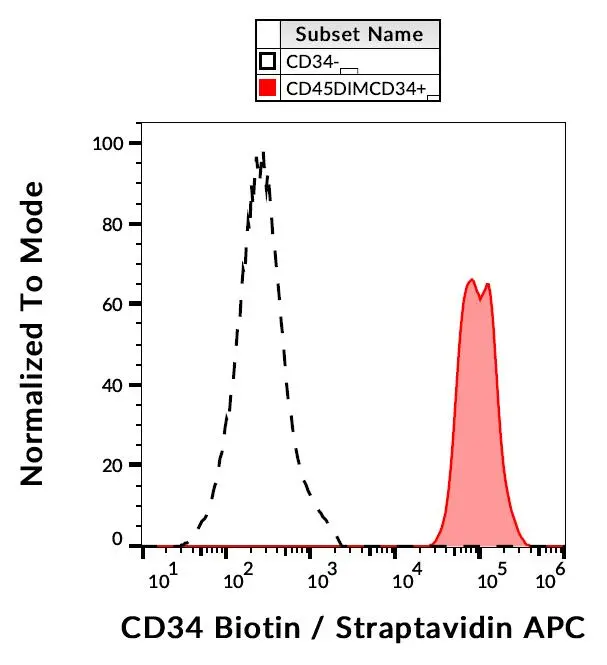
FACS analysis of human peripheral blood using GTX78339 CD34 antibody [4H11(APG)] (Biotin).
FACS analysis of human peripheral blood using GTX78339 CD34 antibody [4H11(APG)] (Biotin).
CD34 antibody [4H11(APG)] (Biotin)
GTX78339

ApplicationsFlow Cytometry, ImmunoFluorescence, Western Blot, ImmunoCytoChemistry, ImmunoHistoChemistry, ImmunoHistoChemistry Paraffin
Product group Antibodies
ReactivityHuman
TargetCD34
Overview
- SupplierGeneTex
- Product NameCD34 antibody [4H11(APG)] (Biotin)
- Delivery Days Customer9
- ApplicationsFlow Cytometry, ImmunoFluorescence, Western Blot, ImmunoCytoChemistry, ImmunoHistoChemistry, ImmunoHistoChemistry Paraffin
- CertificationResearch Use Only
- ClonalityMonoclonal
- Clone ID4H11(APG)
- Concentration1 mg/ml
- ConjugateBiotin
- Gene ID947
- Target nameCD34
- Target descriptionCD34 molecule
- Target synonymshematopoietic progenitor cell antigen CD34, CD34 antigen, CD34 sialomucin
- HostMouse
- IsotypeIgG1
- Protein IDP28906
- Protein NameHematopoietic progenitor cell antigen CD34
- Scientific DescriptionThe protein encoded by this gene may play a role in the attachment of stem cells to the bone marrow extracellular matrix or to stromal cells. This single-pass membrane protein is highly glycosylated and phosphorylated by protein kinase C. Two transcript variants encoding different isoforms have been found for this gene. [provided by RefSeq, Aug 2011]
- ReactivityHuman
- Storage Instruction2°C to 8°C
- UNSPSC12352203
References
- Lin TK, Chen SD, Chuang YC, et al. Mitochondrial Transfer of Wharton's Jelly Mesenchymal Stem Cells Eliminates Mutation Burden and Rescues Mitochondrial Bioenergetics in Rotenone-Stressed MELAS Fibroblasts. Oxid Med Cell Longev. 2019,2019:9537504. doi: 10.1155/2019/9537504Read this paper
Datasheet
Related products

Product group Antibodies

Anti-CD34 [My10]Ab00127-1.1
ApplicationsFlow Cytometry, ImmunoPrecipitation, ImmunoHistoChemistry
ReactivityHuman
TargetCD34
- SizePrice
Product group Antibodies

Cd34 Polyclonal AntibodyCAC07639
ApplicationsImmunoFluorescence, Western Blot, ELISA, ImmunoHistoChemistry
ReactivityMouse
TargetCD34
- SizePrice

Product group Antibodies
References

CD34 Polyclonal AntibodyBS-0646R
ApplicationsImmunoFluorescence, ImmunoPrecipitation, Western Blot, ImmunoHistoChemistry, ImmunoHistoChemistry Frozen, ImmunoHistoChemistry Paraffin
ReactivityHuman, Mouse, Rat
TargetCD34
- SizePrice
Product group Antibodies

CD34 AntibodyCSB-PA001451
ApplicationsWestern Blot, ELISA
ReactivityHuman, Mouse
TargetCD34
- SizePrice
Product group Antibodies

Anti-CD34 AntibodyAMAB91974
ApplicationsImmunoHistoChemistry
ReactivityHuman
TargetCD34
- SizePrice
![FACS analysis of human peripheral blood using GTX00478-06 CD34 antibody [581] (FITC).](https://www.genetex.com/upload/website/prouct_img/normal/GTX00478-06/GTX00478-06_20191025_AP_006_22_w_23053121_749.webp)
Product group Antibodies
References
CD34 antibody [581] (FITC)GTX00478-06
ApplicationsFlow Cytometry
ReactivityHuman, Primate
TargetCD34
- SizePrice
![FACS analysis of human peripheral blood using GTX00478-07 CD34 antibody [581] (APC).](https://www.genetex.com/upload/website/prouct_img/normal/GTX00478-07/GTX00478-07_20191025_AP_006_23_w_23053121_174.webp)
Product group Antibodies
References
CD34 antibody [581] (APC)GTX00478-07
ApplicationsFlow Cytometry
ReactivityHuman, Primate
TargetCD34
- SizePrice
Product group Antibodies
References
CD34 antibody [581] (PE)GTX00478-08
ApplicationsFlow Cytometry
ReactivityHuman, Primate
TargetCD34
- SizePrice