

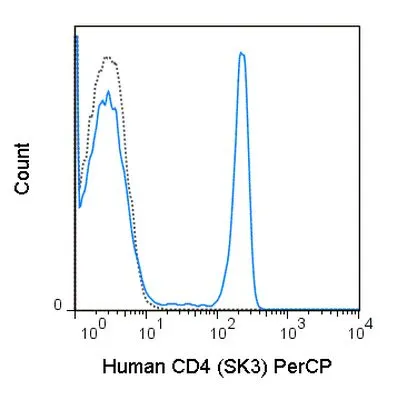
FACS analysis of human peripheral blood lymphocytes using GTX01461-16 CD4 antibody [SK3] (PerCP). Solid lone : primary antibody Dashed line : isotype control antibody amount : 0.06 μg (5 μl)
FACS analysis of human peripheral blood lymphocytes using GTX01461-16 CD4 antibody [SK3] (PerCP). Solid lone : primary antibody Dashed line : isotype control antibody amount : 0.06 μg (5 μl)
CD4 antibody [SK3] (PerCP)
GTX01461-16

ApplicationsFlow Cytometry
Product group Antibodies
ReactivityHuman, Monkey, Primate
TargetCD4
Overview
- SupplierGeneTex
- Product NameCD4 antibody [SK3] (PerCP)
- Delivery Days Customer9
- Application Supplier NoteFACS: 0.06 microg (5 microl) for 105-108 cells in 100 microl sample per test. *Optimal dilutions/concentrations should be determined by the researcher.Not tested in other applications.
- ApplicationsFlow Cytometry
- CertificationResearch Use Only
- ClonalityMonoclonal
- Clone IDSK3
- Concentration0.012 mg/ml
- ConjugatePerCP
- Gene ID920
- Target nameCD4
- Target descriptionCD4 molecule
- Target synonymsCD4mut, IMD79, Leu-3, OKT4D, T4, T-cell surface glycoprotein CD4, CD4 antigen (p55), CD4 receptor, T-cell surface antigen T4/Leu-3
- HostMouse
- IsotypeIgG1
- Protein IDP01730
- Protein NameT-cell surface glycoprotein CD4
- Scientific DescriptionThis gene encodes a membrane glycoprotein of T lymphocytes that interacts with major histocompatibility complex class II antigenes and is also a receptor for the human immunodeficiency virus. This gene is expressed not only in T lymphocytes, but also in B cells, macrophages, and granulocytes. It is also expressed in specific regions of the brain. The protein functions to initiate or augment the early phase of T-cell activation, and may function as an important mediator of indirect neuronal damage in infectious and immune-mediated diseases of the central nervous system. Multiple alternatively spliced transcript variants encoding different isoforms have been identified in this gene. [provided by RefSeq, Aug 2010]
- ReactivityHuman, Monkey, Primate
- Storage Instruction2°C to 8°C
- UNSPSC12352203
References
- Heninger AK, Theil A, Wilhelm C, et al. IL-7 abrogates suppressive activity of human CD4+CD25+FOXP3+ regulatory T cells and allows expansion of alloreactive and autoreactive T cells. J Immunol. 2012,189(12):5649-58. doi: 10.4049/jimmunol.1201286Read this paper
- Lafont BA, Gloeckler L, D'Hautcourt JL, et al. One-round determination of seven leukocyte subsets in rhesus macaque blood by flow cytometry. Cytometry. 2000,41(3):193-202.Read this paper
- Yoshino N, Ami Y, Terao K, et al. Upgrading of flow cytometric analysis for absolute counts, cytokines and other antigenic molecules of cynomolgus monkeys (Macaca fascicularis) by using anti-human cross-reactive antibodies. Exp Anim. 2000,49(2):97-110.Read this paper
- Evans RL, Wall DW, Platsoucas CD, et al. Thymus-dependent membrane antigens in man: inhibition of cell-mediated lympholysis by monoclonal antibodies to TH2 antigen. Proc Natl Acad Sci U S A. 1981,78(1):544-8.Read this paper
- Sattentau QJ, Dalgleish AG, Weiss RA, et al. Epitopes of the CD4 antigen and HIV infection. Science. 1986,234(4780):1120-3.Read this paper
Datasheet
Related products
Product group Antibodies

Anti-CD4 Antibody144-01549
ApplicationsWestern Blot
ReactivityHuman, Mouse
TargetCD4
- SizePrice
Product group Antibodies

Anti-CD4 [YNB46.1.8 (Campath-9H)]Ab00167-23.0
ApplicationsFlow Cytometry, ImmunoHistoChemistry, ImmunoHistoChemistry Frozen
ReactivityHuman
TargetCD4
- SizePrice


Product group Antibodies

ApplicationsFlow Cytometry, ImmunoCytoChemistry
ReactivityHuman
TargetCD4
- SizePrice
![FACS analysis of human peripheral blood lymphocytes using GTX01461-06 CD4 antibody [SK3] (FITC). Solid lone : primary antibody Dashed line : isotype control antibody amount : 0.06 μg (5 μl)](https://www.genetex.com/upload/website/prouct_img/normal/GTX01461-06/GTX01461-06_20200428_FACS68_w_23053121_794.webp)
Product group Antibodies
References
CD4 antibody [SK3] (FITC)GTX01461-06
ApplicationsFlow Cytometry
ReactivityHuman, Monkey, Primate
TargetCD4
- SizePrice
![FACS analysis of human peripheral blood lymphocytes using GTX01461-07 CD4 antibody [SK3] (APC). Solid lone : primary antibody Dashed line : isotype control antibody amount : 0.06 μg (5 μl)](https://www.genetex.com/upload/website/prouct_img/normal/GTX01461-07/GTX01461-07_20200428_FACS3_w_23053121_182.webp)
Product group Antibodies
References
CD4 antibody [SK3] (APC)GTX01461-07
ApplicationsFlow Cytometry
ReactivityHuman, Monkey, Primate
TargetCD4
- SizePrice
![FACS analysis of human peripheral blood lymphocytes using GTX01461-08 CD4 antibody [SK3] (PE). Solid lone : primary antibody Dashed line : isotype control antibody amount : 0.125 μg (5 μl)](https://www.genetex.com/upload/website/prouct_img/normal/GTX01461-08/GTX01461-08_20200428_FACS95_w_23053121_708.webp)
Product group Antibodies
References
CD4 antibody [SK3] (PE)GTX01461-08
ApplicationsFlow Cytometry
ReactivityHuman, Monkey, Primate
TargetCD4
- SizePrice
![FACS analysis of human peripheral blood lymphocytes using GTX01461-10 CD4 antibody [SK3] (PE-Cy7). Solid lone : primary antibody Dashed line : isotype control antibody amount : 0.06 μg (5 μl)](https://www.genetex.com/upload/website/prouct_img/normal/GTX01461-10/GTX01461-10_20200428_FACS136_w_23053121_678.webp)
Product group Antibodies
References
CD4 antibody [SK3] (PE-Cy7)GTX01461-10
ApplicationsFlow Cytometry
ReactivityHuman, Monkey, Primate
TargetCD4
- SizePrice
![FACS analysis of human peripheral blood lymphocytes using GTX01461-11 CD4 antibody [SK3] (PerCP-Cy5.5). Solid lone : primary antibody Dashed line : isotype control antibody amount : 0.06 μg (5 μl)](https://www.genetex.com/upload/website/prouct_img/normal/GTX01461-11/GTX01461-11_20200428_FACS154_w_23053121_161.webp)
Product group Antibodies
References
CD4 antibody [SK3] (PerCP-Cy5.5)GTX01461-11
ApplicationsFlow Cytometry
ReactivityHuman, Monkey, Primate
TargetCD4
- SizePrice
![IHC-P analysis of human B-cell chronic lymphocytic leukemia (B-CLL) tissue using GTX04379 CD4 antibody [MSVA-004R] HistoMAX?. B CLL containing numerous CD4 positive lymphocytes.](https://www.genetex.com/upload/website/prouct_img/normal/GTX04379/GTX04379_20230728_IHC-P_12_23072722_686.webp)
Product group Antibodies
ApplicationsImmunoHistoChemistry, ImmunoHistoChemistry Paraffin
ReactivityHuman
TargetCD4
- SizePrice