

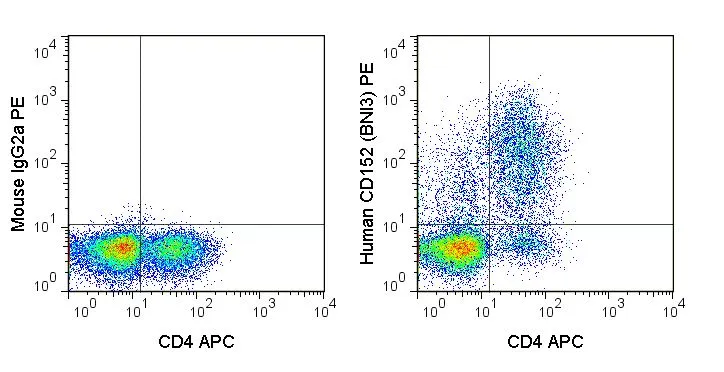
FACS analysis of human PBMC stimulated overnight with PMA and Ionomycin stained APC anti-human CD4 antibody, followed by intracellular staining with GTX00492-08 CTLA4 antibody [BNI3] (PE). Right panel : Co-stained with APC anti-human CD4 antibody and GTX00492-08 Left panel : Co-stained with APC anti-human CD4 antibody and PE mouse IgG2a isotype control Antibody amount : 0.5 microg
FACS analysis of human PBMC stimulated overnight with PMA and Ionomycin stained APC anti-human CD4 antibody, followed by intracellular staining with GTX00492-08 CTLA4 antibody [BNI3] (PE). Right panel : Co-stained with APC anti-human CD4 antibody and GTX00492-08 Left panel : Co-stained with APC anti-human CD4 antibody and PE mouse IgG2a isotype control Antibody amount : 0.5 microg
CTLA4 antibody [BNI3] (PE)
GTX00492-08

ApplicationsFlow Cytometry
Product group Antibodies
ReactivityHuman, Monkey, Primate
TargetCTLA4
Overview
- SupplierGeneTex
- Product NameCTLA4 antibody [BNI3] (PE)
- Delivery Days Customer9
- Application Supplier NoteFACS: 0.5 microg (5 microl) for 105-108 cells in 100 microl sample per test. *Optimal dilutions/concentrations should be determined by the researcher.Not tested in other applications.
- ApplicationsFlow Cytometry
- CertificationResearch Use Only
- ClonalityMonoclonal
- Clone IDBNI3
- Concentration0.1 mg/ml
- ConjugateRPE
- Gene ID1493
- Target nameCTLA4
- Target descriptioncytotoxic T-lymphocyte associated protein 4
- Target synonymsALPS5, CD, CD152, CELIAC3, CTLA-4, GRD4, GSE, IDDM12, cytotoxic T-lymphocyte protein 4, celiac disease 3, cytotoxic T lymphocyte associated antigen 4 short spliced form, cytotoxic T-lymphocyte-associated serine esterase-4, gluten-sensitive enteropathy, insulin-dependent diabetes mellitus 12, ligand and transmembrane spliced cytotoxic T lymphocyte associated antigen 4
- HostMouse
- IsotypeIgG2a
- Protein IDP16410
- Protein NameCytotoxic T-lymphocyte protein 4
- Scientific DescriptionThis gene is a member of the immunoglobulin superfamily and encodes a protein which transmits an inhibitory signal to T cells. The protein contains a V domain, a transmembrane domain, and a cytoplasmic tail. Alternate transcriptional splice variants, encoding different isoforms, have been characterized. The membrane-bound isoform functions as a homodimer interconnected by a disulfide bond, while the soluble isoform functions as a monomer. Mutations in this gene have been associated with insulin-dependent diabetes mellitus, Graves disease, Hashimoto thyroiditis, celiac disease, systemic lupus erythematosus, thyroid-associated orbitopathy, and other autoimmune diseases. [provided by RefSeq, Jul 2008]
- ReactivityHuman, Monkey, Primate
- Storage Instruction2°C to 8°C
- UNSPSC12352203
References
- Zhao Y, Wei Z, Yang H, et al. Enhance the anti-renca carcinoma effect of a DNA vaccine targeting G250 gene by co-expression with cytotoxic T-lymphocyte associated antigen-4(CTLA-4). Biomed Pharmacother. 2017,90:147-152. doi: 10.1016/j.biopha.2017.03.015Read this paper
- Miles B, Miller SM, Folkvord JM, et al. Follicular Regulatory CD8 T Cells Impair the Germinal Center Response in SIV and Ex Vivo HIV Infection. PLoS Pathog. 2016,12(10):e1005924. doi: 10.1371/journal.ppat.1005924Read this paper
- Gibson HM, Mishra A, Chan DV, et al. Impaired proteasome function activates GATA3 in T cells and upregulates CTLA-4: relevance for Sézary syndrome. J Invest Dermatol. 2013,133(1):249-57. doi: 10.1038/jid.2012.265Read this paper
- Moreno-Fernandez ME, Rueda CM, Rusie LK, et al. Regulatory T cells control HIV replication in activated T cells through a cAMP-dependent mechanism. Blood. 2011,117(20):5372-80. doi: 10.1182/blood-2010-12-323162Read this paper
- Green AM, Mattila JT, Bigbee CL, et al. CD4(+) regulatory T cells in a cynomolgus macaque model of Mycobacterium tuberculosis infection. J Infect Dis. 2010,202(4):533-41. doi: 10.1086/654896Read this paper
- Schönfeld D, Matschiner G, Chatwell L, et al. An engineered lipocalin specific for CTLA-4 reveals a combining site with structural and conformational features similar to antibodies. Proc Natl Acad Sci U S A. 2009,106(20):8198-203. doi: 10.1073/pnas.0813399106Read this paper
- Bonzheim I, Geissinger E, Tinguely M, et al. Evaluation of FoxP3 expression in peripheral T-cell lymphoma. Am J Clin Pathol. 2008,130(4):613-9. doi: 10.1309/L65GWEQ803PP6VX1Read this paper
- Young NT, Waller EC, Patel R, et al. The inhibitory receptor LILRB1 modulates the differentiation and regulatory potential of human dendritic cells. Blood. 2008,111(6):3090-6.Read this paper
- Jonuleit H, Schmitt E, Stassen M, et al. Identification and functional characterization of human CD4(+)CD25(+) T cells with regulatory properties isolated from peripheral blood. J Exp Med. 2001,193(11):1285-94.Read this paper
- Oaks MK, Hallett KM. Cutting edge: a soluble form of CTLA-4 in patients with autoimmune thyroid disease. J Immunol. 2000,164(10):5015-8.Read this paper
Datasheet
Related products
Product group Antibodies

Anti-CTLA-4 [CP-675,206 (Tremelimumab, 11.2.1)]Ab02327-10.0
ApplicationsFlow Cytometry, ELISA, Neutralisation/Blocking
ReactivityHuman, Monkey
TargetCTLA4
- SizePrice
Product group Antibodies

ApplicationsImmunoPrecipitation, Western Blot, ImmunoCytoChemistry, ImmunoHistoChemistry
ReactivityPorcine
TargetCTLA4
- SizePrice
Product group Antibodies

Anti-CTLA4 Antibody144-60535
ApplicationsWestern Blot
ReactivityHuman
TargetCTLA4
- SizePrice

![WB analysis of HEK293 overexpressing human CTLA-4 using GTX52659 CTLA4 antibody [8F16].](https://www.genetex.com/upload/website/prouct_img/normal/GTX52659/GTX52659_20191119_WB_w_23060900_874.webp)
Product group Antibodies
CTLA4 antibody [8F16]GTX52659
ApplicationsWestern Blot
ReactivityHuman
TargetCTLA4
- SizePrice
Product group Antibodies
References
CTLA4 antibody [BNI3]GTX75283
ApplicationsFlow Cytometry, ImmunoPrecipitation, ELISA, ImmunoHistoChemistry, ImmunoHistoChemistry Frozen, ImmunoHistoChemistry Paraffin, Neutralisation/Blocking, Other Application
ReactivityHuman, Monkey, Primate
TargetCTLA4
- SizePrice
Product group Antibodies
ApplicationsImmunoHistoChemistry, ImmunoHistoChemistry Paraffin
ReactivityHuman
TargetCTLA4
- SizePrice
Product group Antibodies
References
CTLA4 antibody [BNI3] (Low Endotoxin)GTX00492-00
ApplicationsFlow Cytometry, ImmunoFluorescence, ImmunoPrecipitation, ImmunoCytoChemistry, ImmunoHistoChemistry, ImmunoHistoChemistry Frozen, ImmunoHistoChemistry Paraffin
ReactivityHuman
TargetCTLA4
- SizePrice
Product group Antibodies
References
CTLA4 antibody [BNI3] (APC)GTX00492-07
ApplicationsFlow Cytometry
ReactivityHuman
TargetCTLA4
- SizePrice
Product group Antibodies
References
CTLA4 antibody [BNI3] (PE-Cy5)GTX00492-09
ApplicationsFlow Cytometry
ReactivityHuman
TargetCTLA4
- SizePrice