

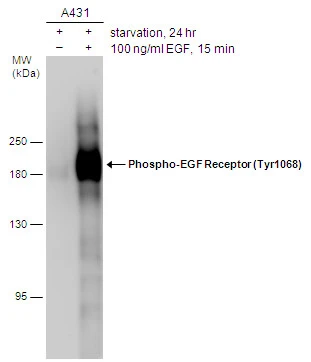
Untreated (–) and treated (+) A431 whole cell extracts (20 μg) were separated by 7.5% SDS-PAGE, and the membrane was blotted with Phospho-EGF Receptor (Tyr1068) antibody (GTX132810) diluted at 1:2000.
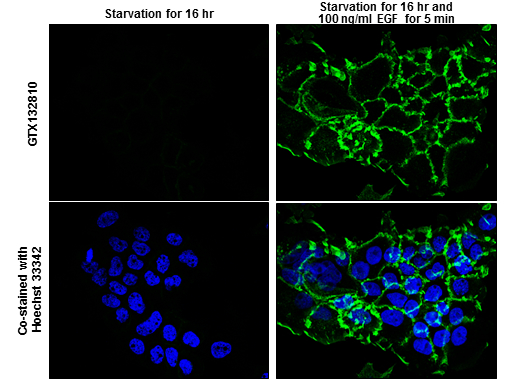
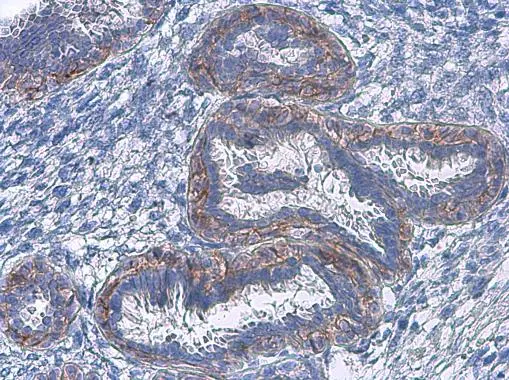
Untreated (–) and treated (+) A431 whole cell extracts (20 μg) were separated by 7.5% SDS-PAGE, and the membrane was blotted with Phospho-EGF Receptor (Tyr1068) antibody (GTX132810) diluted at 1:2000.
EGFR (phospho Tyr1068) antibody
GTX132810

ApplicationsImmunoFluorescence, Western Blot, ImmunoCytoChemistry, ImmunoHistoChemistry, ImmunoHistoChemistry Paraffin
Product group Antibodies
ReactivityHuman, Mouse, Rat
TargetEGFR
Overview
- SupplierGeneTex
- Product NameEGFR (phospho Tyr1068) antibody
- Delivery Days Customer9
- Application Supplier NoteWB: 1:500-1:3000. ICC/IF: 1:100-1:1000. IHC-P: 1:100-1:1000. *Optimal dilutions/concentrations should be determined by the researcher.Not tested in other applications.
- ApplicationsImmunoFluorescence, Western Blot, ImmunoCytoChemistry, ImmunoHistoChemistry, ImmunoHistoChemistry Paraffin
- CertificationResearch Use Only
- ClonalityPolyclonal
- Concentration0.09 mg/ml
- ConjugateUnconjugated
- Gene ID1956
- Target nameEGFR
- Target descriptionepidermal growth factor receptor
- Target synonymsERBB, ERBB1, ERRP, HER1, NISBD2, NNCIS, PIG61, mENA, epidermal growth factor receptor, EGFR vIII, avian erythroblastic leukemia viral (v-erb-b) oncogene homolog, cell growth inhibiting protein 40, cell proliferation-inducing protein 61, epidermal growth factor receptor tyrosine kinase domain, erb-b2 receptor tyrosine kinase 1, proto-oncogene c-ErbB-1, receptor tyrosine-protein kinase erbB-1
- HostRabbit
- IsotypeIgG
- Protein IDP00533
- Protein NameEpidermal growth factor receptor
- Scientific DescriptionThe protein encoded by this gene is a transmembrane glycoprotein that is a member of the protein kinase superfamily. This protein is a receptor for members of the epidermal growth factor family. EGFR is a cell surface protein that binds to epidermal growth factor. Binding of the protein to a ligand induces receptor dimerization and tyrosine autophosphorylation and leads to cell proliferation. Mutations in this gene are associated with lung cancer. [provided by RefSeq]
- ReactivityHuman, Mouse, Rat
- Storage Instruction-20°C or -80°C,2°C to 8°C
- UNSPSC12352203
References
- Nango H, Ohtani M. S-1-propenyl-L-cysteine suppresses lipopolysaccharide-induced expression of matrix metalloproteinase-1 through inhibition of tumor necrosis factor-α converting enzyme-epidermal growth factor receptor axis in human gingival fibroblasts. PLoS One. 2023,18(4):e0284713. doi: 10.1371/journal.pone.0284713Read this paper
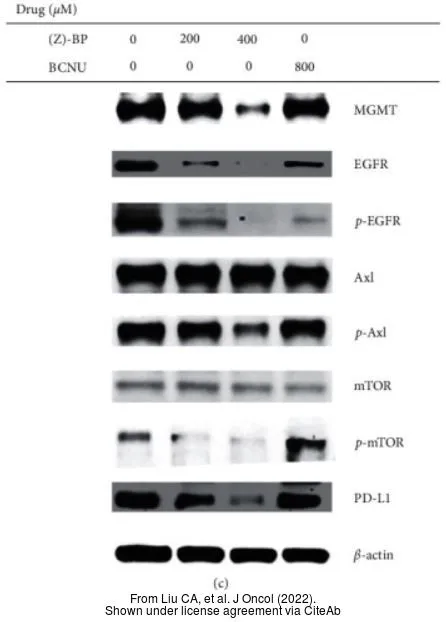
- Liu CA, Harn HJ, Chen KP, et al. Targeting the Axl and mTOR Pathway Synergizes Immunotherapy and Chemotherapy to Butylidenephthalide in a Recurrent GBM. J Oncol. 2022,2022:3236058. doi: 10.1155/2022/3236058Read this paper
- Jao TM, Fang WH, Ciou SC, et al. PCDH10 exerts tumor-suppressor functions through modulation of EGFR/AKT axis in colorectal cancer. Cancer Lett. 2021,499:290-300. doi: 10.1016/j.canlet.2020.11.017Read this paper
- Li J, Ma J, Tian Y, et al. Effective-component compatibility of Bufei Yishen formula II inhibits mucus hypersecretion of chronic obstructive pulmonary disease rats by regulating EGFR/PI3K/mTOR signaling. J Ethnopharmacol. 2020,257:112796. doi: 10.1016/j.jep.2020.112796Read this paper
- Wang CH, Chang CH, Lin TL, et al. The novel application of cordycepin in maintaining stem cell pluripotency and increasing iPS cell generation efficiency. Sci Rep. 2020,10(1):2187. doi: 10.1038/s41598-020-59154-5Read this paper
- Nocita E, Del Giovane A, Tiberi M, et al. EGFR/ErbB Inhibition Promotes OPC Maturation up to Axon Engagement by Co-Regulating PIP2 and MBP. Cells. 2019,8(8). doi: 10.3390/cells8080844Read this paper
- Lin TY, Chang CC, Tseng AJ, et al. Sodium thiosulfate enhances production of polysaccharides and anticancer activities of sulfated polysaccharides in Antrodia cinnamomea. Carbohydr Polym. 2019,216:204-212. doi: 10.1016/j.carbpol.2019.04.017Read this paper
- Segawa R, Shigeeda K, Hatayama T, et al. EGFR transactivation is involved in TNF-α-induced expression of thymic stromal lymphopoietin in human keratinocyte cell line. J Dermatol Sci. 2018,89(3):290-298. doi: 10.1016/j.jdermsci.2017.12.008Read this paper
Datasheet
Related products
Product group Antibodies

Anti-EGFR [C225 (Cetuximab)]Ab00279-1.1
ApplicationsFlow Cytometry, Neutralisation/Blocking
ReactivityHuman
TargetEGFR
- SizePrice
Product group Antibodies

EGFR-S1026 AntibodyABX032521
ApplicationsFlow Cytometry, Western Blot, ELISA, ImmunoHistoChemistry
- SizePrice
Product group Antibodies

ApplicationsFlow Cytometry
TargetEGFR
- SizePrice

Product group Antibodies

Anti-EGFR AntibodyAMAB90816
ApplicationsWestern Blot, ImmunoHistoChemistry
ReactivityHuman
TargetEGFR
- SizePrice

Product group Antibodies

Anti-EGFR (N-term) Antibody131-0167
ApplicationsELISA
ReactivityHuman
TargetEGFR
- SizePrice

Product group Antibodies

Anti-EGFR Antibody Picoband(r)A00023-4-CARRIER-FREE
ApplicationsFlow Cytometry, ImmunoFluorescence, Western Blot, ELISA, ImmunoCytoChemistry, ImmunoHistoChemistry
ReactivityHuman, Mouse, Rat
TargetEGFR
- SizePrice
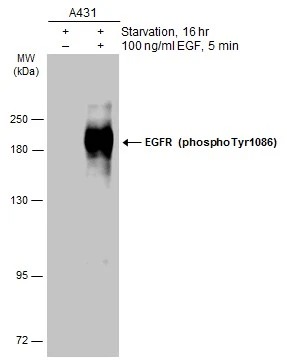
Product group Antibodies
EGFR (phospho Tyr1086) antibodyGTX133421
ApplicationsImmunoFluorescence, Western Blot, ImmunoCytoChemistry
ReactivityHuman
TargetEGFR
- SizePrice
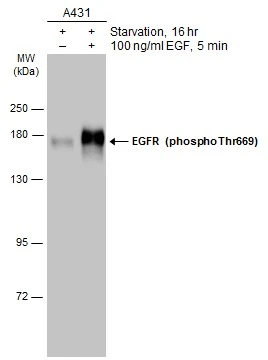
Product group Antibodies
EGFR (phospho Thr669) antibodyGTX133425
ApplicationsWestern Blot
ReactivityHuman
TargetEGFR
- SizePrice
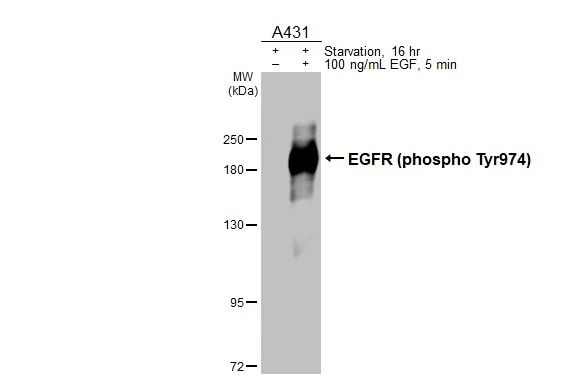
Product group Antibodies
EGFR (phospho Tyr974) antibodyGTX133427
ApplicationsWestern Blot
ReactivityHuman
TargetEGFR
- SizePrice