

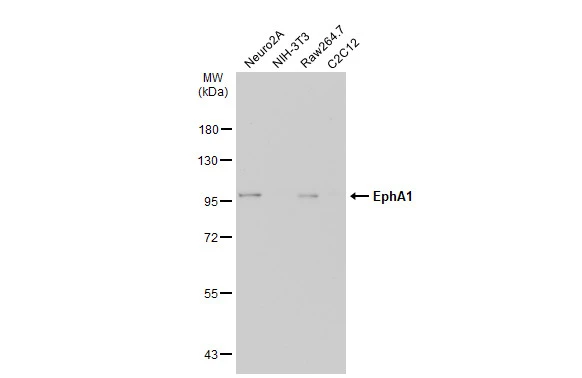
Various whole cell extracts (30 μg) were separated by 7.5% SDS-PAGE, and the membrane was blotted with EphA1 antibody [C1C3-2] (GTX111449) diluted at 1:1000. The HRP-conjugated anti-rabbit IgG antibody (GTX213110-01) was used to detect the primary antibody, and the signal was developed with Trident ECL plus-Enhanced.
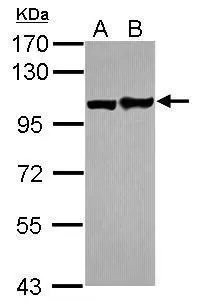
Various whole cell extracts (30 μg) were separated by 7.5% SDS-PAGE, and the membrane was blotted with EphA1 antibody [C1C3-2] (GTX111449) diluted at 1:1000. The HRP-conjugated anti-rabbit IgG antibody (GTX213110-01) was used to detect the primary antibody, and the signal was developed with Trident ECL plus-Enhanced.
EphA1 antibody [C1C3-2]
GTX111449

ApplicationsWestern Blot
Product group Antibodies
ReactivityHuman, Mouse
TargetEPHA1
Overview
- SupplierGeneTex
- Product NameEphA1 antibody [C1C3-2]
- Delivery Days Customer9
- Application Supplier NoteWB: 1:500-1:3000. *Optimal dilutions/concentrations should be determined by the researcher.Not tested in other applications.
- ApplicationsWestern Blot
- CertificationResearch Use Only
- ClonalityPolyclonal
- Concentration1 mg/ml
- ConjugateUnconjugated
- Gene ID2041
- Target nameEPHA1
- Target descriptionEPH receptor A1
- Target synonymsEPH, EPHT, EPHT1, ephrin type-A receptor 1, eph tyrosine kinase 1, erythropoietin-producing hepatoma amplified sequence, erythropoietin-producing hepatoma receptor, hEpha1, oncogene EPH, tyrosine-protein kinase receptor EPH
- HostRabbit
- IsotypeIgG
- Protein IDP21709
- Protein NameEphrin type-A receptor 1
- Scientific DescriptionThis gene belongs to the ephrin receptor subfamily of the protein-tyrosine kinase family. EPH and EPH-related receptors have been implicated in mediating developmental events, particularly in the nervous system. Receptors in the EPH subfamily typically have a single kinase domain and an extracellular region containing a Cys-rich domain and 2 fibronectin type III repeats. The ephrin receptors are divided into 2 groups based on the similarity of their extracellular domain sequences and their affinities for binding ephrin-A and ephrin-B ligands. This gene is expressed in some human cancer cell lines and has been implicated in carcinogenesis. [provided by RefSeq]
- ReactivityHuman, Mouse
- Storage Instruction-20°C or -80°C,2°C to 8°C
- UNSPSC41116161
Datasheet
Related products
Product group Antibodies

Anti-EPHA1 AntibodyA99825
ApplicationsImmunoFluorescence, Western Blot, ELISA
ReactivityHuman
- SizePrice
Product group Antibodies

Anti-EPHA1 Antibody144-07328
ApplicationsWestern Blot
ReactivityHuman, Mouse
TargetEPHA1
- SizePrice
Product group Antibodies

Eph receptor A1 Polyclonal AntibodyBS-15514R
ApplicationsImmunoFluorescence, ELISA, ImmunoCytoChemistry, ImmunoHistoChemistry, ImmunoHistoChemistry Frozen, ImmunoHistoChemistry Paraffin
ReactivityCanine, Equine, Human, Mouse, Porcine, Rabbit, Rat
TargetEPHA1
- SizePrice
Product group Antibodies

EPHA1 AntibodyCSB-PA002360
ApplicationsImmunoFluorescence, Western Blot, ELISA, ImmunoHistoChemistry
ReactivityHuman
TargetEPHA1
- SizePrice
Product group Antibodies

EPHA1 Polyclonal AntibodyCAC14587
ApplicationsImmunoFluorescence, Western Blot, ELISA, ImmunoHistoChemistry
ReactivityMouse
TargetEPHA1
- SizePrice
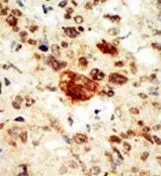
Product group Antibodies
EphA1 antibodyGTX25385
ApplicationsWestern Blot, ImmunoHistoChemistry, ImmunoHistoChemistry Paraffin
ReactivityHuman
TargetEPHA1
- SizePrice
Product group Antibodies
EphA1 antibodyGTX27036
ApplicationsWestern Blot, ELISA
ReactivityHuman
TargetEPHA1
- SizePrice
Product group Antibodies

ApplicationsImmunoFluorescence, Western Blot, ImmunoCytoChemistry, ImmunoHistoChemistry, ImmunoHistoChemistry Paraffin
ReactivityHuman
TargetEPHA1
- SizePrice
![WB analysis of A549 (1) and HeLa (2) cell lysate using GTX83346 EphA1 antibody [5D2].](https://www.genetex.com/upload/website/prouct_img/normal/GTX83346/GTX83346_20170912_WB_w_23061322_738.webp)
Product group Antibodies
EphA1 antibody [5D2]GTX83346
ApplicationsWestern Blot, ELISA, ImmunoHistoChemistry, ImmunoHistoChemistry Paraffin
ReactivityHuman
TargetEPHA1
- SizePrice
Product group Antibodies
EphA1 antibody [8D36]GTX52714
ApplicationsWestern Blot, ImmunoHistoChemistry, ImmunoHistoChemistry Frozen
ReactivityHuman
TargetEPHA1
- SizePrice