

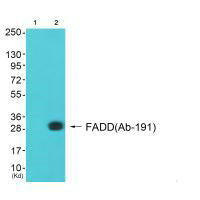
Western blot analysis of extracts from A549 cells (Lane 2), using FADD (Ab-191) antiobdy. The lane on the left is treated with synthesized peptide.
Western blot analysis of extracts from A549 cells (Lane 2), using FADD (Ab-191) antiobdy. The lane on the left is treated with synthesized peptide.
FADD (Ab-191) Antibody
CSB-PA975869

ApplicationsWestern Blot, ELISA
Product group Antibodies
ReactivityHuman, Mouse
TargetFadd
Overview
- SupplierCusabio
- Product NameFADD (Ab-191) Antibody
- Delivery Days Customer20
- ApplicationsWestern Blot, ELISA
- CertificationResearch Use Only
- ClonalityPolyclonal
- ConjugateUnconjugated
- Gene ID14082
- Target nameFadd
- Target descriptionFas associated via death domain
- Target synonymsMort1/FADD, FAS-associated death domain protein, FAS-associating death domain-containing protein, Fas (TNFRSF6)-associated via death domain, Fas-associating protein with death domain, mediator of receptor induced toxicity, protein FADD
- HostRabbit
- IsotypeIgG
- Protein IDQ61160
- Protein NameFAS-associated death domain protein
- Scientific DescriptionApoptotic adaptor molecule that recruits caspase-8 or caspase-10 to the activated Fas (CD95) or TNFR-1 receptors. The resulting aggregate called the death-inducing signaling complex (DISC) performs caspase-8 proteolytic activation. Active caspase-8 initiates the subsequent cascade of caspases mediating apoptosis By similarity. Involved in interferon-mediated antiviral immune response, playing a role in the positive regulation of interferon signaling By similarity. Zhang J., Mol. Cell. Biol. 16:2756-2763(1996). Hsu H., Cell 84:299-308(1996). Carninci P., Science 309:1559-1563(2005)
- ReactivityHuman, Mouse
- Storage Instruction-20°C or -80°C
- UNSPSC41116161
Related products

Product group Antibodies

Anti-FADD Antibody Picoband(r)A00237-3-CARRIER-FREE
ApplicationsFlow Cytometry, Western Blot, ImmunoHistoChemistry
ReactivityMouse, Rat
TargetFadd
- SizePrice
Product group Antibodies

ApplicationsWestern Blot, ImmunoHistoChemistry
ReactivityMouse, Rat
TargetFadd
- SizePrice
Product group Antibodies
References

FADD Polyclonal AntibodyBS-0511R
ApplicationsImmunoFluorescence, Western Blot, ELISA, ImmunoCytoChemistry, ImmunoHistoChemistry, ImmunoHistoChemistry Frozen, ImmunoHistoChemistry Paraffin
ReactivityHuman, Mouse, Porcine, Rat
TargetFadd
- SizePrice