

Goat anti-STAP2 / BKS
EB05127

ApplicationsWestern Blot, ELISA
Product group Antibodies
ReactivityHuman
TargetSTAP2
Overview
- SupplierEverest Biotech
- Product NameGoat anti-STAP2 / BKS
- Delivery Days Customer5
- ApplicationsWestern Blot, ELISA
- Applications SupplierPep-ELISA, WB
- CertificationResearch Use Only
- ClonalityPolyclonal
- Concentration0.5 mg/ml
- Gene ID55620
- Target nameSTAP2
- Target descriptionsignal transducing adaptor family member 2
- Target synonymsBKS, signal-transducing adaptor protein 2, BRK substrate, breast tumor kinase substrate, brk kinase substrate
- HostGoat
- Scientific DescriptionRefSeq number(s): NP_060190.2; NP_001013863.1. Purification: Antigen affinity purified. Names and symbols: STAP2; BKS; STAP-2; FLJ20234; breast tumor kinase substrate; brk kinase substrate; signal-transducing adaptor protein-2; signal transducing adaptor family member 2
- ReactivityHuman
- Reactivity SupplierHuman
- Storage Instruction-20°C
- UNSPSC12352203
References
- Ikeda O, Mizushima A, Sekine Y, et al. Involvement of STAP-2 in Brk-mediated phosphorylation and activation of STAT5 in breast cancer cells. Cancer Sci. 2011,102(4):756-61. doi: 10.1111/j.1349-7006.2010.01842.xRead this paper
- Ikeda O, Sekine Y, Mizushima A, et al. Interactions of STAP-2 with Brk and STAT3 participate in cell growth of human breast cancer cells. J Biol Chem. 2010,285(49):38093-103. doi: 10.1074/jbc.M110.162388Read this paper
- Sekine Y, Ikeda O, Tsuji S, et al. Signal-transducing adaptor protein-2 regulates stromal cell-derived factor-1 alpha-induced chemotaxis in T cells. J Immunol. 2009,183(12):7966-74. doi: 10.4049/jimmunol.0902096Read this paper
- Ikeda O, Miyasaka Y, Sekine Y, et al. STAP-2 is phosphorylated at tyrosine-250 by Brk and modulates Brk-mediated STAT3 activation. Biochem Biophys Res Commun. 2009,384(1):71-5. doi: 10.1016/j.bbrc.2009.04.076Read this paper
Related products

Product group Antibodies

Anti-STAP2 Antibody Picoband(r)A08413-3-CARRIER-FREE
ApplicationsFlow Cytometry, Western Blot, ELISA, ImmunoHistoChemistry
ReactivityHuman
TargetSTAP2
- SizePrice
Product group Antibodies

Anti-STAP2 Antibody144-64131
ApplicationsWestern Blot
ReactivityHuman, Mouse
TargetSTAP2
- SizePrice
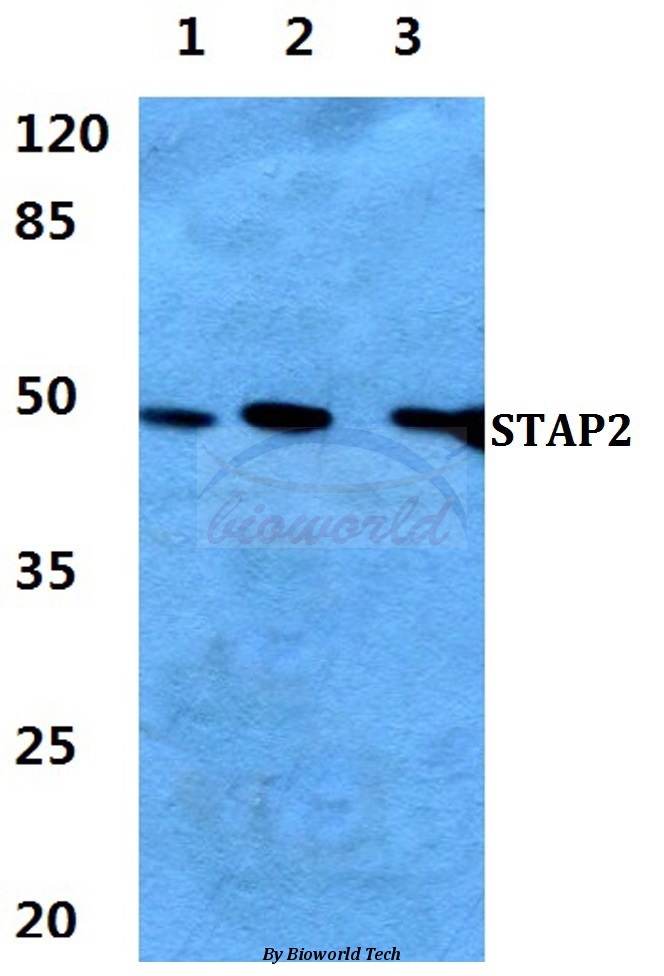
Product group Antibodies

Anti-STAP2 AntibodyA28474
ApplicationsWestern Blot
ReactivityHuman, Mouse, Rat
- SizePrice
Product group Antibodies
ApplicationsWestern Blot, ELISA, ImmunoHistoChemistry
ReactivityHuman
TargetSTAP2
- SizePrice
Product group Antibodies
Goat anti-Stap2 (mouse)EB11480
ApplicationsWestern Blot, ELISA
ReactivityBovine, Mouse, Rat
TargetStap2
- SizePrice
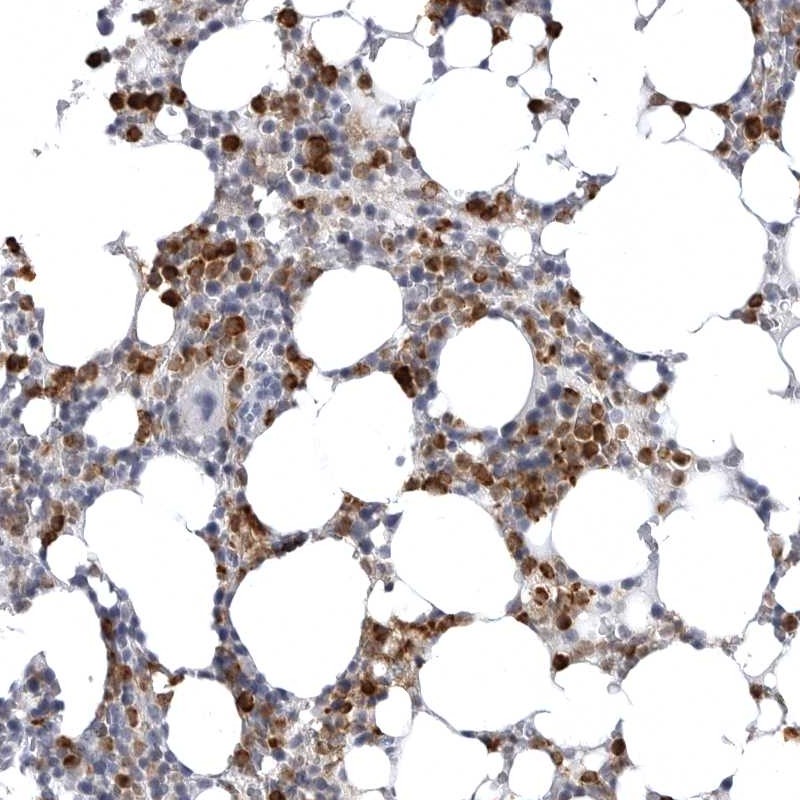
Product group Antibodies

Anti-STAP2 AntibodyHPA027761
ApplicationsImmunoHistoChemistry
ReactivityHuman
TargetSTAP2
- SizePrice
Product group Antibodies

STAP2 Antibody (Internal)LS-C353484
ApplicationsWestern Blot
ReactivityHuman, Mouse, Rat
TargetSTAP2
- SizePrice
Product group Antibodies

STAP2 Polyclonal AntibodyBS-13667R
ApplicationsImmunoFluorescence, Western Blot, ELISA, ImmunoCytoChemistry, ImmunoHistoChemistry, ImmunoHistoChemistry Frozen, ImmunoHistoChemistry Paraffin
ReactivityHuman
TargetSTAP2
- SizePrice
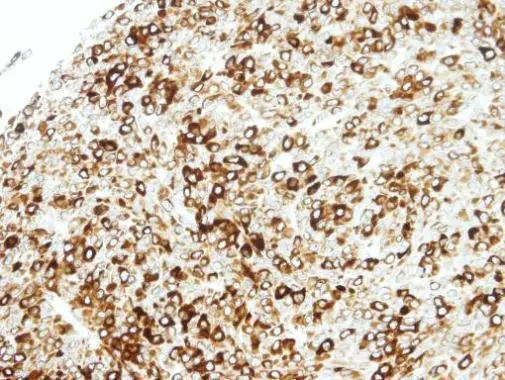
Product group Antibodies

STAP2 antibody [C3], C-termGTX106287
ApplicationsImmunoFluorescence, Western Blot, ImmunoCytoChemistry, ImmunoHistoChemistry, ImmunoHistoChemistry Paraffin
ReactivityHuman
TargetSTAP2
- SizePrice