

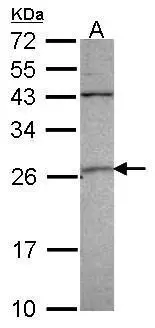
Sample (30 ug of whole cell lysate) A: 293T 12% SDS PAGE GST A4 antibody GTX104390 diluted at 1:1000
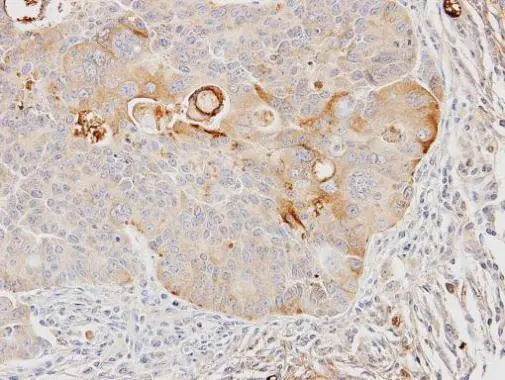
Sample (30 ug of whole cell lysate) A: 293T 12% SDS PAGE GST A4 antibody GTX104390 diluted at 1:1000
GSTA4 antibody [N1C3]
GTX104390

ApplicationsWestern Blot, ImmunoHistoChemistry, ImmunoHistoChemistry Paraffin
Product group Antibodies
ReactivityHuman, Porcine
TargetGSTA4
Overview
- SupplierGeneTex
- Product NameGSTA4 antibody [N1C3]
- Delivery Days Customer9
- Application Supplier NoteWB: 1:500-1:3000. IHC-P: 1:100-1:1000. *Optimal dilutions/concentrations should be determined by the researcher.Not tested in other applications.
- ApplicationsWestern Blot, ImmunoHistoChemistry, ImmunoHistoChemistry Paraffin
- CertificationResearch Use Only
- ClonalityPolyclonal
- Concentration1 mg/ml
- ConjugateUnconjugated
- Gene ID2941
- Target nameGSTA4
- Target descriptionglutathione S-transferase alpha 4
- Target synonymsGSTA4-4, GTA4, glutathione S-transferase A4, GST class-alpha member 4, S-(hydroxyalkyl)glutathione lyase A4, glutathione S-alkyltransferase A4, glutathione S-aralkyltransferase A4, glutathione S-aryltransferase A4, glutathione S-transferase A4-4, glutathione transferase A4-4
- HostRabbit
- IsotypeIgG
- Protein IDO15217
- Protein NameGlutathione S-transferase A4
- Scientific DescriptionCytosolic and membrane-bound forms of glutathione S-transferase are encoded by two distinct supergene families. These enzymes are involved in cellular defense against toxic, carcinogenic, and pharmacologically active electrophilic compounds. At present, eight distinct classes of the soluble cytoplasmic mammalian glutathione S-transferases have been identified: alpha, kappa, mu, omega, pi, sigma, theta and zeta. This gene encodes a glutathione S-tranferase belonging to the alpha class. The alpha class genes, which are located in a cluster on chromosome 6, are highly related and encode enzymes with glutathione peroxidase activity that function in the detoxification of lipid peroxidation products. Reactive electrophiles produced by oxidative metabolism have been linked to a number of degenerative diseases including Parkinsons disease, Alzheimers disease, cataract formation, and atherosclerosis. [provided by RefSeq]
- ReactivityHuman, Porcine
- Storage Instruction-20°C or -80°C,2°C to 8°C
- UNSPSC41116161
Datasheet
Related products
Product group Antibodies

GSTA4 AntibodyCSB-PA009973ESR1HU
ApplicationsWestern Blot, ELISA, ImmunoHistoChemistry
ReactivityHuman
TargetGSTA4
- SizePrice
Product group Antibodies

Goat anti-GSTA4EB12978
ApplicationsWestern Blot, ELISA
ReactivityHuman
TargetGSTA4
- SizePrice

Product group Antibodies

Anti-GSTA4 Antibody Picoband(r)A03699-1-CARRIER-FREE
ApplicationsFlow Cytometry, Western Blot, ELISA, ImmunoHistoChemistry
ReactivityHuman, Monkey
TargetGSTA4
- SizePrice
Product group Antibodies

GSTA4 Antibody (aa1-222, FITC)LS-C369737
ApplicationsELISA
ReactivityHuman
TargetGSTA4
- SizePrice
Product group Antibodies

ApplicationsImmunoPrecipitation, Western Blot, ImmunoCytoChemistry, ImmunoHistoChemistry
ReactivityPorcine
TargetGSTA4
- SizePrice
![WB analysis of HEK293T cells transfected with GSTA4 plasmid (Right) or empty vector (Left) for 48 hrs using GTX84404 GSTA4 antibody [1E2]. Loading : 5 ug per lane](https://www.genetex.com/upload/website/prouct_img/normal/GTX84404/GTX84404_4341_WB_w_23061420_219.webp)
Product group Antibodies
GSTA4 antibody [1E2]GTX84404
ApplicationsWestern Blot
ReactivityHuman
TargetGSTA4
- SizePrice
![FACS analysis of HeLa cells using GTX84405 GSTA4 antibody [3F5]. Red : Primary antibody Blue : Negative control antibody](https://www.genetex.com/upload/website/prouct_img/normal/GTX84405/GTX84405_402_FACS_w_23061420_615.webp)
Product group Antibodies
GSTA4 antibody [3F5]GTX84405
ApplicationsFlow Cytometry, Western Blot, ImmunoHistoChemistry, ImmunoHistoChemistry Paraffin
ReactivityHuman
TargetGSTA4
- SizePrice
Product group Antibodies

Anti-GSTA4 Antibody107-10449
ApplicationsWestern Blot, ImmunoHistoChemistry, ImmunoHistoChemistry Paraffin
ReactivityHuman, Porcine
TargetGSTA4
- SizePrice
Product group Antibodies

GSTA4 Recombinant AntibodyBSM-62798R
ApplicationsWestern Blot
ReactivityHuman, Rat
TargetGSTA4
- SizePrice