

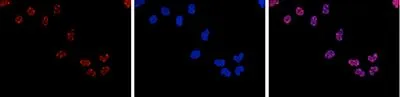
ICC/IF analysis of 4% paraformaldehyde fixed HeLa cells using GTX60366 HDAC3 antibody [GT9007]. Red : Primary antibody Blue : DAPI Dilution : 1:500
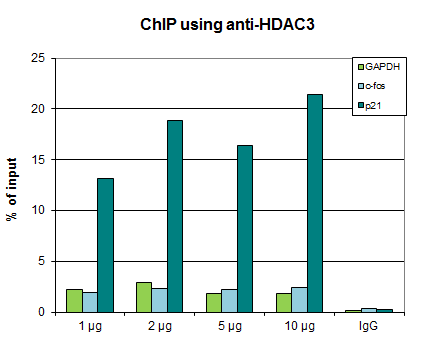
![ChIP analysis of sheared chromatin from 10? HeLa cells using GTX60366 HDAC3 antibody [GT9007]. A titration of the antibody consisting of 1, 2, 5, and 10 μg per ChIP experiment was analysed. IgG (5 μg/IP) was used as negative IP control. QPCR was performed with primers for the promoters of the active genes c-fos and GAPDH, and for the coding region of p21, a known target gene of HDAC3. Figure 4 shows the recovery, expressed as a % of input (the relative amount of immunoprecipitated DNA compared to input DNA after qPCR analysis).](https://www.genetex.com/upload/website/prouct_img/normal/GTX60366/GTX60366_20201117_ChIP_152_w_23061123_873.webp "ChIP analysis of sheared chromatin from 10? HeLa cells using GTX60366 HDAC3 antibody [GT9007]. A titration of the antibody consisting of 1, 2, 5, and 10 μg per ChIP experiment was analysed. IgG (5 μg/IP) was used as negative IP control. QPCR was performed with primers for the promoters of the active genes c-fos and GAPDH, and for the coding region of p21, a known target gene of HDAC3. Figure 4 shows the recovery, expressed as a % of input (the relative amount of immunoprecipitated DNA compared to input DNA after qPCR analysis).")
ICC/IF analysis of 4% paraformaldehyde fixed HeLa cells using GTX60366 HDAC3 antibody [GT9007]. Red : Primary antibody Blue : DAPI Dilution : 1:500
HDAC3 antibody [GT9007]
GTX60366

ApplicationsImmunoFluorescence, ChIP Chromatin ImmunoPrecipitation, ImmunoCytoChemistry
Product group Antibodies
ReactivityHuman
TargetHDAC3
Overview
- SupplierGeneTex
- Product NameHDAC3 antibody [GT9007]
- Delivery Days Customer9
- Application Supplier NoteICC/IF: 1:500. ChIP assay: 1-5 microg. *Optimal dilutions/concentrations should be determined by the researcher.Not tested in other applications.
- ApplicationsImmunoFluorescence, ChIP Chromatin ImmunoPrecipitation, ImmunoCytoChemistry
- CertificationResearch Use Only
- ClonalityMonoclonal
- Clone IDGT9007
- Concentration2 mg/ml
- ConjugateUnconjugated
- Gene ID8841
- Target nameHDAC3
- Target descriptionhistone deacetylase 3
- Target synonymsHD3, KDAC3, RPD3, RPD3-2, histone deacetylase 3, SMAP45, protein deacetylase HDAC3, protein deacylase HDAC3
- HostMouse
- IsotypeIgG1
- Protein IDO15379
- Protein NameHistone deacetylase 3
- Scientific DescriptionHistones play a critical role in transcriptional regulation, cell cycle progression, and developmental events. Histone acetylation/deacetylation alters chromosome structure and affects transcription factor access to DNA. The protein encoded by this gene belongs to the histone deacetylase/acuc/apha family. It has histone deacetylase activity and represses transcription when tethered to a promoter. It may participate in the regulation of transcription through its binding with the zinc-finger transcription factor YY1. This protein can also down-regulate p53 function and thus modulate cell growth and apoptosis. This gene is regarded as a potential tumor suppressor gene. [provided by RefSeq, Jul 2008]
- ReactivityHuman
- Storage Instruction-20°C or -80°C,2°C to 8°C
- UNSPSC12352203
Datasheet
Related products

Product group Antibodies

Anti-HDAC3 Antibody Picoband(r)A00839-CARRIER-FREE
ApplicationsFlow Cytometry, Western Blot, ELISA
ReactivityHuman, Mouse, Rat
TargetHDAC3
- SizePrice
Product group Antibodies

ApplicationsImmunoFluorescence, ChIP Chromatin ImmunoPrecipitation
ReactivityHuman
TargetHDAC3
- SizePrice
Product group Antibodies

Anti-HDAC3 Antibody144-02139
ApplicationsImmunoFluorescence, ImmunoPrecipitation, Western Blot, ChIP Chromatin ImmunoPrecipitation, ImmunoHistoChemistry
ReactivityHuman, Mouse, Rat
TargetHDAC3
- SizePrice
Product group Antibodies

HDAC3 Polyclonal AntibodyCAC13761
ApplicationsImmunoFluorescence, Western Blot, ChIP Chromatin ImmunoPrecipitation, ELISA, ImmunoHistoChemistry
ReactivityMouse
TargetHDAC3
- SizePrice
Product group Antibodies

ApplicationsFlow Cytometry, Western Blot, ImmunoCytoChemistry
ReactivityHuman, Mouse, Rat
TargetHDAC3
- SizePrice

Product group Antibodies

HDAC3 AntibodyCSB-PA002880
ApplicationsImmunoFluorescence, Western Blot, ELISA, ImmunoHistoChemistry
ReactivityHuman, Mouse, Rat
TargetHDAC3
- SizePrice


Product group Antibodies

Anti-HDAC3 AntibodyHPA052052
ApplicationsWestern Blot, ChIP Chromatin ImmunoPrecipitation, ImmunoCytoChemistry, ImmunoHistoChemistry
ReactivityHuman
TargetHDAC3
- SizePrice
![IHC-P analysis of human esophagus cancer (left) and breast carcinoma tissue (right) using GTX83172 HDAC3 antibody [3A7B5].](https://www.genetex.com/upload/website/prouct_img/normal/GTX83172/GTX83172_20170912_IHC-P_w_23061322_791.webp)
Product group Antibodies
HDAC3 antibody [3A7B5]GTX83172
ApplicationsWestern Blot, ELISA, ImmunoHistoChemistry, ImmunoHistoChemistry Paraffin
ReactivityHuman
TargetHDAC3
- SizePrice