

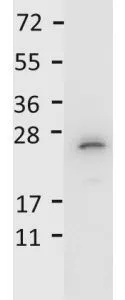
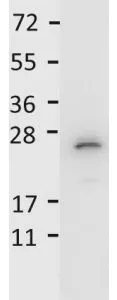
Detection of recombinant IL27/p28 protein by anti-Mouse IL-27/p28 antibody (GTX48686). Recombinant mouse IL27/p28 was loaded on to an SDS-PAGE gel at 0.25 μg and after separation, transferred to nitrocellulose. The membrane was blocked with 1% BSA in TBST for 30 min at RT, followed by incubation with primary antibody diluted 1:1,000 in 1% BSA in TBST overnight at 4oC. After washes, the blot was reacted with secondary antibody HRP Goat anti-Rabbit IgG antibody diluted 1:40,000 in blocking buffer for 30 min at RT. Data was collected using Bio-Rad VersaDocR 4000 MP imaging system.
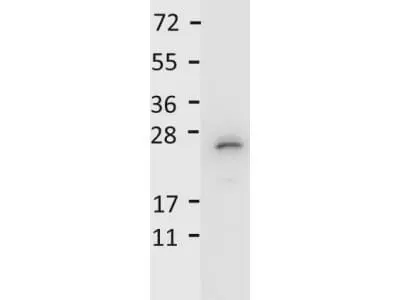
Detection of recombinant IL27/p28 protein by anti-Mouse IL-27/p28 antibody (GTX48686). Recombinant mouse IL27/p28 was loaded on to an SDS-PAGE gel at 0.25 μg and after separation, transferred to nitrocellulose. The membrane was blocked with 1% BSA in TBST for 30 min at RT, followed by incubation with primary antibody diluted 1:1,000 in 1% BSA in TBST overnight at 4oC. After washes, the blot was reacted with secondary antibody HRP Goat anti-Rabbit IgG antibody diluted 1:40,000 in blocking buffer for 30 min at RT. Data was collected using Bio-Rad VersaDocR 4000 MP imaging system.
IL27 antibody
GTX48686

ApplicationsWestern Blot, ELISA
Product group Antibodies
ReactivityMouse
TargetIl27
Overview
- SupplierGeneTex
- Product NameIL27 antibody
- Delivery Days Customer9
- Application Supplier NoteWB: 1:500-1:2000. ELISA: 1:1000-1:5000. *Optimal dilutions/concentrations should be determined by the researcher.Not tested in other applications.
- ApplicationsWestern Blot, ELISA
- CertificationResearch Use Only
- ClonalityPolyclonal
- Concentration1 mg/ml
- ConjugateUnconjugated
- Gene ID246779
- Target nameIl27
- Target descriptioninterleukin 27
- Target synonymsIL-27, IL-27-A, IL-27p28, IL27-A, Il30, p28, interleukin-27 subunit alpha, IL-27 p28 subunit, IL-27 subunit alpha, interleukin 30
- HostRabbit
- IsotypeIgG
- Protein IDQ8K3I6
- Protein NameInterleukin-27 subunit alpha
- Scientific DescriptionThe cytokine Interleukin 27 (IL-27) is produced in response to inflammation. It is made by activated antigen presenting cells including monocytes, endothelial cells, and dendritic cells. IL-27 consists of a heterodimeric combination of Epstein-Barr virus-induced molecule 3 (EBI3, or IL-27B) non-covalently linked with IL-27 p28 (or IL-27A). It is a regulator of T helper cell development and suppressor of T-cell proliferation. IL-27 has both pro- and anti-inflammatory properties. It can stimulate cytotoxic T cell activity and induce isotype switching in B-cells. It has diverse effects on innate immune cells. It induces monocytes and mast cells to secrete pro-inflammatory cytokines. When infection is present, IL-27 induces naive CD4+ T cells to proliferate and develop Th1 cell responses. As an anti-inflammatory regulator, IL-27 can inhibit Th1 or Th2 responses and restrict the strength and duration of adaptive immune responses. The IL-27 p28 subunit, a 28 kDa glycoprotein belonging to the type I cytokine family, is homologous to IL-12 p35, IL-23 p19, and IL-6. The EBI3 (Epstein-Barr virus-induced molecule 3, or IL-27B) subunit is a 23.6 kDa glycoprotein containing two fibronectin type III domains, and belongs to the type I cytokine receptor family. It can exist as a homodimer and can also heterodimerize with IL-12 p35. It is homologous to the p40 subunit of IL-12 and IL-23 and to the extracellular domain of IL-6 R. EBI3 can heterodimerize also with IL-12 p35, or can exist as a homodimer. The heterodimeric IL-27 receptor contains WSX-1 (TCCR) and gp130. WSX-1 is specific for IL-27, and is expressed on resting/naive CD4+ T cells, CD8+ T cells, NK cells, dendritic cells, monocytes, mast cells, and B cells. Gp130, on the other hand, functions as a subunit of the receptor complexes for at least seven other cytokines. IL-27 also promotes effector functions of NK cells and CD8+ T cells.
- ReactivityMouse
- Storage Instruction-20°C or -80°C,2°C to 8°C
- UNSPSC41116161
Datasheet
Related products


Product group Antibodies

Anti-IL27 Antibody Picoband(r)A00857-2-CARRIER-FREE
ApplicationsWestern Blot, ELISA
ReactivityRat
TargetIl27
- SizePrice
Product group Antibodies

Anti-IL-27p28 [MM27-7B1]AB01267-2.0-BT
ApplicationsFlow Cytometry, ELISA, Neutralisation/Blocking
ReactivityMouse
TargetIl27
- SizePrice
Product group Antibodies

ApplicationsImmunoPrecipitation, Western Blot, ImmunoCytoChemistry, ImmunoHistoChemistry
ReactivityMouse, Rat
TargetIl27
- SizePrice
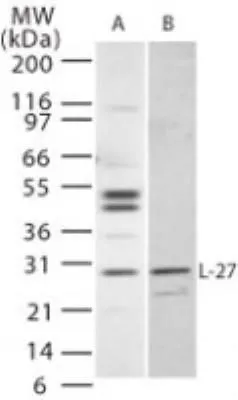
Product group Antibodies
IL27 antibodyGTX77915
ApplicationsWestern Blot
ReactivityHuman, Mouse
TargetIl27
- SizePrice
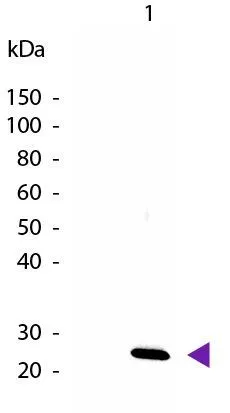
Product group Antibodies
IL27 antibody (Biotin)GTX48684
ApplicationsWestern Blot, ELISA, ImmunoHistoChemistry
ReactivityMouse
TargetIl27
- SizePrice
Product group Antibodies
IL27 antibody (HRP)GTX48685
ApplicationsWestern Blot, ELISA, ImmunoHistoChemistry
ReactivityMouse
TargetIl27
- SizePrice
Product group Antibodies
IL27 antibody [11B29]GTX53349
ApplicationsWestern Blot
ReactivityMouse
TargetIl27
- SizePrice
Product group Antibodies

Anti-Mouse Il27 (Center) Antibody102-23568
ApplicationsWestern Blot
TargetIl27
- SizePrice