MAPK9 Antibody, HRP conjugated
CSB-PA013471LB01HU

ApplicationsELISA
Product group Antibodies
ReactivityHuman
TargetMAPK9
Overview
- SupplierCusabio
- Product NameMAPK9 Antibody, HRP conjugated
- Delivery Days Customer20
- ApplicationsELISA
- CertificationResearch Use Only
- ClonalityPolyclonal
- ConjugateHRP
- Gene ID5601
- Target nameMAPK9
- Target descriptionmitogen-activated protein kinase 9
- Target synonymsJNK-55, JNK2, JNK2A, JNK2ALPHA, JNK2B, JNK2BETA, PRKM9, SAPK, SAPK1a, p54a, p54aSAPK, mitogen-activated protein kinase 9, Jun kinase, MAP kinase 9, MAPK 9, c-Jun N-terminal kinase 2, c-Jun kinase 2, stress-activated protein kinase 1a, stress-activated protein kinase JNK2
- HostRabbit
- IsotypeIgG
- Protein IDP45984
- Protein NameMitogen-activated protein kinase 9
- Scientific DescriptionSerine/threonine-protein kinase involved in various processes such as cell proliferation, differentiation, migration, transformation and programmed cell death. Extracellular stimuli such as proinflammatory cytokines or physical stress stimulate the stress-activated protein kinase/c-Jun N-terminal kinase (SAP/JNK) signaling pathway. In this cascade, two dual specificity kinases MAP2K4/MKK4 and MAP2K7/MKK7 phosphorylate and activate MAPK9/JNK2. In turn, MAPK9/JNK2 phosphorylates a number of transcription factors, primarily components of AP-1 such as JUN and ATF2 and thus regulates AP-1 transcriptional activity. In response to oxidative or ribotoxic stresses, inhibits rRNA synthesis by phosphorylating and inactivating the RNA polymerase 1-specific transcription initiation factor RRN3. Promotes stressed cell apoptosis by phosphorylating key regulatory factors including TP53 and YAP1. In T-cells, MAPK8 and MAPK9 are required for polarized differentiation of T-helper cells into Th1 cells. Upon T-cell receptor (TCR) stimulation, is activated by CARMA1, BCL10, MAP2K7 and MAP3K7/TAK1 to regulate JUN protein levels. Plays an important role in the osmotic stress-induced epithelial tight-junctions disruption. When activated, promotes beta-catenin/CTNNB1 degradation and inhibits the canonical Wnt signaling pathway. Participates also in neurite growth in spiral ganglion neurons. Phosphorylates the CLOCK-ARNTL/BMAL1 heterodimer and plays a role in the regulation of the circadian clock. MAPK9 isoforms display different binding patterns: alpha-1 and alpha-2 preferentially bind to JUN, whereas beta-1 and beta-2 bind to ATF2. However, there is no correlation between binding and phosphorylation, which is achieved at about the same efficiency by all isoforms. JUNB is not a substrate for JNK2 alpha-2, and JUND binds only weakly to it.
- ReactivityHuman
- Storage Instruction-20°C or -80°C
- UNSPSC41116161
Related products
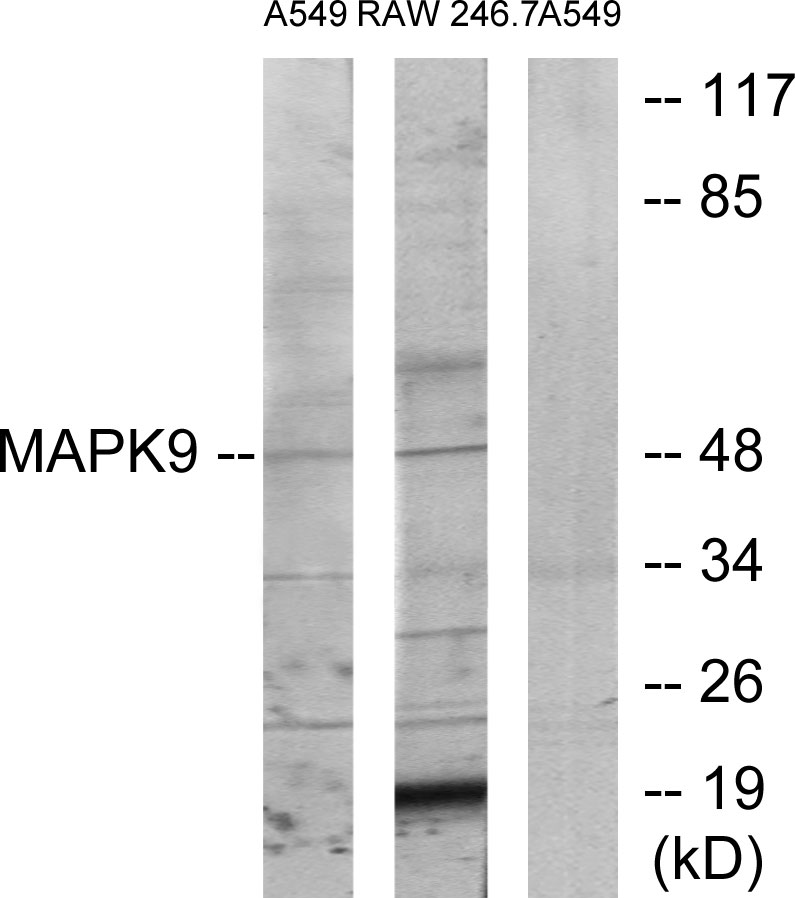
Product group Antibodies

Anti-MAPK9 AntibodyA97416
ApplicationsWestern Blot, ELISA
ReactivityHuman, Mouse, Rat
- SizePrice
Product group Antibodies

Anti-MAPK9 Antibody144-01251
ApplicationsImmunoFluorescence, Western Blot, ImmunoHistoChemistry
ReactivityHuman, Mouse
TargetMAPK9
- SizePrice
Product group Antibodies

MAPK9 / JNK2 AntibodyLS-C767694
ApplicationsWestern Blot, ELISA, ImmunoHistoChemistry
ReactivityHuman, Mouse, Rat
TargetMAPK9
- SizePrice
Product group Antibodies
MAPK9 AntibodyCSB-PA003087
ApplicationsWestern Blot, ELISA, ImmunoHistoChemistry
ReactivityHuman, Mouse, Rat
TargetMAPK9
- SizePrice
Product group Antibodies

ApplicationsWestern Blot, ELISA
ReactivityCanine, Human, Mouse, Rat
TargetMAPK9
- SizePrice
Product group Antibodies

ApplicationsImmunoPrecipitation, Western Blot, ImmunoCytoChemistry, ImmunoHistoChemistry
ReactivityMouse, Porcine, Rat
TargetMAPK9
- SizePrice
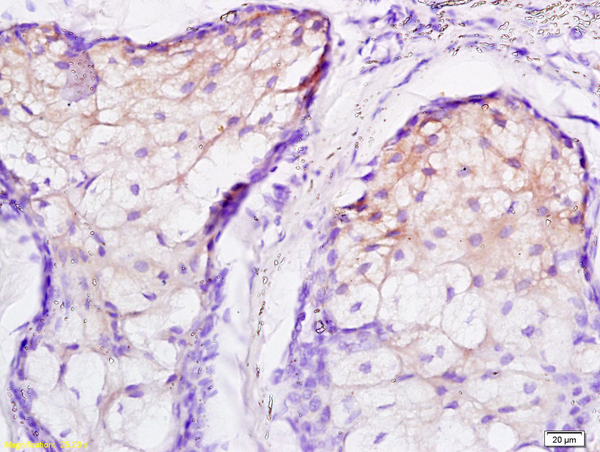
Product group Antibodies

JNK2/MAPK9 Polyclonal AntibodyBS-2900R
ApplicationsImmunoFluorescence, Western Blot, ELISA, ImmunoCytoChemistry, ImmunoHistoChemistry, ImmunoHistoChemistry Frozen, ImmunoHistoChemistry Paraffin
ReactivityBovine, Canine, Equine, Human, Mouse, Porcine, Rabbit, Rat
TargetMAPK9
- SizePrice

Product group Antibodies

Anti-MAPK9 AntibodyHPA072462
ApplicationsImmunoCytoChemistry
ReactivityHuman
TargetMAPK9
- SizePrice
Product group Antibodies

JNK2 antibody [N1C3]GTX105523
ApplicationsImmunoFluorescence, Western Blot, ImmunoCytoChemistry, ImmunoHistoChemistry, ImmunoHistoChemistry Paraffin
ReactivityHuman, Insect, Mouse, Rat
TargetMAPK9
- SizePrice